“How did you get to be the boss of ABN AMRO?”
- ABN AMRO Foundation
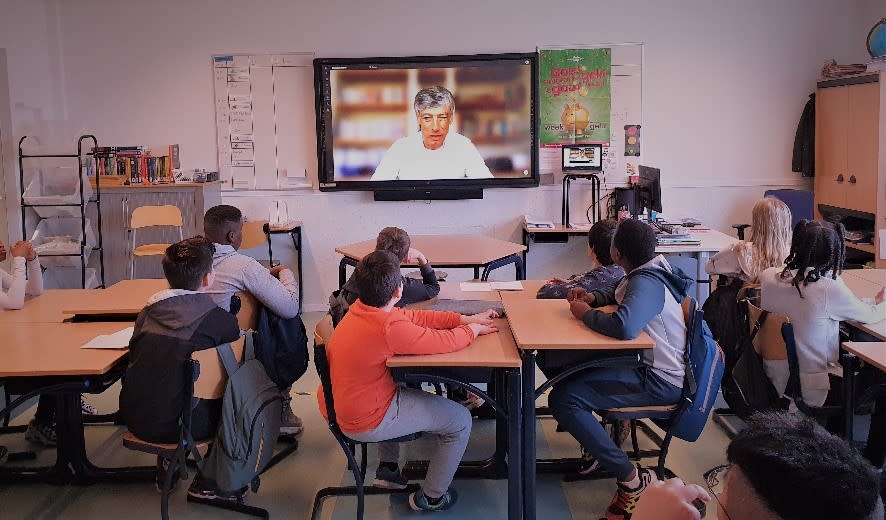
During Dutch National Money Week, Robert Swaak visited schoolteacher Monique’s class at De Aquamarijn primary school in Almere. Although he mostly talked about learning to be responsible with money, the kids’ spontaneous questions were also answered by ‘the boss of ABN AMRO’. The bank needs to give whatever help it can to the ‘generations to come’, Robert stresses. We caught up with him after his virtual visit to Ms Monique’s classroom.
Robert, why is it important for the bank to make this virtual visit to primary schools?
“Banking for better, for generations to come is very important to the bank. This includes a responsibility to prepare children for their future finances. The younger you are when you learn to handle money properly, the better it is for your financial health when you grow up. The ‘Banks in the classroom’ project appealed to me right away. It’s very accessible, and you connect with the kids directly. And all Dutch banks are taking part.”
Has social responsibility become even more important at this time?
“Many different parts of society are under pressure from Covid-19. From the very start of the pandemic, the bank has been taking action to help struggling clients, by offering payment deferments and loans. People see this, and they appreciate it. We also need to ask ourselves what we can do for the generations to come, though. Younger people are also struggling: they’re losing their jobs, many of them can’t go to school fulltime, and their opportunities are slipping away before their eyes. The bank has a responsibility to help wherever it can. A few weeks ago, I urged our people to create opportunities for student internships. I’m also pleased that we’ve opened up the Circl pavilion and the offices on Gustav Mahlerlaan for the pupils of two secondary schools nearby – and let’s not forget the incredible impact of the bank’s hundreds of volunteers who help kids through the Foundation!”
You joined the kids in group 8 of De Aquamarijn primary school in Almere. How did that go?
“It was short but very sweet. Ms Monique, the teacher, had scheduled half an hour for the kids to ask questions. I appeared on the digital whiteboard, which the kids didn’t think was unusual at all, and they interacted with the screen in a very natural way. They asked all kinds of questions: How did you become the boss of ABN AMRO? How do you make sure that the money isn’t stolen? How old do you have to be to work for the bank? How much money comes into the bank every month? That one was very difficult to explain, ha-ha! When the kids heard me talk about ‘a billion euros’, most of them started giggling. They asked a great final question: What’s your top money tip? That gave me a great opportunity to explain how important it is to save – that’s still the most important part of learning to be responsible with money.”
Will you be joining the class again next year?
“Actually I’ll be going back before that. I’ve promised Ms Monique’s class that I’ll visit them in person as soon as the restrictions are lifted – so hopefully before the summer break. Also, starting next week I’ll be taking part in Remote Buddies, which is another wonderful programme that our Foundation organises to increase the bank’s social impact. I’ll be a reading buddy for Wadie, who’s in group 4 of a primary school in Delft. It’s going to be an interesting six Fridays: Wadie has chosen a book about monsters at school for us to read. I’m really looking forward to it!”
From playing football to reading to kids, we’ve previously published special stories about employees who work as volunteers through ABN AMRO Foundation to promote equal opportunities for children. And what do you know: their enthusiasm was contagious, because hundreds of new colleagues have since signed up. .