Key pension changes in 2015

- Economy

Masha Bril
Pensions Specialist
Budget Day in the Netherlands, known as Prinsjesdag locally, brought little in the way of pensions news. Not so surprising, as impending changes had been communicated to the country as the year wore on. The main Budget Day news related to pensions was that holders of life-course savings accounts would again be able to use the so-called 80% rule in 2015.
“"Still have a life-course savings account or insurance policy? The 80% rule will apply in 2015 as well."”
Masha Bril
PensioenexpertThe changes
The rules for 2015 and what we learned previously:• Annual pension accruals to be reduced further • Salary ceiling for pension accrual put in place • Tax allowance for annuity premiums to be reduced • Net pension scheme and net annuity scheme launched • ‘Pension fund’ for the self-employed launched
Less pension accrual per annum
From 2015, the pension amount employees are allowed to build in employer pension schemes will be reduced further, with the maximum accrual percentage in average earnings-based schemes cut from 2.25 to 1.875 per cent in the space of two years. Meanwhile, the standard retirement age was raised from 65 to 67 in 2014.
ExampleLet’s suppose an employee earns an annual income of €70,000. They won’t accrue any pension on the first €15,000 (the pension offset) but will on the other €55,000 (pensionable earnings). The table below shows annual pension accrual:
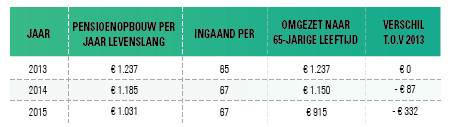
An employee with another 20 years of work ahead of them will now accrue over €6,000 less in pension (20 years times €322) than they would have done in 2013. €100,000 ceiling
From 2015, employees can only build up a pension via an employer scheme up to a maximum annual salary of €100,000. A small group of 110,000 Dutch people in work will be affected (see below).
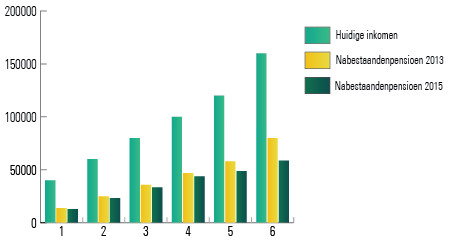
ExampleLet’s suppose an employee is looking at an annual income of €150,000. The pension offset is unchanged at €15,000 and pensionable earnings would have worked out at €135,000 in 2014. In 2015, this will be reduced to €85,000 (€100,000 - €15,000). This, coupled with the reduced accrual percentage, will push down retirement pension build-up by an annual €1,300 under the most tax-friendly average earnings-based scheme. An employee with another 20 years of work ahead of them stands to lose €26,000 a year in their lifetime, while dependants’ pension entitlements will move down in tandem. As a result, a family’s income could fall by two-thirds when one partner dies.
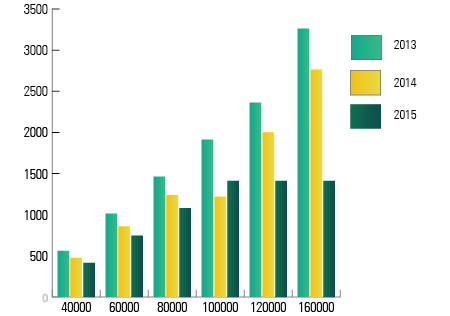
The consequencesThe chart below plots the annual pension accrual outcomes for employees on salaries from €40,000 to €160,000, assuming an average earnings-based scheme at the highest permitted accrual percentage for tax purposes and a target retirement age of 65. The pension offset is €15,000.
From 2015, employees can only build up a pension via an employer scheme up to a maximum annual salary of €100,000. A small group of 110,000 Dutch people in work will be affected (see below).
ExampleLet’s suppose an employee is looking at an annual income of €150,000. The pension offset is unchanged at €15,000 and pensionable earnings would have worked out at €135,000 in 2014. In 2015, this will be reduced to €85,000 (€100,000 - €15,000). This, coupled with the reduced accrual percentage, will push down retirement pension build-up by an annual €1,300 under the most tax-friendly average earnings-based scheme. An employee with another 20 years of work ahead of them stands to lose €26,000 a year in their lifetime, while dependants’ pension entitlements will move down in tandem. As a result, a family’s income could fall by two-thirds when one partner dies.
The consequencesThe chart below plots the annual pension accrual outcomes for employees on salaries from €40,000 to €160,000, assuming an average earnings-based scheme at the highest permitted accrual percentage for tax purposes and a target retirement age of 65. The pension offset is €15,000.
Reduced tax relief for annuity premiumsIn the Netherlands, people able to prove they are looking at a pension shortfall are eligible for tax relief on annuity premiums, with the precise amount determined by an annual formula. The formula and available tax arrangements have been changed and there will be less tax relief available on annuity premiums.
Let’s return to our example of a 45-year-old employee on an income of €70,000 with a lease car addition of €7,000. The table shows how much they are allowed to deduct from tax every year:
An income ceiling of €100,000 also applies in this formula.
Launch of net pension scheme
While they can no longer accrue pension on work-based incomes in excess of €100,000, employees/self-employed people are allowed to contribute to their own voluntary net pension or net annuity schemes. Features and tax rules:
• Premiums cannot be offset against tax.• Accrued entitlement is exempt from tax in Box 3. • Pay-outs are not taxed in Box 1 if they need to be purchased at a future date . • In the event of long-term disability, pension savings in the scheme may be drawn earlier, subject to terms and conditions. • No inheritance tax is due on the balance in the event of death. • A premium ceiling is in force and premiums should be paid from the taxpayer’s net income.
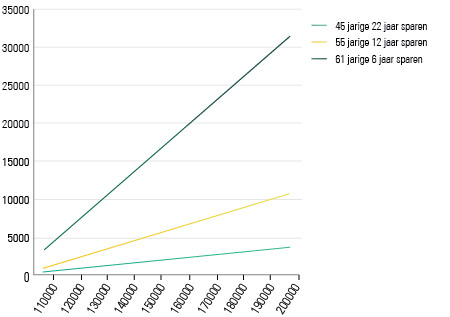
For the pros and cons of net pension and annuity schemes relative to savings in Box 3, click . On Budget Day we should hear what sanctions will be imposed for immediate withdrawal of the complete balance.The chart below shows the estimated advantage of joining the net annuity scheme relative to savings in Box 3. Note that members are allowed to save even more in a net pension scheme.
‘Pension fund’ for the self-employed
The launch of a type of ‘pension fund’ for the self-employed had been announced previously, one of its key features being that members can also withdraw their savings if they are disabled. The relevant change to the law will be included in the bill to be announced on Budget Day (Prinsjesdag).
Life-course savings scheme
Those of us who still have a life-course savings account or insurance policy will have another opportunity in 2015 to withdraw their funds under the 80% rule, implying that only 80% of the money will be taxed. To prevent anticipation effects, the 80% rule will only apply to the total of the savings entitlement up until 31 December 2013. The full balance will need to be drawn for savers to avail themselves of the 80%, and no further saving will be allowed.
Other measures
Legislation is expected to be introduced shortly that will reduce the chance of pensions being index-linked, while major changes are also expected for entrepreneurs (director-owners) administering their own pension schemes.
Third Wednesday of SeptemberOn Wednesday 17 September, ABN AMRO will host a live debate on the government’s new budget, with Gerrit Zalm and Han de Jong presenting their perspectives on the government’s budget day plans. Our experts will also share their views about the budget’s key measures. .