Exploring the potential of hydrogen as a major source of low carbon energy
- United Kingdom

Martyn Kember-Smith
Marketing and Communications Officer
The ABN AMRO UK Hydrogen Strategy client roundtable
In August this year the UK government released the UK Hydrogen Strategy with the aim of developing low carbon hydrogen energy to play a key role in reducing the UK’s CO2 emissions.
To explore the implications of this ABN AMRO, recently held a roundtable event for clients with a panel comprising four individuals with considerable experience in the field of sustainable energy: Michael Burns - Head of Energy Industry Group, Ashurst; Joris Hermsen – Energy Sector Lead, ABN AMRO; Peter van Ees – Energy Sector Lead, ABN AMRO; and Peter Ellemann – Loan Markets Origination, ABN AMRO. Pat Roberts, Corporate Banking Coverage, ABN AMRO, hosted and moderated the session.
As well as taking a deep dive into the UK Hydrogen Strategy the panel also took a look at how it compares with initiatives across Europe and more generally at the challenges facing the development of hydrogen as an important source of low carbon energy.
It became evident very early in the discussion that while hydrogen represents considerable potential to be a major source of low-carbon energy, it is still very much in the development phase with a long way to go if it is to achieve widescale adoption as a viable alternative to fossil fuels.
The UK Hydrogen Strategy – work in progress

First to speak was Michael Burns who took us through the detail of the UK Hydrogen Strategy starting with its top level goals of:
Achieving 5GW of low carbon hydrogen production capacity by 2030
Creating green jobs - up to 100,000 jobs by 2050
Having hydrogen account for 20-35% of UK final energy consumption by 2050
Seizing opportunities to be a global exporter of technology and expertise as well as possible opportunities for physical export of hydrogen
These are clearly great ambitions and as Michael pointed out it was evident that considerable work has gone in to developing the strategy so far and indeed that there is undoubted enthusiasm for hydrogen as a future source of fuel. However much of the Strategy is still subject to consultation.
Also the Strategy acknowledges that there is virtually no low carbon hydrogen produced in the UK today and what hydrogen production there is concentrated in the chemicals and refinery industries with output typically being used on site. In other words, in order to hit its emissions targets the UK Government is looking to create a whole new industry from scratch and the market demand for its output. This is radically more challenging than the transition of electricity generation from hydrocarbons to renewables.
So how does the government intend to do this?
The UK Hydrogen Strategy has three strands:
Hydrogen greenhouse gas emissions: consultation on how to calculate these and what are acceptable levels? And, based on this, which low carbon hydrogen projects should benefit from government support?
Supply side: creation of the Net Zero Hydrogen Fund (NZHF) supporting commercial development of new hydrogen projects including carbon capture and storage (CCS) in order to reach the 2030 5GW goal
Business model: consultation to stimulate a market to encourage investment in production including a proposal aiming to mitigate price and volume offtake risks similar to the contracts for difference (CFD) regime used for offshore wind. This would work by mitigating the risk of low demand for early stage projects to offer a higher level of support on initial volumes allowing the producer to recover fixed costs at relatively low offtake volumes.
Which industries will be the prime targets for hydrogen supply?
A key challenge that the UK Hydrogen Strategy aims to address is creating a broad demand base for hydrogen supply. To this end the government is looking to invest in demand growth across a number of sectors – although it anticipates that initially smaller scale production projects will match with dedicated offtakers:
Industry – carbon heavy industries will be supported to decarbonise though CCS and hydrogen business models. In addition a GBP 350m industrial energy transformation fund is supporting technologies that improve efficiencies and reduce emissions – low carbon hydrogen projects are key beneficiaries.
Power generation – low carbon hydrogen is seen as having the potential to play a key role in ensuring consistency of supply while also being able to draw on excess renewable electricity that would otherwise have to be curtailed.
Heating – the Strategy plans to develop the use of hydrogen in domestic heating as well as exploring a 20% blend of hydrogen in the gas network and the development of hydrogen ready appliances such as boilers.
Fuel/transport – currently there is small scale hydrogen use in cars, trucks, buses and marine vessels but it is recognised that the key opportunities rest in larger vehicles, shipping and aviation where batteries are currently unsuitable for the size of the vehicles and the distances involved.
How can supply and demand be matched together?
Unlike other parts of the UK Hydrogen Strategy there’s less detail when it comes to transportation and storage. However it recognises that private sector players are already investing in the development of localised transport infrastructure for instance, Project Union, a National Grid initiative linking a number of industrial clusters around the country. Storage represents as big a challenge as transport and the government is looking to encourage both large and small scale storage solutions.
How does the UK Hydrogen Strategy compare with what’s happening in Europe?

One of the first points that became clear when Joris Hermsen compared the UK’s strategy to that of France, Germany - and the EU more generally - was that while they all have similar gigawatt production targets the budget commitments are vastly different.
The UK government has specifically committed GBP 240m to hydrogen development over the next four years while the technology is also set to benefit from other government schemes such as the GDP 1bn Net Zero Innovation Portfolio). Moreover the intention is that a further GBP 4bn of investment will come from the private sector.
Germany and France are committing EUR 9bn and EUR 7bn respectively – while the EU is targeting funding in the range of EUR 180-470bn until 2050 (with an expectation that member states and the private sector will make significant contributions towards this).
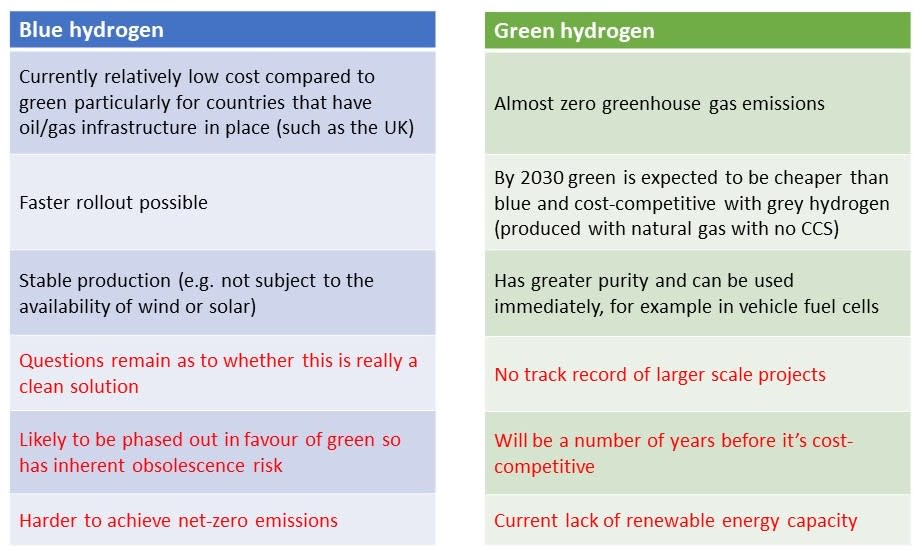
Another difference from many of its European neighbours is that the UK will be pursuing a twin track approach, supporting both the development of blue hydrogen - produced mainly using natural gas with CO2 as a by-product which is then trapped though CCS; and green hydrogen – produced through renewables, such as solar and wind, to power the electrolysis of water, eliminating emissions of greenhouse gases altogether.
For the most part while European nations acknowledge that blue hydrogen will be around for some time by far the largest portion of their subsidies will be focused on green hydrogen.
What are the relative merits of blue and green hydrogen?
Both technologies have their pros and cons however it looks as if both will have a part to play in achieving 2030 and 2050 targets.
The importance of client demand
Peter van Ees highlighted that a key driver for low carbon hydrogen will be demand as companies look to substantially reduce their own CO2 emissions. An example is in the Swedish steel industry where projects have already demonstrated that green steel doesn’t necessarily have to be much more expensive than conventional steel. Not surprisingly car manufacturers, especially Swedish and German, are actively looking into manufacturing vehicles with green steel.
This in turn creates demand for green hydrogen - although meeting this presents a challenge. However it’s Peter’s view that shifting demand patterns will drive a substantial change in supply. He noted that the EU expects investments in hydrogen to reach EUR 450bn in 2030. As subsidies will be needed, the EU is committed to fund parts of this (to what extent, remains to be seen though). This level of investment sounds substantial however it is roughly equivalent to what is spent on the oil, gas and the power industry each year. Consequently there is reason to believe that once the urgency kicks in significant finance could be found quickly.
Despite the increasing focus on low carbon hydrogen both the EU and Europe’s national governments (as with the UK) are still to commit to specific plans of action. The EU is currently in a process termed IPCEI – Important Projects of Common European Interest – in which it is determining what projects are allowed to receive member state support. This should progress the further development of the sector.
In parallel the EU is looking at creating a spot market to efficiently match suppliers and buyers, however there is some way to go before this can happen because currently (again as with the UK) most hydrogen is produced onsite with local offtake. A way to accelerate market development, is to allow green power via Guarantees of Origin for electrolysis purposes – and as a consequence allow the hydrogen produced to be labelled green. At this stage however there is some uncertainty surrounding this development.
Project finance for low carbon hydrogen
Peter Ellemann talked through ABN AMRO’s approach to project finance and how it engages with emerging technologies, giving the example of its support for wind power as it transitioned from infancy to now being a major source of energy.
Peter noted that with more mature businesses, where there are already dedicated offtakes and stable cashflows, there are unlikely to be any issues financing a project. However with an emerging industry there are a number of factors to take into account such as technology risk, delivery risk and offtake risk – plus the fact that there may not be any fixed price in the offtake.
So in this phase finance is likely to proceed on the basis of a full recourse back to the project sponsors. As an industry develops and commercialises then banks would have increasing comfort taking on more of the project risk.
Banks that are willing to finance pioneering projects - such as ABN AMRO - are very keen to support low carbon hydrogen projects but at the moment it’s a matter of picking the right projects and the right sponsors, and then figuring out the degrees of recourse. As the technology evolves, and there is growing confidence in the business model, debt financing for projects will scale up.
ABN AMRO taking the lead
Peter van Ees highlighted that ABN AMRO was already at the forefront of developments in the low carbon marketplace participating in cutting edge consortia that are project developing hydrogen solutions. One of these, between the Netherlands and Portugal, actually kick-started the entire IPCEI process, something of which the bank is very proud.
Speaking about the role the bank is playing in the development of low carbon hydrogen he said:
“ABN AMRO is not only here as a bank but also as an adviser helping to make sure that the ‘chicken and egg’ situation that characterises developments in the low carbon hydrogen industry are resolved at the earliest opportunity. To this end we advise industry participants to keep the conversation going, to talk to their banks or to us, to their consultants and each other to ensure that collectively we can get the low carbon hydrogen industry off the ground.”