China - Protecting the fragile US-China truce
Notwithstanding solid Q1 GDP and ongoing strong foreign trade... April macro data are a reminder that China is cushioned, but not immune to the Iran conflict. US-China presidential summit reduces (but not fully takes away) tail risks.

April data are a reminder China is cushioned, but not immune to the Iran conflict
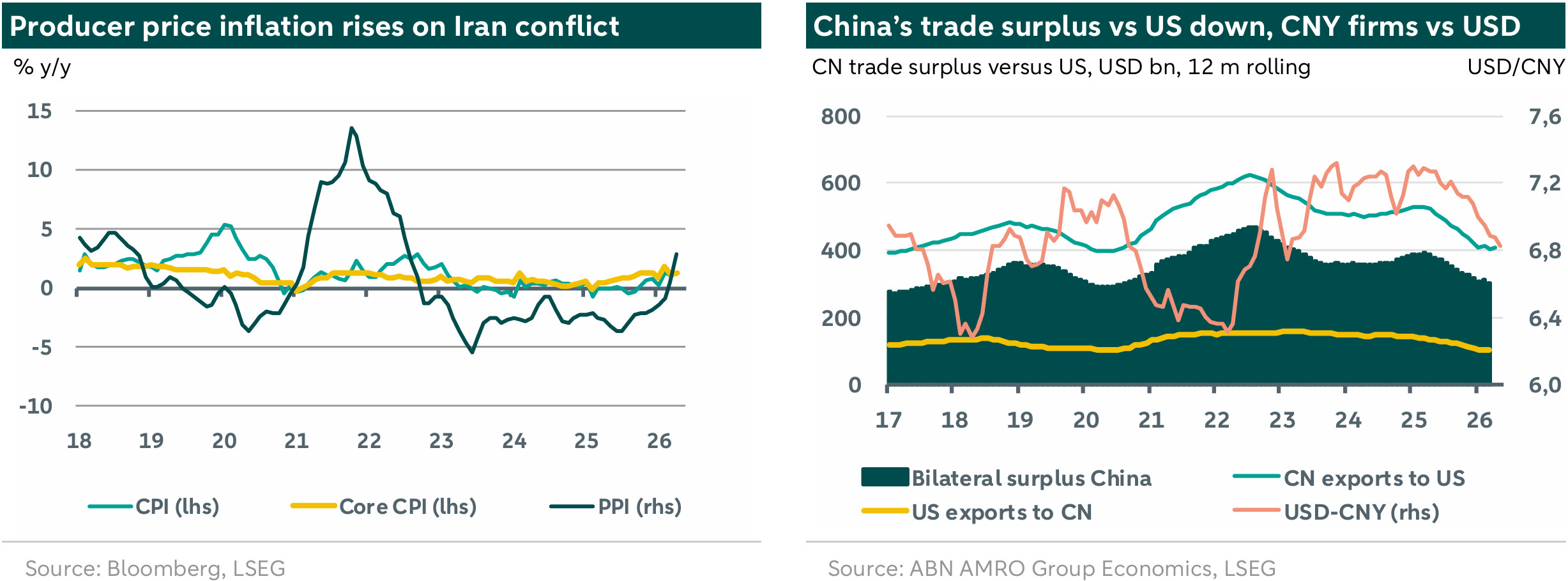
Due to its relatively high oil reserves, access to Russian energy imports, and large availability of home-produced energy sources like coal, China is relatively well-positioned to weather the Iran energy shock. However, as we already flagged in our previous Monthlies, China is not immune to it. Despite resilient GDP and export growth in Q1, March data already showed some impact of the Iran conflict. The April data brought additional evidence of this. Most striking is the further acceleration of producer price inflation, to a 45-month high of 2.8% y/y. Headline and core inflation picked up moderately, but remain quite low at just above 1% y/y, reflecting ongoing domestic demand weakness. In terms of growth, April activity data signalled a broad weakening. Industrial production slowed to 4.1% y/y and 0.1% m/m sa, weighed by declines in oil refinery output. The spike in commodity prices may also have contributed to the turnaround in fixed investment, which fell back into contraction territory. This also shows the government’s push to boost infrastructure investment is fading, while property investment also continues to shrink. Meanwhile, retail sales growth fell to a post-pandemic low of 0.2% y/y, and contracted by 0.5% m/m sa, with sales of cars and home appliances also impacted by the expiration of subsidy programmes. April data also brought some rays of light, with home sales bottoming out, the unemployment rate falling, and foreign trade solid despite the Iran conflict driven by the global tech/AI boom.
All in all, the Iran conflict exposes China to the drawbacks of its imbalanced growth, with a slowdown of global demand the main risk stemming from a (prolonged) energy crisis. Should this materialise, we expect Beijing to come with additional stimulus, while maintaining a cautious approach. In our base case, we anticipate weaker growth in Q2 due to the conflict. We already adjusted our growth and inflation forecasts in March, and leave them unchanged for now.
US-China presidential summit reduces (but not fully takes away) tail risks
On 14-15 May, US and Chinese delegations led by presidents Trump and Xi, met in Beijing. Most important at the summit was to stabilise US-China relations, and prevent tensions from getting out of control again, in an ever more complex geopolitical landscape. This goal looks to have been met. Although an extension of the truce on tariffs and chokepoints reached in late 2025 was not formalized ‘on paper’, according to a Chinese statement countries agreed to reduce tariffs for some products and ease certain import restrictions, while boards of investment and trade will be installed to discuss bilateral concerns. For the US, which travelled with a big delegation of business leaders to Beijing, trade commitments made by China (farm products, airplanes) are concrete results from the summit. The US also claimed China is eager to step up purchases of US energy, although China is securing energy imports from Russia (Putin visited Beijing one week after Trump). For China, next to the stabilisation of bilateral ties, trying to get the US to gradually soften its support for Taiwan was a key objective. In the run-up to the meeting, the PBoC tolerated a further appreciation of the Chinese yuan versus the US dollar, while China’s bilateral goods trade surplus versus the US has come down significantly. The summit could help stem the decline in bilateral trade, although strategic decoupling in sensitive sectors is likely to continue.