Closing in on a Russian oil ban before the end of 2022
The G7 will impose a full ban on Russian oil and oil products, but in an timely and orderly fashion. Oil prices to rise further in the coming months, depending on the lifting of the Chinese lockdowns. Also the risk of a full ban on Russian gas imports has increased. Global gas prices have been revised higher due to shifts in global demand. And finally, there is an increased divergence between short term and long term power prices.

ABN AMRO Group Economics
Author has left Group Economics, see text
Author: Hans van Cleef
A Russian oil ban would add to tight oil markets
On 4 May, European Commission (EC) President Ursula von der Leyen announced a proposal for a gradual ban on Russian oil and oil products before the end of this year. According to Ms. von der Leyen, the ban will be aimed at pipeline and seaborne, crude and refined products. On top of this, the EC was proposing a ban for services towards the Russian oil sector, including insurance. That would make it also more difficult for Russia to find buyers of the country’s oil in other parts of the world. However, due to pushback from Hungary, Slovakia, the Czech Republic and Greece, the EU has not reached an agreement yet. Especially Hungary is blocking the plan due to its high reliance on Russian oil and lack of alternatives from other suppliers. At the same time, Greece and Malta opposed banning EU vessels from carrying Russian oil, and this has been dropped.
Over the weekend, also the G7 announced plans for a Russian oil ban. However, this should be done in a ‘timely and orderly fashion’. Especially Japan was initially very reluctant to adopt this ban, as it is largely dependent on energy imports. With the gradual reduction of Russian oil imports, the seven industrial countries appear to be in favour of this sanction against Russia.
There are three important factors to watch in the coming months: the possible rerouting of the Russian oil, the OPEC+ policy and the end of the Chinese lockdowns. It is likely that Russian oil exports will be rerouted towards other countries like China and India. Or it could find its way to the market indirectly. Kazakhstan for instance could increase their oil exports, and at the same time increase its imports from Russia for local consumption. Another possibility is blending the Russian oil to lose the Russian origin. The question is whether China and India are willing to buy the Russian oil and at what price. For sure they want the insurance issue to be compensated for, and they would therefore would be looking for a big discount on the current market price.
OPEC+ ignores the EU oil ban proposal and likely decline of Russian supply and sticks to its policy
On Thursday 5 May, OPEC+ decided to increase the production (cap) by another 432 kb/d in June as expected. Again, the meeting was ended within minutes. Despite the fact that lower Russian production starts to show up in the numbers, the Ministerial Meeting minutes noted that OPEC+ believe that ‘continuing oil market fundamentals and the consensus on the outlook pointed to a balanced market. It further noted the continuing effects of geopolitical factors and issues related to the ongoing pandemic’.
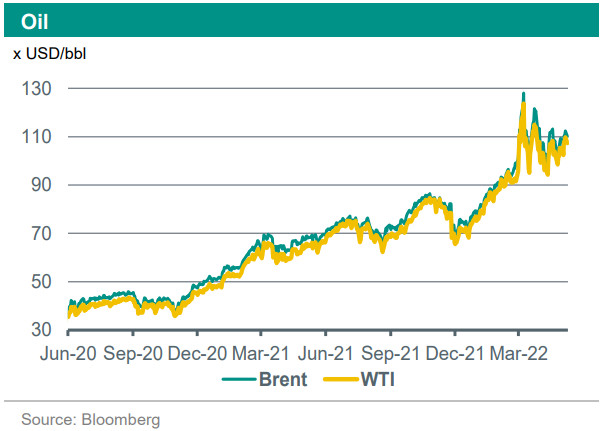
So far, the impact on oil prices of the announced EU/G7 oil ban was rather limited, also because of some East-European countries are still not fully convinced. But since it is likely that the EC proposal for a full Russian oil ban will be adopted eventually, the upside price risk for oil has increased. Especially when the Chinese lockdowns will come to an end, Chinese demand for oil will recover and add pressure to the already tight markets. The lack of guidance from OPEC+ gave some extra support to oil prices. Taking into account that the tightness in the market is likely to increase, oil prices are therefore expected to rise, especially in the second half of the year. A test of the March high is then likely, a test of the 2008 all-time high can also not be fully ruled out.
Oil products are getting more expensive
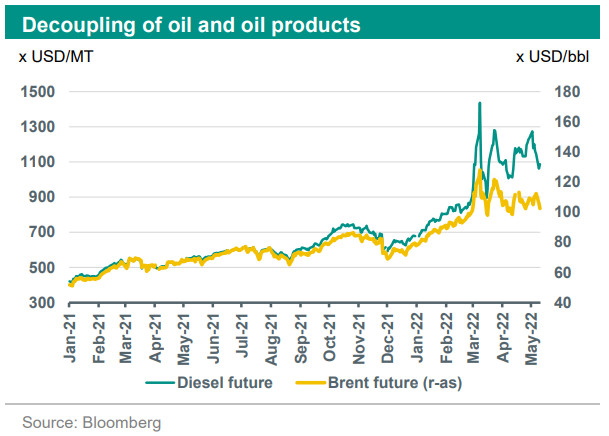
Due to a lack of refining capacity, we do see higher prices for refined products like gasoline, kerosine and especially diesel. However, also other products made from oil will see upward price pressure. Europe’s refining capacity has been under pressure for already quite some time. However, with Ukrainian and Russian capacity out of reach, even more pressure is building on the production capacity of oil products. Refining capacity in the Middle East and China has increased in recent years. However, China’s refining capacity will not be helpful for European and other western markets as the Chinese government is giving priority to filling their local inventories first. As a result, prices of refined products have been rising rapidly lately. Especially diesel prices have reached fresh record highs as the market is very tight and inventories relatively low. With new refining capacity not in the pipeline in Europe, this situation could last for longer.
Gas markets possibly affected by the oil ban
In March Russian deputy prime minister Novak indicated that an EU oil ban could have consequences for the gas flows via NordStream 1 (from Russia towards Germany). So far, the gas exports from Russia towards Europe continue, but a counterreaction (some lower supply) on the EU ban for Russian oil cannot be excluded. It would complicate the filling of EU gas inventories and thus translate into higher natural gas prices in most of Europe.
Earlier Russia already halted the gas exports towards Poland and Bulgaria. Both countries refused to pay in roubles as demanded by the Kremlin. The EU policy is not to pay in roubles as it would violate the sanctions. However, since some countries / companies indicated that they need the natural gas and therefore consider to pay in roubles anyway, the EU may not come anytime soon with clearer rules regarding the gas payments.
Gas inventories are rising
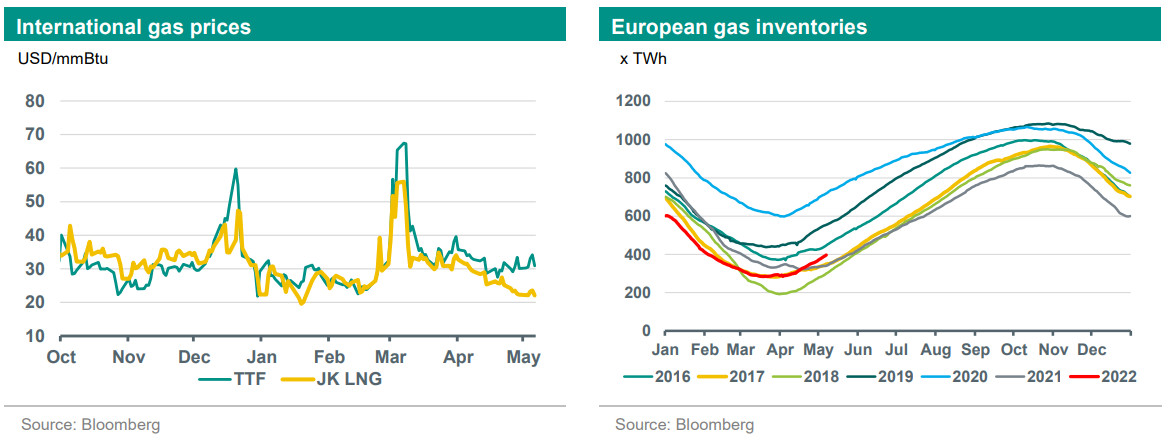
EU gas inventories are rising (see right hand graph above). The gas inflow from Russia still continues. However, also LNG imports have increased in recent months. In order to meet the 80% filling requirements, EU companies are aiming to increase the number of LNG-contracts. Engie recently announced a 15-year contract for LNG imports from the US. More of these kind of contracts can be expected over the coming months, especially after the US government indicated a willingness to increase the LNG-exports significantly over the coming years. The aim is to import up to 15 billion cubic meter (bcm) from the US this year. And this should grow towards 50 bcm annually in 2030. But, although the US LNG export capacity is increasing, European parties need long term contracts with the US LNG suppliers to secure these flows to come towards Europe. An aim also seen in Asia where for instance Japan is calling for more US LNG inflow in their attempt to lower Russian gas dependency.
Still, it will be a major challenge to fill the inventories for the coming winter season. Simply because it will be impossible to find enough available LNG, or reduce gas demand, in a short period of time to fully replace the Russian gas imports. At the moment, we even see a decoupling of TTF prices and Japan/Korea LNG prices (JKL). This is the result of lower Asian demand (Chinese lockdowns) and due to bottlenecks in the gas infrastructure in Spain and the UK. The UK and Spanish gas infrastructure are not or hardly connected to the infrastructure in the rest of Europe. So high LNG imports in these countries will not be shipped further into Europe. The UK inventories almost reached 90% by now, while the average EU inventories are filled by only +/- 35%. As a result, also National Balancing Point (NBP) and TTF have decoupled.
It is one of the reasons why it will remain difficult for the EU to impose sanctions against the Russian gas industry. The ambition of the Dutch government is to halt Russian gas imports at the end of this year. But, as the European gas markets are highly interlinked, it will only be the European policy which will have an impact on the TTF-gas prices. Up to now, in our scenario analysis we assumed that a full Russian gas ban would have a 25% probability. After the announcement of the proposed EU oil ban which increases the risk of a gas ban and with the aims to a) reduce the dependence on Russian energy imports as soon as possible, and b) to dry up the cash flows towards Russia, the chance for a full gas ban towards the end of this year has increased.
Also gas prices have been revised higher
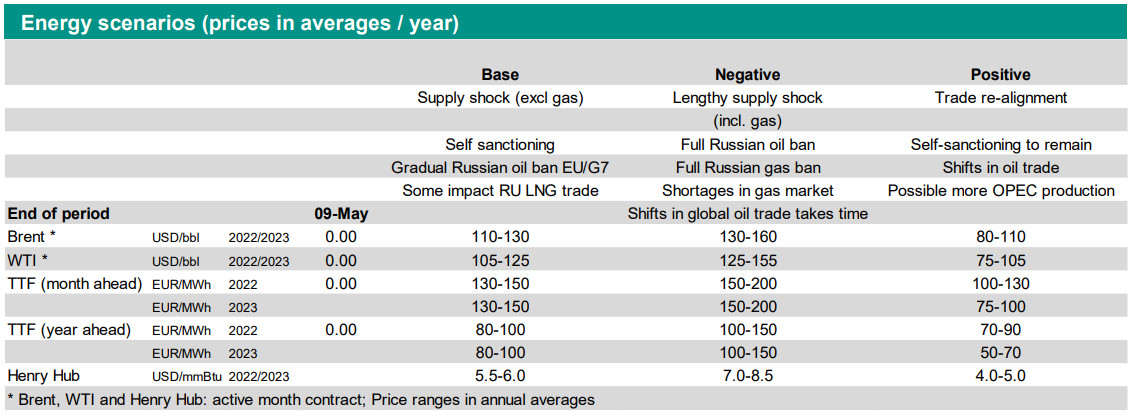
Also gas prices are expected to remain high, especially up to spring 2023. An expectation which was already in place since last autumn as inventories are, and will remain, very tight. With the oil ban, and the ambition of a EU ban on natural gas before the end of the year, the situation will not improve in the near term. In fact, if the Russia comes with a counter reaction earlier this year, a sudden halt of Russian gas flows before an EU ban is imposed cannot be ruled out. It would immediately increase upside price risks even further. In the table below we drafted several scenario’s and price ranges per scenario (annual average prices). However, with these high uncertain market conditions it is very difficult to indicate where prices could go, especially in tight and volatile market conditions. Therefore, even more than ever these price forecasts and ranges should be mainly seen as a directional view.
US henry hub prices nearly touched USD 9/mmBtu at the end of last week. More and more demand for US gas, including LNG for export purposes, pushed US inventories below the 5-year averages and although the Energy Information Administration (EIA) does expect some inventory build over the coming months, the annual average is expected to remain below the 5-year average. With demand expected to increase even more, whilst investing in new supply – either directly or in the form of associated gas with oil production – is increasing only gradually, it will continue to trigger upside price pressure. As a result, we have revised our Henry Hub price forecasts higher.
Power prices show higher volatility for short term deliveries…
In recent weeks we have seen several records in day-ahead power prices. We have seen a record high in France’s power prices of almost EUR 3.000/MWh after a combination of low solar and wind revenues and an unexpected large percentage of outages at nuclear power plants. As this situation continues to linger and a rapid return of the nuclear power plants is not expected, France’s power prices continue to trade higher than most of the other European day-ahead power prices.
Indeed, the Dutch day-ahead power prices dropped to a record low on Saturday 23 April. Low demand and a high supply of solar and wind energy (100% of electricity demand at the time) pushed prices during the afternoon towards the lowest level ever (EUR -222,36/MWh). The fact that prices were so low clearly indicates that the flexibility in the Dutch electricity grid is very limited. The fact that demand response or the option to reduce some supply is not enough to mitigate these low prices indicates that there is enough room to improve in the coming years. After all, the number of occasions that the electricity prices will drop to zero or below will continue to increase with the ongoing build of more renewable energy.
…whilst the forward curve hint on higher prices for longer
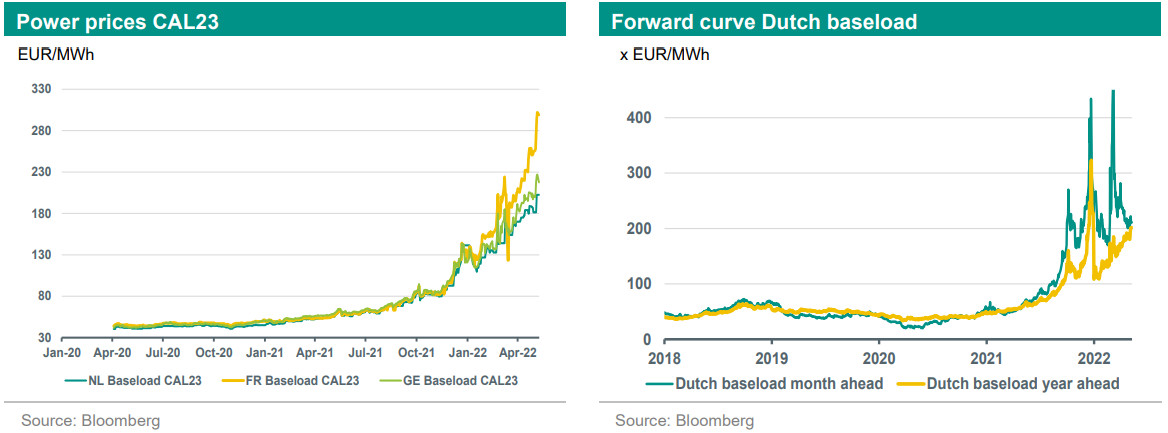
Although day-ahead prices show strong volatility and noted record low prices in some areas, the forward curve is pointing into another direction. The higher coal, gas and carbon prices are translated in these futures for power prices. And where the forward curve of Dutch baseload early January ‘only’ indicated elevated prices up to spring 2022, the invasion of Ukraine by Russia pushed prices higher along the curve. Still, power prices are expected to remain high until the spring of 2023 (due to uncertainties about gas inventories for the coming winter season), but also the end of the curve is trading higher as the supply issues regarding fossil fuels are expected to remain for longer.