Dutch cabinet ambitious but dependent on opposition
• D66, VVD and CDA are forming a Dutch minority cabinet lacking a majority in both parliament and the senate, policy making will remain a challenge and dependent upon opposition buy-in • The coalition agreement seeks to rebalance consumption and investment spending, in favour of the latter. For instance more will be spent on defence and housing, at the cost of healthcare and social security • The agreement limits the budget deficit at 2% of GDP, perhaps also to leave room for opposition wishes. • This cabinet is shifting towards a more constructive stance towards Europe • The Netherlands will be put back on track to meet the EU Climate Law targets, with likely strong opposition support


Liberal Progressive Jetten to be PM of minority cabinet with CDA and VVD
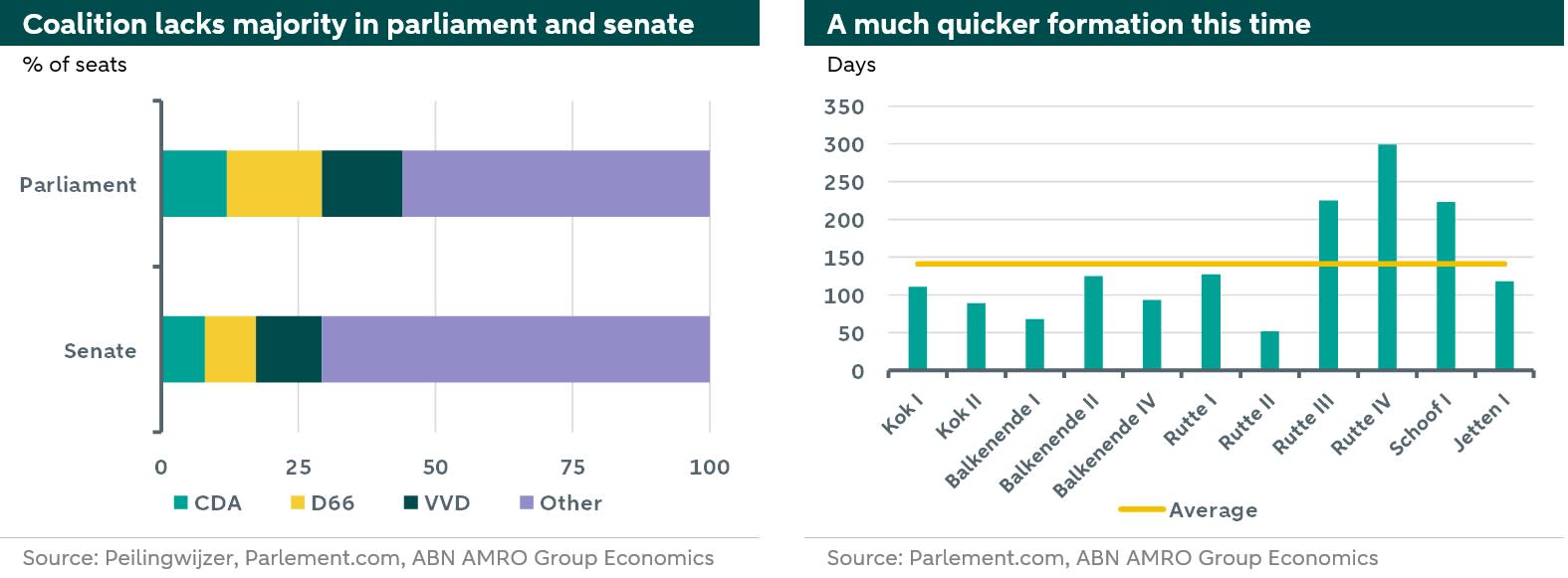
Today D66 (liberal progressive), the VVD (liberal conservative) and the CDA (Christian democratic) presented their coalition agreement after a relative short formation process. This was much needed given the elevated domestic policy uncertainty of recent years. By the time the new cabinet is inaugurated - expected on 23 February- the Netherlands will have spent 45% of the period since 2020 under a caretaker government.
The challenges the new government is facing are significant and the wish list for policy changes was long. These wishes ranged from domestic issues such as reduced competitiveness, binding nitrogen norms and the NATO target for defence spending of 3.5% of GDP, alongside some leftover bills from the previous government on, for instance, EU contributions. In general, we see three overarching conclusions. First, this agreement seeks to rebalance consumption and investment spending by reversing several of the policies of the previous government, such as the cuts in spending on education. In general, it intends to invest more at the cost of spending on healthcare and social security. Secondly, the agreement recognises the economy’s capacity limits and aims to relieve them by tackling the nitrogen impasse and grid congestion. And the third conclusion is that given the minority status, all plans will require opposition buy-in (see below).
Minority status means execution hinges on opposition buy-in
Prime Minister to be Jetten’s cabinet will form a minority government resting on 66 seats in parliament (76 needed for a majority). Also, in the Senate the coalition has just 22 seats (38 needed for a majority). This means that for every policy measure, opposition support needs to be found in both chambers. The opposition indicated it is willing to cooperate but will probably be very critical and likely seek bargaining chips for policies elsewhere even if they agree with proposed policies. Crucial will be the Greenleft/Labour party, the biggest opposition party, which could provide the required votes for a majority in parliament and, almost, the senate. However, the proposed cuts to healthcare spending and social security are at odds with their party manifesto. In general, because of the minority status, the risk that today’s proposed policies are watered down, or only partly implemented due to opposition requests, is high.
Government adhering to fiscal discipline
The minority status also has budgetary implications. It seems that by limiting budget deficits to 2% of GDP, in line with the influential budgetary committee’s advice, the cabinet leaves some budgetary room for opposition requests. In general, the focus on a deficit of 2% of GDP would imply the Dutch government keeps its traditional focus on fiscal discipline, despite rumours that CDA and D66 were in favour of higher deficits to finance investments. The extra spending, for instance on defence, housing and nitrogen measures, is financed by cuts on healthcare spending, social security and cuts on civil servants. Finally, explicit Eurobonds, where the Netherlands would guarantee other member states' debt are ruled out by the minority cabinet. However, we do see a more constructive tone in the coalition agreement compared to earlier Dutch governments when it comes to common financing through existing instruments and for common investment goals such as ramping up defense spending, for instance via the European Defence Fund and the European SAFE instrument.
As the opposition will play an important role in securing a majority for the plans in both Parliament and the Senate, it is expected that there will be tough negotiations on the financing of these plans. This means that it may be challenging for the coalition to limit the budget deficit to a maximum of 2%.
Stance towards the EU turning more constructive
Despite the clear No on common financing, in international affairs the Dutch government signals a clear shift in stance compared to the previous government. This is most visible in European affairs. The incoming cabinet sees the Netherlands as a constructive member state in Europe and is in favour of increased cooperation in security, defense and economic integration, for instance by completing the Single market and the capital markets union. This is a change from the previous government, which often clashed with the EU amid that its influence in Brussels waned.
Climate policy could receive relatively strong support from the opposition
The main climate related policy measure that was announced in the coalition agreement is related to the interrelated issues of nitrogen emissions, agriculture and nature. The incoming cabinet is allocating EU20 bn (equal to 1.8% of nominal GDP) to finally deal with the country’s nitrogen problems and wants to set new legally binding nitrogen‑reduction targets for 2035 for each sector, with an interim target for 2030. Since 2019, the Dutch economy has been partly ‘locked down’ because too much nitrogen is being emitted. As a result, it had become almost impossible to obtain permits for major infrastructure projects or to build new homes. The previous Schoof cabinet had scrapped all funds that were intended to solve the nitrogen crisis, because the fund was highly controversial within the BBB party. So, the current government aims to get the country back on track in reducing nitrogen deposition in the Natura 2000 areas. Regarding other climate‑related policy measures, the government remains committed to meeting the 2030, 2040 and 2050 targets set out in the EU Climate Law, although 'the 2030 target will be difficult to achieve’. The national carbon tax for companies will be abolished, and EUR 3bn will be spent to compensate companies for a rise in energy costs due to EU ETS pricing and for higher electricity prices.
Based on the outcome of the general elections and the climate policy proposals outlined in the main parties’ election programmes (an extensive analysis of the climate policies in the various party programmes can be found ), it appears that the new minority government’s climate plans could receive relatively strong support from the opposition. As we have mentioned in earlier research notes (see ) it is extremely unlikely (probability < 5%) that the Netherlands will meet the EU targets for GHG emissions, primary energy use and renewable energy use. Therefore, additional and structural climate policy measures will be needed. The key party that could give support to any climate policy proposals by the new government is Greenleft/Labour Party (GL/PvdA), which will hold 20 seats in parliament. This party has a strong pro-climate stance, backed by clear and strict climate targets. If it voted in favour of the government’s climate policies a comfortable majority in parliament (around 86 out of the total 150 seats) could be achieved. Other, smaller parties, such as Christenunie (3 seats) and Volt (1 seat) also have a pro-climate policy stance and might vote in favour of any of the government’s proposals as well.