Eurozone - Disinflation continues
Disinflation has gained momentum, with headline and core inflation declining noticeably in September. We expect further declines in the coming months, despite the renewed energy price rises. Recent economic data and surveys suggest GDP contracted moderately or stagnated in Q3. The ECB is expected to keep rates on hold for a while and pivot towards rate cuts in March 2024.

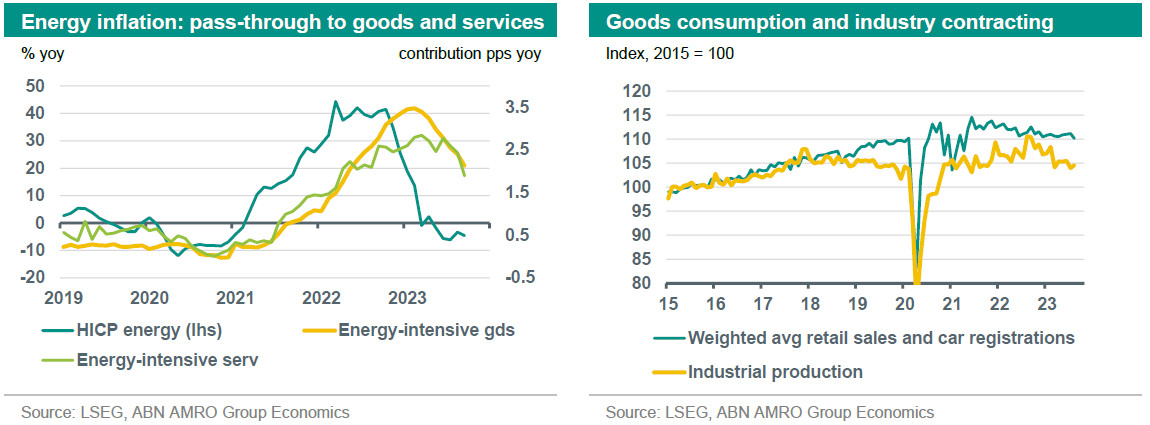
Eurozone disinflation has gathered momentum. Headline inflation fell to 4.3% in September, down from 5.2% in August. The core rate decreased to 4.5% from 5.3%. The drop in inflation was broad-based, with declines in all main components: industrial goods, services, food and energy. Energy inflation fell (to -4.6% from -3.3%) despite the recent rise in oil and gas commodity prices. We think the trough in energy inflation is reached now, and see it rising in the coming months. Still, in our base case the rise in energy inflation will remain much more limited than in 2022 (also see our Global Monthly of 26 September). Despite the expected rise in energy prices, headline and core inflation should continue to gradually decline in the coming months. First, the impact of the 2022 jump in energy prices on the inflation rate of energy-intensive goods and services is petering out (see graph below, left), while downward base effects should dampen food price inflation in the coming months. Next, ongoing weakness in private consumption is limiting the room for companies to pass on any further rises in input prices to consumers. Finally, labour market conditions in the eurozone seem to be slowly turning, with the number of unemployed rising slightly in some countries. We expect the eurozone unemployment rate to move higher in the coming quarters, which will limit wage growth. All in all, we expect headline inflation to continue to decline, approaching the ECB’s 2% target in 2024Q2. Core inflation should trail a bit behind, and reach the ECB target around the middle of 2024.
Meanwhile, monthly economic data and surveys published so far for July-September indicate that GDP probably contracted moderately or stagnated in Q3 (GDP is published on 31 October). The volume of goods consumption, industrial production and construction all declined on a 3Mo3M basis in August. Even if we assume rebounds in September they would still contract in Q3. Next, the low level of producer confidence, the rise in interest rates and tightening bank lending standards indicate that private fixed investment was sluggish in Q3. Yet, foreign trade data suggests the combination of weak exports but even weaker (collapsing) imports could result in a positive contribution to GDP in Q3, keeping total growth close to zero.
Following its policy rate hike in September, the ECB has probably done enough and we think the rate hike cycle may be over now. Although the recent rise in energy prices will have an upward impact on headline inflation, it also means a weaker economic outlook, which is already quite bleak at the moment. Nevertheless, the ECB will probably keep rates at their current level for a while. We expect a pivot in ECB policy around March 2024, when we expect a rate cut cycle to begin. We see the deposit rate at 2.25% by the end of 2024.
This article is part of the Global Monthly of October 23