Eurozone - Economy hit by the Russia-Ukraine conflict
The eurozone economy is already being hit by the energy and commodity supply shocks resulting from the Russia-Ukraine conflict, with activity and sentiment indicators dropping in March. The ECB has announced its intention to scale back policy accommodation. It will gradually reduce its asset purchases during Q2. The end of purchases and the first rate hike are data-dependent.

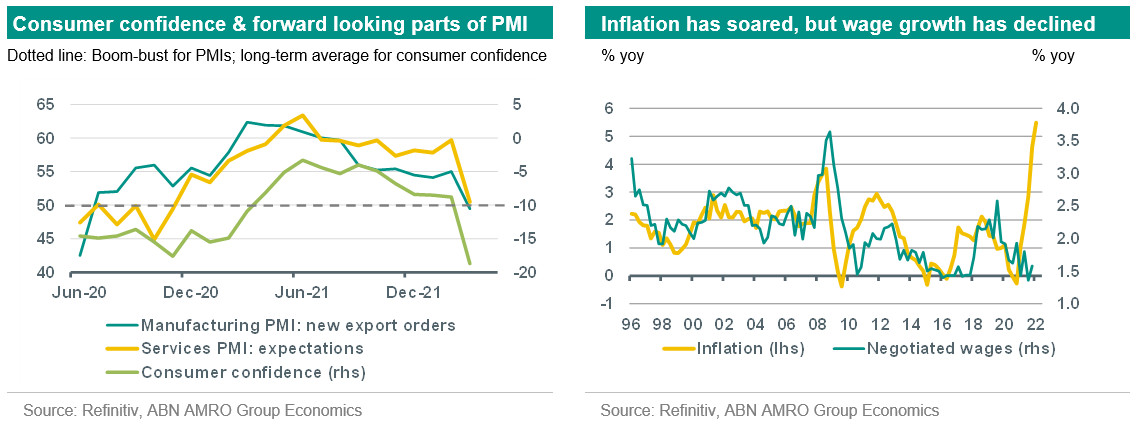
Just as the eurozone economy was bouncing back from COVID-related restrictions in February, the escalation of the Russia-Ukraine conflict seriously clouded the economic outlook. Around 40% of Europe’s gas imports are from Russia and around 25% of its oil imports. In addition, Russia and Ukraine are significant suppliers of other commodities and intermediate goods that are essential inputs for Europe’s industrial sector. Indicators of activity and sentiment have dropped sharply lower following the outbreak of the conflict. For instance, the forward-looking parts of the PMIs and consumer confidence plummeted in March (see graph), with consumer confidence falling almost to the low point that was registered during the first wave of the pandemic. Indeed, we expect soaring energy prices will result in only moderate consumption growth in the first half of this year, despite the post-lockdown rebound in services consumption. Moreover, indicators for Germany’s industry have collapsed, with the Ifo business climate in industry falling at a record pace in March. The drops in these eurozone indicators look to be in line with our base scenario for the economy of modest quarterly growth (of around 0.3-0.4% qoq) in the first half of this year, which is below the consensus forecast and also below the ECB’s most recent projections.
Inflation has also soared due to jumps in energy and other commodity prices. Prices are expected to remain elevated for a considerable time. Supply chain disruptions have also raised the inflation rate of global industrial goods. These disruptions have been intensified by the Ukraine war and sanctions on Russia, which came over and above disruptions related to new pandemic-related lockdowns in China. Finally, services price inflation is still lifted by the normalisation of holiday and entertainment related prices following lockdowns, as well as by energy related price rises of transport services. Although these effects will probably keep inflation at levels well above the ECB’s symmetrical 2% target for a while, underlying inflation is subdued. Indeed, wage growth has eased in recent quarters (see graph). Wage growth is expected to strengthen during this year and the next, but the impact on underlying inflation should be buffered by rises in labour productivity.
At its March meeting, the ECB announced a gradual reduction in the amount of monthly APP asset purchases during Q2. In addition, the ‘calibration of net purchases for Q3 will be data-dependent’, while any adjustments to the key ECB interest rates will take place ‘some time’ after the end of the net purchases and be ‘gradual’. Given the ECB’s hawkish tilt and its eagerness to reduce policy accommodation, we still expect net asset purchases to end in September. We have also pencilled in a 10bp deposit rate hike in December of this year and an additional one in March of next year. After that, we expect rate hikes to be aborted, or at least put on ice, with the deposit rate at -0.3% by the end of 2023. Having said that, there is a significant risk that this policy tightening is delayed, depending on the precise growth-inflation mix.