Germany - Don’t rest on the economic recovery

The current economic recovery will continue in 2027, primarily due to fiscal impulses in the pipeline. Looking ahead, growth prospects are in line with the potential growth rate of around 0.3 percent. Inflation will remain an ongoing concern in 2027, but its impact will diminish as the year progresses.
Alexander Krüger
Chief Economist Germany
Bastian Hepperle
Senior Economist
The good news so far this year is that the German economy has emerged from the period of stagnation it experienced in recent years. This assessment remains valid despite the slightly lower GDP growth in the third quarter. We expect an annual GDP growth of 1.3 percent in 2026. This would mean that the economy has, to some extent, weathered the pressures from the sharp rise in energy prices and the heatwave.
However rosy the growth rate for 2026 may appear, it is no cause for celebration. The economic recovery is primarily driven by the impulses from the debt-financed fiscal package for infrastructure and defense enacted by the Federal Government in 2025. Without this, the economic recovery would have been significantly more subdued, regardless of the repercussions of the Iran war. A closer look at the statistical breakdown of the growth rate also reveals that the expected growth of 1.3 per cent is underpinned by a working-day effect of 0.25 percentage points and a higher base level at the start of the year (0.2 percentage points). This shows that the underlying economic momentum was weaker than the rate suggests at first glance. Furthermore, the growth gap with other countries that has accumulated since the end of the COVID-19 pandemic remains substantial.
Economic recovery continues
We are confident that the economy will maintain this year’s pace of expansion in 2027. In our view, key sentiment indicators point in this direction. The record-high level of industrial order backlog also gives cause for economic optimism. Across the board, however, we do not see companies showing a firm commitment to utilizing existing production capacity to a significantly greater extent. We consider this reasonable, given the challenging business environment. High energy prices and taxes, as well as a high level of bureaucracy, are just some of the factors involved. As a result, significant competitive disadvantages persist when compared internationally. Rising interest rates and political uncertainties have now been added to the list of pressures, alongside US tariff policies and aggressive low-price strategies from Chinese competitors. Investment for a capacity expansion is therefore out of the question for the foreseeable future. There is little prospect of stronger economic momentum in the quarters ahead. Moreover, jobs are likely to be lost rather than created. This also clouds the outlook for consumer spending. As we do not foresee any prospect of a rapid and significant fall in energy prices, the resulting losses in purchasing power are set to persist for the time being. However, the situation is likely to ease with the fall in crude oil prices we expect in 2027.
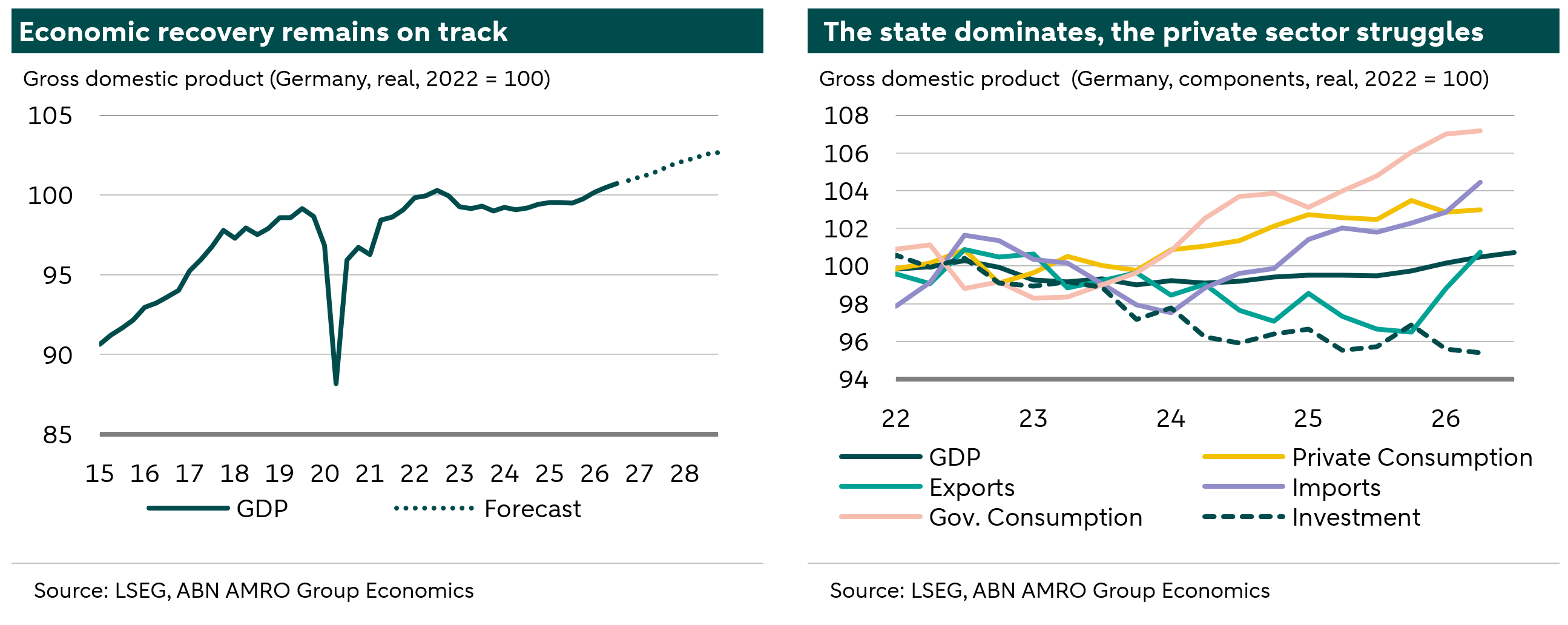
All in all, we expect GDP to grow steadily over the coming quarters, driven by fiscal policy. Our GDP forecast for 2027 stands at 1.0 per cent. In our view, this stems from a renewed, noticeable increase in public consumption and a rise in investment from a low base. Foreign trade, on the other hand, is likely to weigh slightly on economic activity due to an expected high level of imports. On balance, GDP growth for 2027 will also benefit from a working-day effect of 0.1 percentage points and a higher base level of 0.3 percentage points. Overall in our view it is not a self-sustaining and dynamic recovery. All in all, for 2027 we see limited upward potential in the economic cycle.
Reforms urgently needed
Our expectation for GDP growth in 2028 to fall to 0.7% is due to structural factors. It has long been clear that the economy needs a decisive course of supply-side reform in order to address demographic and geopolitical changes and to boost international competitiveness. From an economic analysis, the rationale for this has long been on the table. There have also been positive experiences with Agenda 2010. However, the spark of reform has failed to catch on in the political sphere. Yet the fact that, in Germany, it is primarily the state that drives economic growth should have given politicians cause for concern long ago. Meanwhile, investment activity has been lying dormant for some time. In a thriving economy, however, the impetus should come primarily from the private sector rather than the state.
The current positive economic data is therefore no cause to celebrate. Rather, the Federal Government has so far failed to allocate funds from the fiscal package extensively towards investment. Yet it is precisely investment that enables a capacity-boosting effect to be achieved, thereby paving the way for a higher growth trajectory in the long term. On such a trajectory, with capacity utilized at normal levels, it would then be possible to achieve sustained higher GDP growth. Instead, consumption expenditure accounts for a large proportion of spending. Policymakers are unlikely to make any radical changes to this situation, at least for the time being, which is why obstacles to growth are likely to persist. With regard to growth prospects, this paints the following picture for us: 1) The economic recovery in 2026/27 bears strong similarities to a flash in the pan; 2) Beyond 2028, we expect the GDP growth rate to fall to our estimate of long-run potential, around 0.3%; 3) The slowdown in growth will a) lead to growing doubts amongst investors about the sustainability of public debt, which is set to rise further beyond 2027. They are therefore likely to demand higher risk premiums in future. In addition, b) even more intense battles over the distribution of wealth are to be expected than are already being observed. This, however, increases the risk that companies and skilled workforce will continue to turn their backs on Germany, contrary to demographic requirements. The time for political action has therefore arrived long ago, especially as it is likely to take years before the fruits of reform can be reaped.
Inflation remains a concern
Our inflation forecast for 2027 stands at 2.9 percent. This is yet another notch higher than our forecast of 2.7 percent for 2026. Our assumptions regarding energy prices are the key factor determining the course of inflation over the course of the year.
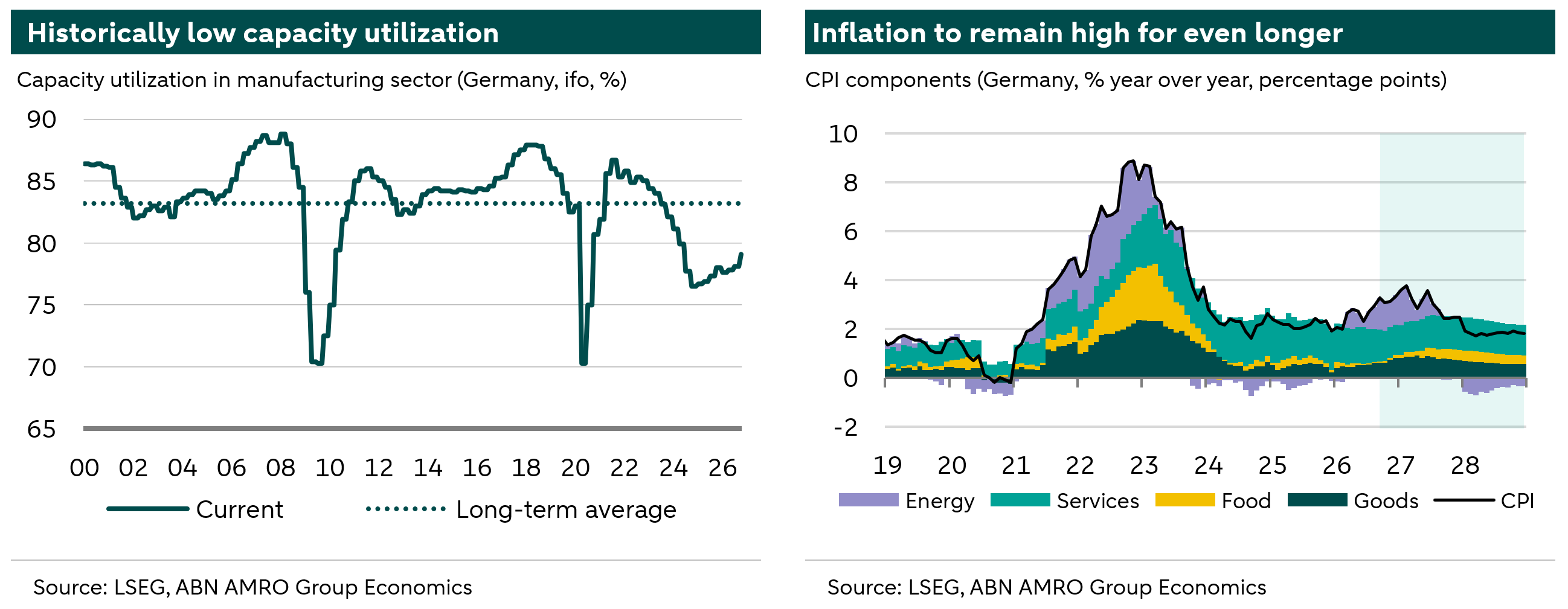
Our forecast is based on the assumption that prices for diesel, petrol and heating oil will initially remain at a high level and then gradually fall in 2027. The resulting downward pressure on inflation is offset by an opposing effect from gas and electricity prices. This stems from increased costs, which utility companies are likely to pass on to their customers. Ultimately, year-on-year changes in the energy price component will remain positive, driving up consumer prices. The situation is similar (partly due to El Niño) for food prices, which have yet to reflect the indirect effects of the energy price shock. The upward pressure from services prices is likely to be limited. Inflation is expected to rise above 3.5 percent at the start of the year, but will fall into a range of 2.0 to 2.5 percent by the end of the year. As energy prices are expected to have largely normalized by 2027, we anticipate that inflation in 2028 will be in line with the ECB’s 2.0 percent price target.