Global Daily – Growth still well-above trend in the eurozone
Euro Macro: Eurozone PMIs signal ongoing robust growth – The eurozone composite PMI (flash estimate) declined to 59.5 in August, down from 60.2 in July. At its current level the index signals that GDP is growing at a rate well above the trend rate. Moreover, the August report indicates that economic growth is gradually getting back to normal, after it had earlier bounced back rapidly in May and June, when lockdown measures in the services sector were scaled back.

The composite PMI is a weighted average of the services activity index and the manufacturing PMI. The manufacturing PMI has been at levels well above the 50-mark that separates contraction from growth in the sector during more than a year now, although it has lost some of its earlier gains in recent months. It fell to 61.5 in August, down from 62.8 in July. As the graph shows, the services PMI was weighed down by restrictions during the second and third wave of the pandemic between September 2020 and May 2021. It returned to levels that are closer in line with to the manufacturing PMI only around the start of the summer, when increased vaccination rates allowed the unwinding of lockdown measures in services. In August, the services PMI moved only marginally (to 59.7 from 59.8).
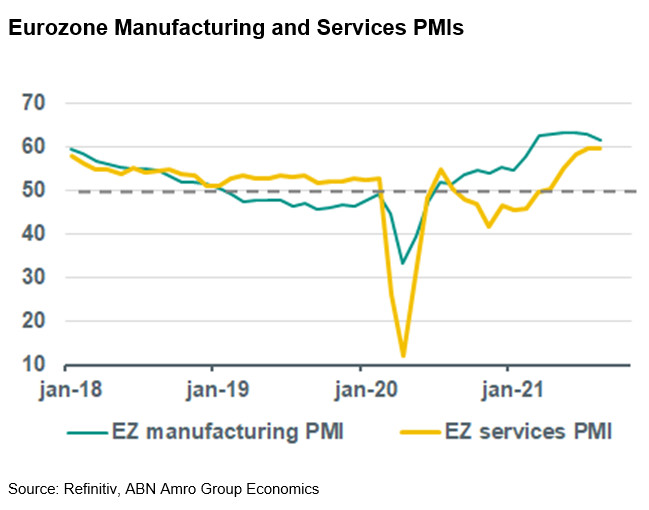
The manufacturing sector has been confronted with supply chain bottlenecks, dramatic rises in suppliers’ delivery times and soaring commodity and other input prices during the past twelve months. The details of the manufacturing report gives some early evidence that these strains eased in August, although the problems still are far from over. The input prices index of the manufacturing PMI is still close to record-high levels, but declined by 2 points (to 87.3) in August, indicating that prices are still rising, but that the pace of the rise has slowed somewhat. Also suppliers’ delivery times continued to lengthen in August, but the share of participants to the PMI survey that reported longer suppliers’ delivery times fell in July and in August. The PMI report suggests that manufacturing output will continue to grow solidly in the coming months. Indeed, the components of the manufacturing PMI that gauge the level of new orders and work backlogs have remained at historically high levels in August, albeit that they each fell by around 2 points to close to 61.
All in all, the result of the August PMIs is in line with our base scenario for the eurozone economy of ongoing robust GDP growth during the rest of this year. We have assumed that the high level of vaccination in the vast majority of eurozone countries will prevent new strict and widespread lockdown measures that would push the services sector back into recession. This should allow GDP to expand by around 2% qoq in Q3 and another 1% in Q4. (Aline Schuiling)