Global Daily – Tax and re-opening set to lift eurozone inflation
Euro Macro: Inflation lifted by impact from tax changes and re-opening of tourism – The first eurozone countries have published inflation data for July.

To begin with, Spain reported that HICP inflation increased to 2.9%, up from 2.5% in June. According to the written statement of the statistical bureau the rise was mainly driven by higher inflation rates of gas and accommodation services. Spain’s core inflation rate increased by 0.4 percentage points to 0.6% in July. Next, Belgium recorded a rise in CPI inflation to 2.3% up from 1.6% in June. Belgium’s core inflation rate increased to 1.4%, up from 1.1% in June. The breakdown of Belgium’s inflation index into main components reveals that the rise was mainly due to higher energy price inflation, although the inflation rate of hotels, cafés, restaurants and the leisure industry also had a modest upward impact. The data from Spain and Belgium suggests that the re-opening of intra-European tourism had some upward impact on inflation in most eurozone countries.
Last but not least, Germany reported that HICP inflation jumped by a full percentage point to 3.1% in July. This jump was largely due to the upward base effect stemming from the temporary cut in the VAT rate between 1 July 2020 and 1 January 2021. Indeed, the detailed inflation reports from Germany’s main states and regions show that the jump in inflation was broad based and that the yoy change in all components of the CPI jumped higher. Over and above that there also seems to have been some impact of the re-opening of the tourism industry and unwinding of lockdown measures in hotels and restaurants. For instance, the inflation rates of hotels and restaurants and leisure and entertainment increased more than total inflation in a number of regions in July.
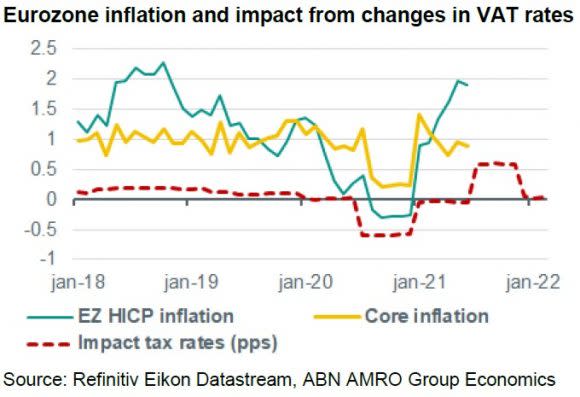
Eurostat will publish the first estimate for July eurozone inflation on 30 July. The upward base effect stemming from Germany’s temporary VAT cut between 1 July 2020 to 1 January 2021 will have an upward impact. Besides, prices related to tourism and leisure will probably also have increased. Combined with an upward impact of energy price inflation this suggest that eurozone headline and core inflation each increased in July. However, working in the opposite direction there is a sharp downward base effect from non-energy industrial goods prices. Indeed, in July 2020, there was a one-off jump in the price of non-energy industrial goods (by 1.6% mom, lifting the yoy change to 1.5% in July 2020 from 0.0% in June 2020), which resulted in a rise in eurozone core inflation, despite the downward impact of Germany’s VAT rate cut that month. This means that this year, the opposite probably will happen: i.e. a fall in the inflation rate of eurozone non-energy industrial goods that compensates all or part of the rise in the other components of the HICP index. All in all, we think that core inflation increased to 1.0% in July, up from 0.9% in June (consensus forecast is a decline to 0.7%) and that the headline rate rose to 2.1% from 1.9% (consensus: 2.0%).
Looking further ahead, inflation is expected to hover around the July level during a couple more months, but should decline noticeably as from the end of the year onwards. Underlying inflation will remain subdued as a slack has built up in the eurozone economy, particularly in the labour market. All in all, we expect core inflation to remain well below the ECB target during the next 2-3 years.