Prinsjesdag 2026: A budget in search of a majority

The Minority cabinet Jetten I presented its first full budget today at ‘Prinsjesdag’ (Budget Day). Today’s budget is yet without a majority and therefore features policies aimed at securing support from opposition parties. As a result, changes to today’s budget are expected during the upcoming budget debates. The impact on the budget deficit is expected to be limited, given tight agreement among coalition partners on budget rules… and as a result, we do not expect a significant impact on the funding need for 2027. The Dutch economy is resilient while long term challenges are mounting and inflation stays too high compared to peers.


Minority status shifts attention from Budget Day to budget debates
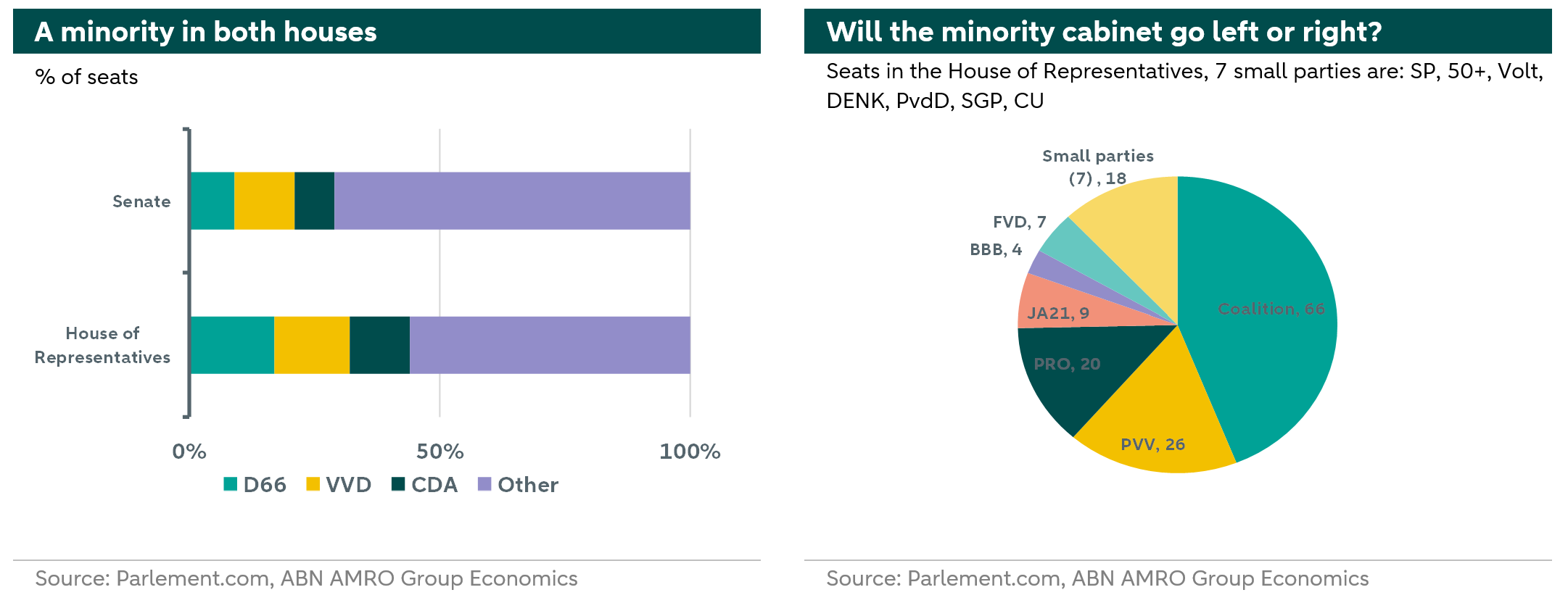
On today’s ‘Prinsjesdag’ (Budget Day), the Jetten I minority cabinet presented its first full budget since taking office in February. With only 66 seats in the Tweede Kamer, well short of the 76 required for a majority, the proposed budget should be viewed as the starting point for negotiations rather than the final policy package. Even before securing a parliamentary majority, finding consensus among coalition partners proved very difficult in recent weeks. In today’s budget the planned reforms on social security – that have led to national strikes – have been softened. Other policy measures such as an extension of reduced fuel levies have been included to attract support from opposition parties. As the government will also need backing in the Senate, the budget debates over the coming weeks are likely to be more important than Budget Day itself in determining the fiscal stance. The process underscores a broader trend in Dutch politics: fragmentation has made coalition-building increasingly difficult, with the Netherlands having spent roughly 40% of the time since 2020 under a caretaker government. Which results in long standing issues on bottlenecks that affect structural growth remaining unresolved. What lies ahead are debates where the budget can still significantly change. A tail risk is that this could prove incompatible with (part of) the coalition and lead to new elections.
What did the budget include? And what not?
Central to today’s budget, and this minority government term, is the commitment to increase defence spending to 3.5% of defence spending in 2035. The coalition initially proposed, amongst others, higher taxation on labour and cuts to social security to fund this ambition. Today’s budget sees a softening in both aspects. Due to higher inflation resulting from the Iran war, the government has softened the rise in income taxation to boost purchasing power (EUR 1.5 bn). The already leaked softening in social security cuts gained most media attention in recent days. Unions have set out an agenda for national strikes to force the cabinet to alter course. It remains to be seen whether cancelling of planned increase of the retirement age, the softening in the reduction of unemployment benefits and the postponed cuts to unemployment benefit duration, is enough to gain opposition support from the left side of parliament.
Contrary to the previous government, the cabinet tries to restore the balance between current spending and investment. Spending in innovation funds is increased as well as a much-needed impulse for physical infrastructure spending. Overall, while steps are made, the fallout from Iran as well as the political reality force the cabinet to focus more on the short term than the ambitions they had laid down in the coalition agreement. More concrete steps on the Wennink agenda, the Dutch ‘Draghi’ report on competitiveness, were for instance lacking.
A clear absentee in today’s policies was a concrete proposal to move to a new system of wealth taxation by 2028. As a result of this, wealth tax revenue would drop by around EUR 2 bn. annually, leading to the need to funding elsewhere in the budget from 2028 onwards. This topic was deemed too politically sensitive within the coalition that it was left for upcoming budgetary negotiations.
What does this mean for government finances?
Today’s budget should be considered as an opening offer to the opposition. We expect changes to the budget in the coming weeks of parliamentary debates to gain opposition support. However, we do not expect this to lead to significant changes to the size of the already considerable budget deficit. The position of the Minister of Finance, supported by the coalition agreement, is clear on this: new expenditures are expected to be covered by higher taxation, or cuts elsewhere.
The budget deficit is expected to be 2.7% of GDP in 2026, amplified by a one-off payment towards military personnel (EUR 8 bn.). Next year the budget deficit will come out to 2.2% of GDP. Going forward, we note that similar to last years, the risk of underspending is high; amongst others due to the tight labour market. Particularly with regards to the increase in defence spending, which will be met with an economy that runs into all kinds of capacity constraints (see below).
No significant changes in funding need expected
The Dutch government’s funding need for a given year is determined by two factors: first, the refinancing of debt securities maturing during the year; and second, the size of the government budget balance. This balance may be either negative or positive, although a sizeable deficit is expected in the coming years. For the Dutch State Treasury Agency (DSTA), which is responsible for financing the Dutch government, the volume of debt to be refinanced in a given year is relatively predictable: typically, around two Dutch State Loans (DSLs) mature each year, while outstanding short-term debt, mainly Dutch Treasury Certificates (DTCs) with maturities of up to six months, is refinanced throughout the year. In 2026, this amounted to EUR 72.6bn in total.
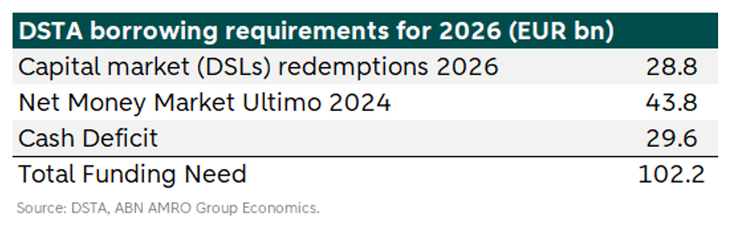
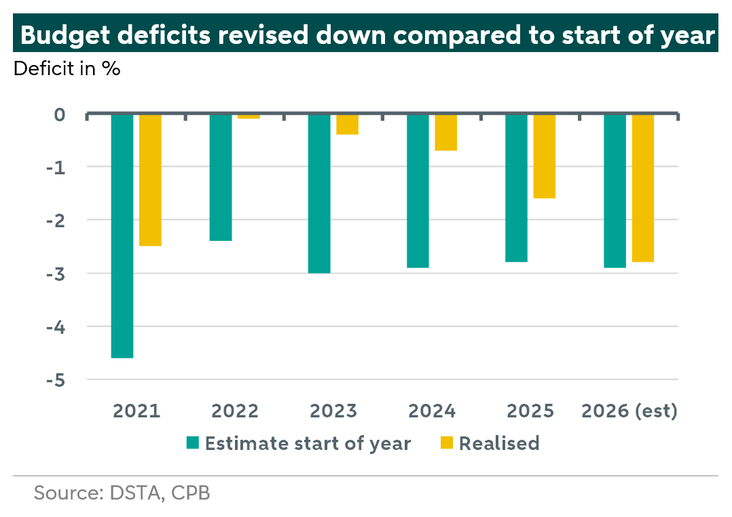
However, the size of the government budget deficit is more difficult to predict, and in each of the past few years it has been revised down during the calendar year. The chart below shows that, at the start of the year, when the DSTA announces its funding plans to the market, the projected deficit as a percentage of GDP has in recent years been considerably more negative than the final outturn. Going forward, the ramping up of defense spending once again increases the probability of underspending. The DSTA attributed these revisions to underspending by government ministries and higher-than-expected tax revenues. Downward revisions to the funding requirement have led to lower issuance of DTCs in recent years than originally communicated to the market. This year, too, the DSTA has already revised the funding requirement down by more than EUR 10bn, to EUR 29.6bn as announced in the for the third quarter of this year.
A government budget deficit of 2.2% is expected next year. However, as discussed earlier in this note, negotiations with the opposition parties on the budget will start after Prinsjesdag and the outcome of these negotiations will determine next year’s government budget deficit and, consequently, the size of the funding requirement for 2027. However, given that the minister of finance will be demand funding from other budgets to finance extra expenditures, we do not expect a significant deterioration of the deficit for next year.
Dutch growth remains resilient, but capacity constraints are becoming more binding
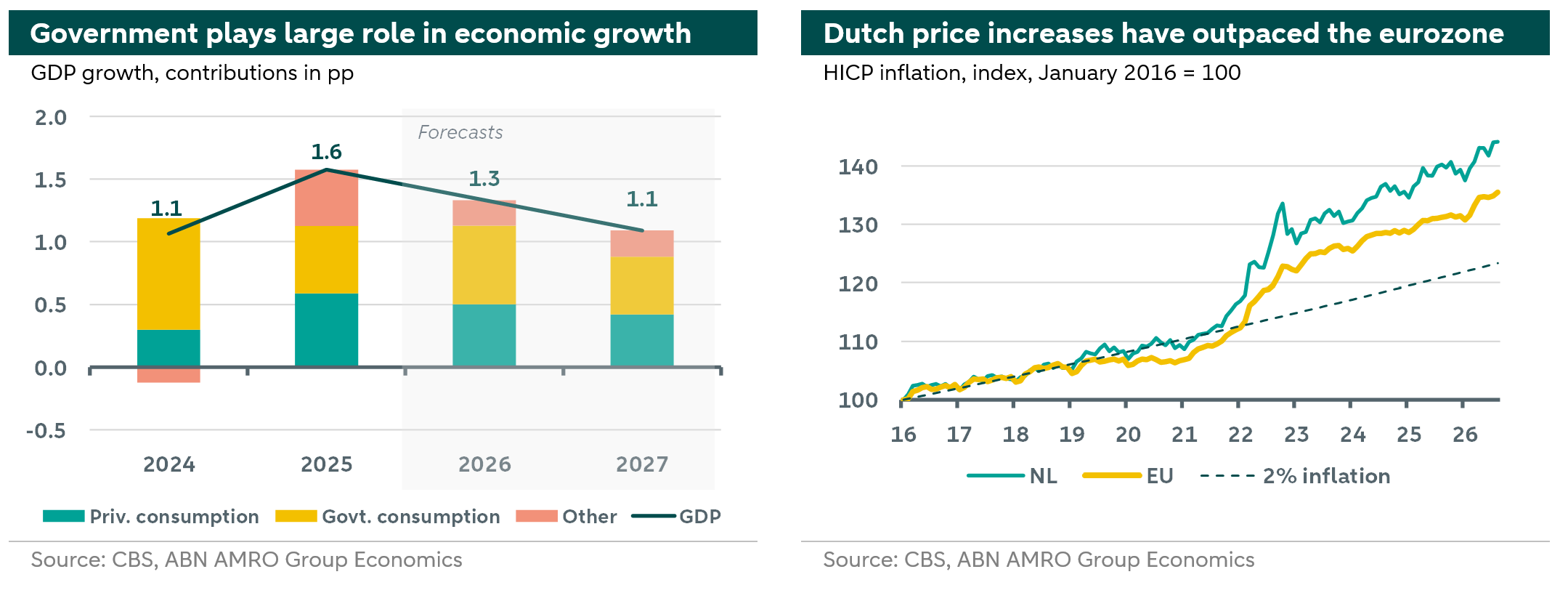
Prinsjesdag takes place against a backdrop of surprisingly strong economic performance despite geopolitical risks and elevated energy prices. The Dutch economy has outperformed most European peers in recent years. Household consumption has remained resilient, supported by robust wage growth and still-ample savings. In addition, the Netherlands continues to benefit from the global AI investment cycle through its semiconductor ecosystem, which has supported exports – for instance to Taiwan.
As a result, the near-term growth outlook remains favourable. The longer-term picture is more challenging. Supply-side constraints are becoming increasingly binding, particularly labour shortages and electricity grid congestion, while growing maintenance needs for transport infrastructure add to capacity pressures. These bottlenecks put a lid on growth and reduce much needed dynamism in the economy.
Inflation remains the main macroeconomic challenge. Higher energy prices have hit while parts of the economy were still adjusting to earlier energy price shocks. While we do not expect a renewed wage-price spiral, elevated wage growth is likely to keep services inflation high going forward. As a result, Dutch inflation is likely to remain around or above 3% this and next year, extending a period of persistent price pressures that has lasted more than 4 years already.