The economic fall-out from Trump’s Greenland ambitions

President Trump has strongly re-stated his view that acquiring Greenland is a national security priority of the United States. The White House has said it is exploring options to do so and that ‘utilising the US military is always an option’. This comes against the background of the capture of Venezuelan President Maduro over the weekend. This was seen as a demonstration that the Trump administration is willing to use military power to achieve its objectives and that international law is not at the forefront of its considerations. Various other Latin American countries appear to be at risk of a similar fate, but there have also been renewed threats in the direction of Greenland. Greenland is an autonomous territory of Denmark, which is a member of both the EU and Nato. In this note, we set out the current state of play, possible scenarios and the implications for the European economy in a Q&A format.


Why does the US want Greenland?
President Trump has identified Greenland as essential to US national security, describing American ownership as an ‘absolute necessity.’ Greenland is seen as important from a US defence perspective because of its strategic Arctic location between the US and Europe. It is a key location for military early-warning systems, space surveillance activities, Arctic military access and the monitoring of Russian and Chinese activity. The US already has had an active military presence in Greenland since the 1950s. In addition, Greenland is rich in natural resources, both fossil fuels and strategically important critical minerals. The melting of Greenland’s ice sheet due to climate changes makes these more accessible. In particular, the Tanbreez Project could, with time, break China’s dominance over these materials.
Broadly speaking, the narrative around Greenland falls within the Trump administration’s revival of the Monroe Doctrine (now referred to as ‘Donroe Doctrine’), which states that the US reserves the right to act to prevent new great-power footholds in the Western Hemisphere, as they are a threat to its security. Indeed, Greenland sits at a key strategic naval and air chokepoint, and even on arctic air and missile trajectories towards the US. Its waters also hold various subsea cables and there’s substantial satellite infrastructure. Effectively, the Doctrine’s implication for Greenland is that there should be no Chinese ports, airports or other infrastructure, no Russian facilities, and no debt-based economic dependence, again mostly to China.
What has the European response been?
Europe has been quick to warn against US intervention in Greenland. Denmark’s Prime Minister Mette Frederiksen warned that the President Trump was serious about taking control of Greenland and stating that ‘If the US choses to attack another NATO country militarily, everything stops. Including our NATO’. She also warned that the ‘US has no right to annex one of the three countries’ in the Kingdom of Denmark. Earlier this week the Danish PM clarified that ‘the military alliance may well continue to exist but its effectiveness will be called into fundamental question’. Meanwhile, European leaders, including Germany, France and the UK issued a joint statement. They asserted that ‘Greenland belongs to its people. It is for Denmark and Greenland, and them only, to decide on matters concerning Denmark and Greenland’. Despite the clarity of this message, the Financial Times has reported that there are significant divisions on how to handle the situation, citing briefings from EU officials. This reflects the EU’s reliance on US support for Ukraine as well as the US security umbrella more generally.
What could happen next?
As with all geopolitical risks, what happens next is surrounded by extreme uncertainty. We see one of four potential scenarios materialising, from the benign to the destructive.
1) The Canada scenario: The most benign, is that President Trump drops this idea, which is actually what appears to have happened with regards his ambition for Canada to join the US as its 51st state. However, the US administration does appear to be more serious when it comes to Greenland.
2) Agreed settlement: Another relatively benign scenario in terms of the economic fallout, is one where the situation is resolved without military intervention. This could involve more US control of Greenland. In the most complete version of that, the US could take over Greenland, for instance, following a referendum of self-determination and/or a financial agreement. Another possibility is that the US and Denmark reach an agreement, which gives the US more freedom for manoeuvre in Greenland, militarily as well as in terms of economic development.
3) Military action, EU takes it on the chin: A third, more negative scenario in terms of the impact on the economy and markets, is that the US takes over Greenland militarily, but the EU does not respond with any significant or only modest economic retaliation. Although this would be a very bitter pill to swallow, the EU might decide (as it did in the case of US tariffs last year) that appeasement was the least damaging response. Still in this scenario, the US commitment to NATO would be questioned and the alliance weakened, which would raise geopolitical uncertainty.
4) Military action, economic escalation: The most negative scenario economically is one where the US takes over Greenland militarily and the EU responds by placing significant economic sanctions and/or tariffs on the US economy. This could then lead to a retaliation from the US leading to major direct economic fallout. Such an escalation would add even further concerns about the US-EU relationship and the NATO alliance leading to an even larger rise in related geopolitical uncertainty. Given how damaging this would be, we would think of it as more of a tail risk scenario.
What does all this mean for the European economy?
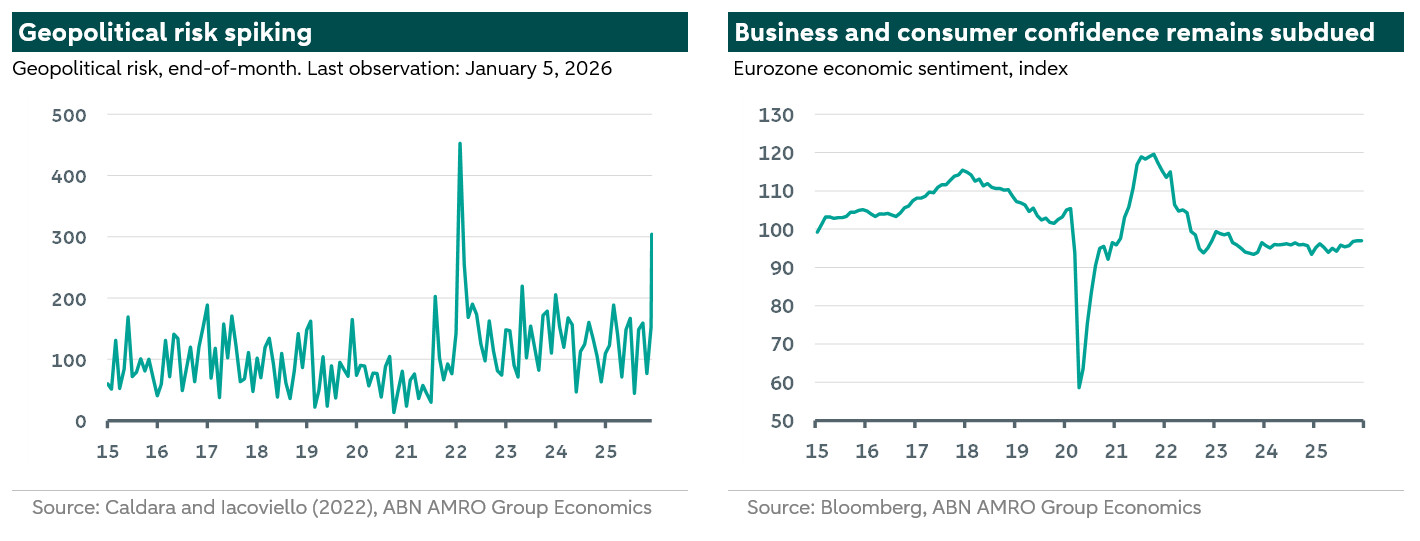
The direct implications of a US military takeover of Greenland are limited, though there could be more significant indirect implications. We see two main channels of impact both in the short- and medium/long-term. First, it could raise geopolitical policy uncertainty hitting household and business confidence, depending on how prolonged any tension between the US and Europe lasts. Such a hit to confidence would have some parallel with the Russian invasion of Ukraine. This would come at a crucial time, as European households are just beginning to shake off the trauma of the energy crisis and general high trade-related uncertainty, and the prospects were pointing to a long-expected decline in consumer caution and the elevated savings rates that have accompanied that. Indeed, coming alongside pass-through of prior rate cuts, this is one of the main reasons we expect European household consumption to pick up over the coming year. Business confidence has also been very weak since the energy crisis, with for instance survey-based investment intentions at levels normally consistent with recession. Alongside consumption, our base case sees a pickup in business investment. Renewed higher uncertainty could throw the revival of ‘animal spirits’ off course, creating downside risks to our near-term growth forecasts. At the same time, we’ve estimated the impact of geopolitical risk on the economy to be mild. Uncertainty about Europe’s response and indeed the threat of economic retaliation could however be more harmful. In the most negative scenario, where military action leads to an economic escalation, the impact of course depends on the scale of potential sanctions and tariffs. In terms of ‘value at risk’, we note that EU exports to the US amount to 4.5% of EU GDP, while US exports to the EU amount to 2.3% of US GDP. These effects would be accentuated by tightening financial conditions as the escalation and rising uncertainty would also hit risk appetite.
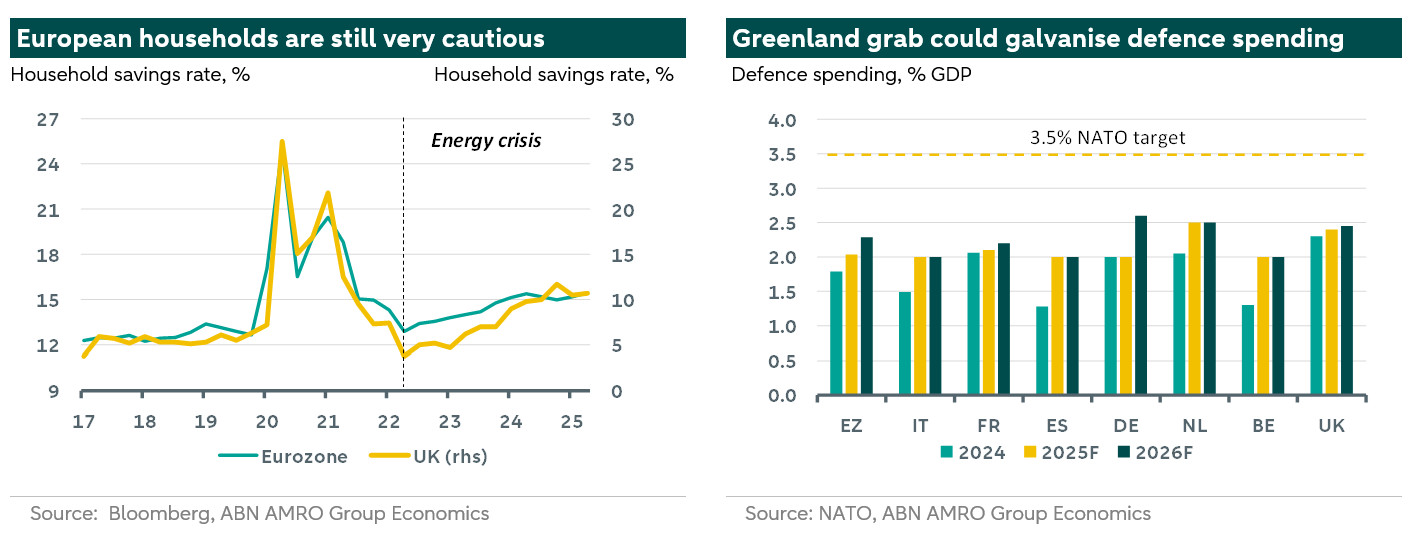
Further out, the risk if anything could tilt more to the upside, with European countries likely to see a renewed impetus to raise defence spending more ambitiously, and in a manner that is less dependent on (US) imports and therefore supportive of European industry. This is already the stated goal of the EU’s plan, but such a hostile move by the US would likely give further momentum to that. Outside of Germany, we continue to judge European defence spending plans to be relatively modest so far, but a Greenland grab could serve as a wakeup call to those member states that have until now been less willing to raise defence spending substantially.
Are there longer term strategic considerations for the US and EU?
The abovementioned ‘Donroe Doctrine’ is the most likely longer-term geopolitical angle. Russia and China are similarly seeking influence in the region. Russia sees the arctic as central to energy exports and shipping, China calls itself a ‘near-Arctic state’ and is looking for mineral access, infrastructure investments and research presence. Greater control over Greenland would prevent these other parties from establishing a strong presence.
Economically, beyond access to critical minerals, there is a significant trade aspect to Greenland’s geography. The US is currently far behind China and Russia in terms of icebreakers and ports in the arctic region. Control of Greenland would put them in the game again. Current climate projections suggest proper northern sea routes by 2065, and they could shave 3,000 nautical miles off the traditional route through the Suez Canal. This would dramatically loosen Russia’s grip on trade in the Arctic region, who currently control the Northern Sea route. According to Article 234 of the United Nations Convention of the Law of the Sea, countries whose coastlines are near Arctic Shipping routes can regulate the route’s traffic, although strictly speaking only when covered with ice for most of the year. Control of Greenland would therefore entail control of these vital shipping routes.
Meanwhile, the EU was also looking at Greenland for its access to critical minerals, and various European initiatives were granted permits by Greenland to start mining. Further permits would be unlikely should the US gain control of Greenland, and even the granted permits would be at risk. From a geopolitical perspective, Greenland ensures a European voice and influence in arctic regional matters, vital for its geopolitical influence, and European aims on promoting sustainable development and environmental protection in the Arctic.