Top of Mind - Out with the old tariffs, in with the new
After a surprisingly long delay, the Supreme Court ruled 6-3 last Friday that the International Emergency Economic Powers Act (IEEPA) does not give the President the authority to impose tariffs. Importantly, they referred the decision on whether paid tariffs, over $160 billion, have to be refunded back to lower courts. The Trump administration was quick to reimpose tariffs through other means. Still, overall tariff levels were somewhat reduced, with some countries benefiting substantially more than others.


The Supreme Court ruled to annul the Trump administration’s tariffs imposed under the International Emergency Economic Powers Act
Roughly 60% of tariffs were cancelled, but quickly replaced by temporary 15% tariffs under Section 122
The aggregate level of tariffs has declined only modestly, but for some countries the decline is significant
For the EU, tariffs remain mostly in place, although there is fresh uncertainty about the ratification of the Turnberry agreement
China, and various emerging markets are the major beneficiaries of this development, who see their competitive position improve
The SCOTUS decision
The legal basis for the tariffs always seemed dubious, relying on chronic bilateral trade deficits to declare a national emergency. From an economic point of view there was always little doubt that the basis was false. The legal case mainly settled around whether the President had the authority to impose tariffs without Congress’ approval. The majority ultimately ruled against the President.
The decision was important, because it shows that the final check on the US presidency remains in place. At the same time, the Trump administration has acted more frequently with seemingly weak legal basis, ‘asking for forgiveness not permission.’ They carried out an attack on Iran without congressional approval last year, they carried out the military operation to extract Maduro from Venezuela without approval. This has allowed the Trump administration to permanently alter the geopolitical environment, seemingly without constraints.
Still, this ruling is a positive development, as it takes away one of the most important instruments Trump has used to pressure its trading partners into gaining various concessions. He can no longer impose arbitrarily high tariff levels on other countries overnight. Any threat would now take the form of a months-long investigation. Many of last year’s developments would have played out very differently with this restriction in place.
Which tariffs are affected
The SC decision annulled IEEPA tariffs, which included the Liberation Day ‘Reciprocal Tariffs,’ as well as the fentanyl-related tariffs. This means that all country-level tariffs imposed last year have been annulled. Sectoral tariffs under Section 232, such as those on steel and aluminium, cars and some other goods, remain in effect. The IEEPA tariffs were however by far the biggest, representing almost 60% of total tariff revenue since Trump took office. It is as of now unclear whether these tariffs will have to be paid back, although it seems unlikely that businesses will just accept having paid an unlawful tax. Lower courts have previously been quick to dismiss the IEEPA tariffs, and we therefore also see it as likely that these will have to be paid back.
The impact on the fiscal picture will be limited. Our base case already saw a decrease in tariffs this year, which has now materialized. Having to pay back last year’s tariffs will raise this year’s deficit again but is overall unlikely to qualitatively alter the trajectory of the US debt. We also do not expect a substantial impact on inflation. The overall aggregate tariff level remains at historically high levels. Even if businesses do get tariff refunds, they’re unlikely to pass that fiscal windfall on to end-consumers. Any pass-through of tariff price hikes will not be reversed, but some of the remaining pressure may ease somewhat.
The Trump response
Trump was clearly not happy with the Supreme Court decision. In line with expectations, he immediately re-implemented some of the tariffs through Section 122. This section allows the US to impose tariffs up to 15% for up to 150 days, without congressional approval. Importantly, it does not allow for between-country variation. The Trump administration initially imposed 10%, the lowest of the country-specific reciprocal rates, but later upgraded to the maximal 15%. Tariff exemptions for goods subject to Section 232 action, such as those for various consumer electronics, energy and pharmaceuticals, as well as USMCA-compliant goods, remained. In the meantime, US Trade representative Greer stated that the SC decision won’t unravel deals that the US negotiated with its partners, such as those with the EU, UK and Japan – at least, from the US’s point of view (see below for the EU’s).
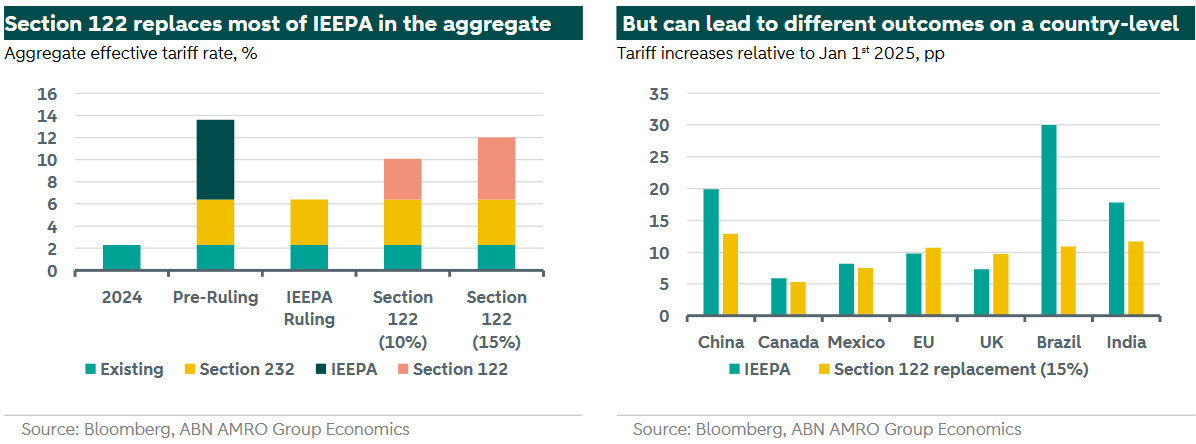
Tariff levels therefore briefly dropped substantially, but quickly bounced back, and the aggregate effective tariff rate has now settled at a level roughly 2pp below the level it was before the ruling (see chart above-left). Some countries benefit, while others do not. In the chart on the right, we see that countries like China, Brazil and India, who had large, and largely political tariffs applied to them, now face substantially lower tariffs. At the same time, the EU and UK may actually see a minor increase in the tariff rate, depending on whether the caps of 15% and 10% in their trade agreements hold, or whether they face the full extent of the 15% Section 122 tariff.
The next tariff steps
Section 122 again provides legally dubious grounds for tariffs. Formally, it was written to prevent international payment problems in a fixed exchange rate regime. Given the precedent in the IEEPA tariffs, it’s unlikely that a legal challenge, which is sure to come, will be concluded before the 150 day term is up. In the meantime, the Trump administration is expected to take the sector-level Section 232 and the ‘unfair foreign trade practices’ Section 301 to rebuild the tariffs in a permanent, and more legally-sound manner. Both require extended investigations before they can be applied. Neither can be used to completely rebuild the Liberation Day package as they do not allow for sweeping universal tariffs, but an extended effort can get close. This might be good news for the penguins on the Heard and MacDonald Islands who currently face 10% tariffs, but will likely not be investigated. Section 232 applies only to certain sectors rather than countries, though country-specific exemptions could be granted. Section 301 applies to countries and similarly requires a long and formal investigation. Duration must be reviewed every four years, and the US trade representative can keep them in place if a US company can claim they are benefitting from the tariffs.
What happens it investigations are not concluded in 150 days? Congress can extend the Section 122 tariffs beyond the 150 day period, and by that time the current Republican majority will still be seated. Still, the timing is consequential, as a decision to extend would be close to the mid-terms. Tariffs are unpopular, and Republican congress members up for re-election might be hesitant to go along.
EU reaction and eurozone impact
The EU responded to the latest tariff developments with a stern statement demanding clarification that the new 15% tariff would not violate the US-EU Turnberry agreement of last July. So far, the list of exemptions to the 15% tariff suggests that the ‘new’ tariff regime is very similar if not identical to what existed before the Supreme Court decision, at least for the EU. However, developments could still be impactful, for two reasons. First, it creates fresh uncertainty around EU ratification of the Turnberry agreement, which was already delayed by the Greenland episode in January. The agreement is quietly loathed in the EU as a capitulation to the US, and Bernd Lange, leader of the European Parliament’s international trade committee, has proposed suspending ratification, which was due to take place tomorrow. Even if the US does uphold its part of the deal, it could be argued that the whole basis for political support of the deal – that the concessions the EU made helps it avoid even higher tariffs – has fallen away now that Trump has no legal basis to impose higher tariffs. Whether this is enough to scupper the deal entirely is unclear. If the deal were to be scrapped entirely, the EU could still run the risk of higher future section 232 tariffs – for instance in pharmaceuticals (1/4 of EU exports to the US), where the Turnberry agreement currently contains a cap of 15%.
The second factor to consider is the EU’s loss of competitiveness vis-à-vis other US trade partners, notably China. Under the previous regime, EU exports faced much lower tariffs to the US than did China and many emerging markets (see below). That competitive advantage has now partly fallen away. However, the EU and China mostly compete in different spheres when it comes to the US market: the EU exports more value-added and differentiated products (think pharmaceuticals, (luxury) cars, food products unique to the EU). Where they do compete, for instance in steel, the EU’s competitive advantage still remains, as steel is covered by the section 232/301 tariffs which are unaffected by the Supreme Court decision.
All told, we do not see sufficient reason yet to adjust our base case for eurozone growth based on current developments. The biggest risk probably comes from a failure to ratify the Turnberry agreement and the potential for this to trigger higher sector-specific tariffs. This could then lead to a renewed tit-for-tat trade war, though the scope for escalation here is clearly capped now by the Supreme Court decision.
China looks to benefit as US tariffs will come down further...
At first glance, China looks to be one of the beneficiaries of the Supreme Court Ruling, as the two grounds that the US used last year to install tariffs on China (the ‘global reciprocal’ one and a fentanyl-related one) under IEEPA are now gone. After an initial skyrocketing following US Liberation Day, bilateral tariffs were lowered sharply after the Geneva truce in May, and reduced further following the Trump-Xi meeting in South Korea end-October. Before the Supreme Court Ruling, US additional nominal tariffs on China under the 2nd Trump administration amounted to 20% (10% reciprocal, and the fentanyl-related part reduced from 20% to 10%), with consumer electronics being exempted. Should the US now install 15% tariffs on China under Section 122 of the 1974 Trade Act, that would leave China facing lower nominal tariffs (assuming exemptions for consumer electronics remain). That could help restore to some extent direct bilateral trade flows between the US and China (in itself a positive for growth), with Chinese exports to the US down by 20% in 2025 compared to 2024. We should add that the decline of direct Chinese exports to the US has been more than offset by higher exports to other regions, including some trade rerouting via South-East Asia. Chinese total exports grew by 5.5% in 2025, and its trade surplus reached a record high of USD 1.2 trillion last year.
...but both China and the US still have reasons to stick to trade truce
The Supreme Court Ruling will likely also strengthen Beijing’s hand in future bilateral trade negotiations, with Trump allegedly visiting his Chinese counterpart in Beijing end-March/early April. China promised to buy more US soybeans and other US products as part of the trade deal, and may now feel emboldened as the US has less ammunition than before in terms of future tariff threats. Nevertheless, we still are of the view that both the US and China will have their own reasons to keep the trade truce in place. A very important part of that truce does not relate to tariffs, but to chokepoints – with both countries agreeing last October to postpone tighter restrictions on semiconductors (US) and rare earth exports (China) by one year. So far, Beijing has responded cautiously to the Supreme Court decision and Trump's new tariff plans. China’s Ministry of Commerce stated on Monday it is conducting a comprehensive assessment of the implications, adding that China will continue to monitor closely further tariff developments while protecting its own interests.
Other EMs also stand to benefit
For the Asian car and electronic producers (Japan, South-Korea, Taiwan) the replacement of IEEPA tariffs by a 15% Section 122 tariff does not seem to have large repercussions at first sight, as the bilateral trade deals of these countries with the US were all based on a 15% tariff rate. Still, these countries are about to lose their comparative edge versus countries like China in terms of US tariffs. Large EMs such as India and Brazil stand to benefit from the new tariff framework. Before the Supreme Court ruling, the US had already agreed to cut tariffs on India from 25% to 18%, while removing additional tariffs installed due to India’s purchasing of Russian oil. The US and India are still negotiating on a broader trade framework. Brazil was faced with high tariffs (around 30%) before the ruling, and should therefore also benefit from the new framework.