Top of Mind - Rising US Treasury yields Q&A

Rising US Treasury yields have been top of mind recently and we have had many client questions on what is driving the market, potential policy interventions and the overall outlook for long-term interest rates. Below, we tackle these issues in a short Q&A format.

What has happened in the Treasury market?
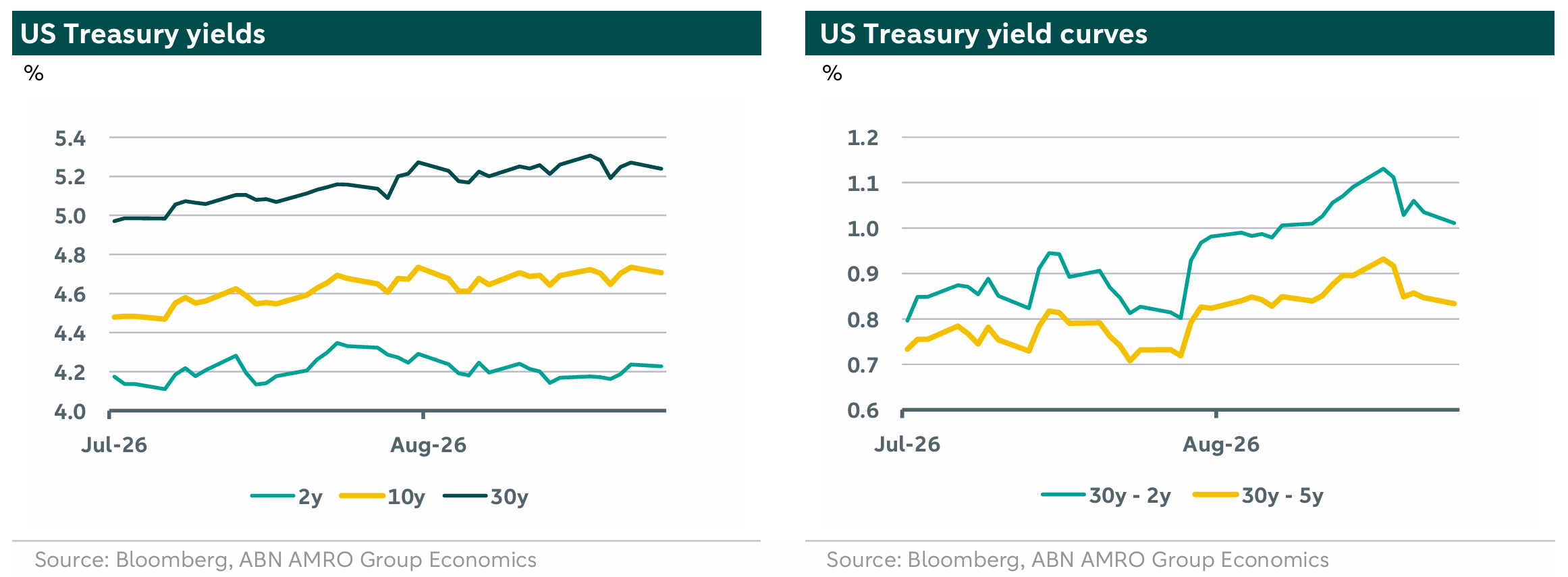
Since the start of July, yields have risen and curves have steepened significantly, with the 30y having risen just shy of 30bp over this period. Of course all this occurs against a longer-term background of rising yields more generally. For instance, earlier in the year, yields moved up as markets priced in more rate hikes on the back of rising energy prices and hence higher inflation. The key driver behind the more recent rise in yields appears to be the outlook for ongoing heavy bond issuance and the related terrible state of the US public finances. However, other factors such as uncertainty about the reaction function of the Fed and the competition provided by hyperscaler bond issuance seems to have also caused jitters. Meanwhile, expectations for policy rates have been volatile, but have not moved too much directionally since July. So the recent moves seem to be more term premium-led, which also corresponds to the steepening of the curve. Finally, the market got only temporary relief from the US Treasury’s interventions.
How is the Treasury intervening?
The US Treasury announced it would at least double the maximum size of its liquidity support buyback operations for US Treasuries with maturities between 10- and 30 years, to USD 4bn. This will start on the 9th of September and run until 4th of November. The move is another attempt by the US Treasury department to support the long end of the Treasury curve. So far this year, policymakers have taken several measures that have, directly or indirectly, tried to support longer-dated Treasuries, including: (i) increasing issuance at the short end of curve, (ii) facilitating JPY intervention, by selling EUR instead of USD, and by promoting the FIMA Repo Facility of the Fed for conducting currency interventions, as the Bank of Japan has done in the last few weeks (iii) increasing liquidity-support buybacks of long-term Treasuries.
Will the interventions work?
The Treasury’s interventions have had only short-lived effects because they lack the credible promise of overwhelming financial firepower. To put the numbers into context, the US Treasury plans to issue USD 69bn of 30y securities and USD 42bn of 20y over the next 3-months alone. There are three buyback operations of 20y to 30y securities planned over the period in question, so ostensibly we are talking about EUR 6bn additional in buybacks in that segment, while overall net supply will remain significant. What is more, over time, increasing buybacks would likely need to be financed by issuing more at shorter maturities, which will increase the refinancing risk of the maturing debt.
Would the Fed step in?
The Federal Reserve does have the balance sheet to make a more credible intervention in the Treasury market. Although new Fed Chair Kevin Warsh opposes bond purchases as a regular monetary policy tool, he did support their use as a temporary emergency liquidity measure to ease market stress during the financial crisis. So there could eventually be a point where the Fed steps in if market functioning becomes disorderly and starts to have broader consequences. This might be reminiscent of the Bank of England’s intervention in 2022 when it bought UK long-term government bonds and said purchases could ultimately be conducted on ‘whatever scale is necessary’.
UK government bond yields ultimately eased, but the moral of that story is not that central banks have a magic wand. The original trigger for rise in gilt yields was the Truss-Kwarteng mini budget, which announced unfunded tax cuts that spooked markets. What helped to return calm was that all these fiscal announcements were quickly reversed. In other words, a financial backstop helps, but you also need to tackle the fiscal fundamentals that were at the heart of the problem.
How bad is the US fiscal situation?
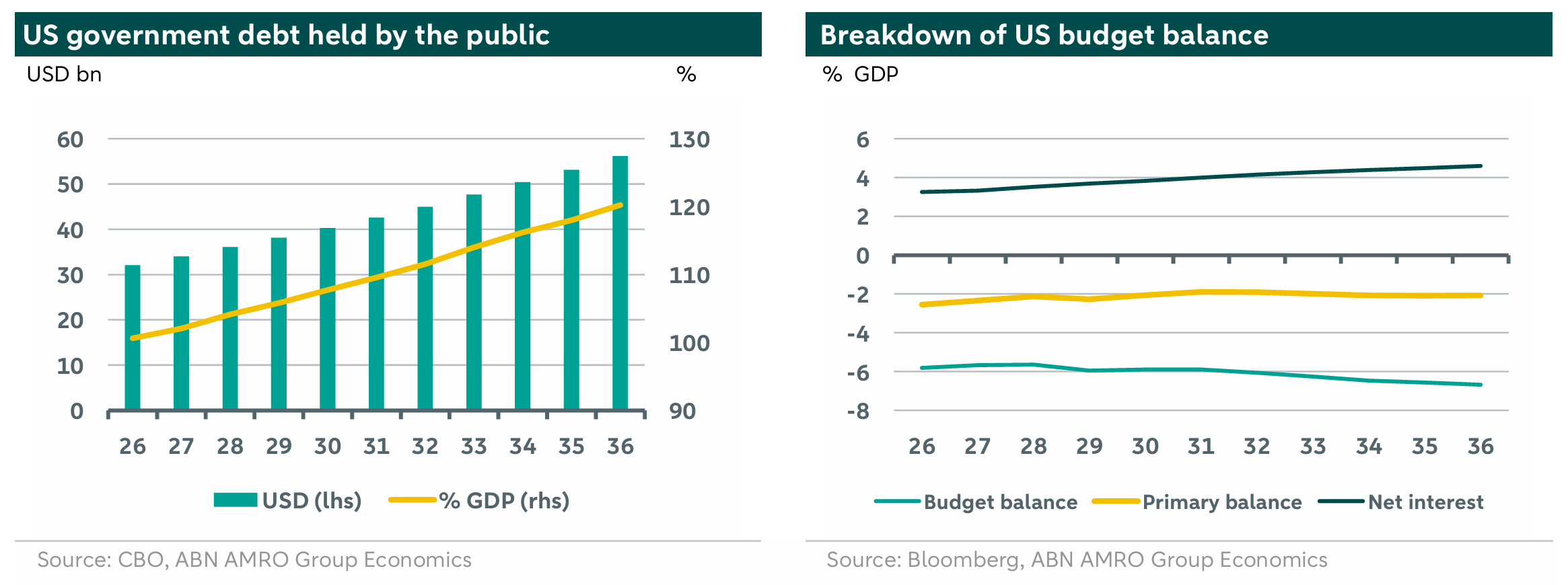
The current fiscal numbers are extraordinary given that the US economy is in economic upswing rather than a recession. According to the bi-partisan Congressional Budget Office, the budget deficit will climb from just under 6% GDP this year to just under 7% in 2036 and there appears to be very little appetite in Washington to tackle this situation. This means the Treasury market will likely grow from around 32 trillion dollars this year to 56 trillion over that time period, or from 100% to 120% GDP. Just to stabilise the debt ratio, a fiscal consolidation of 2.5-3% GDP would be necessary.
Will term premiums continue to rise?
Yes, term premiums (the additional yield that investors demand over and above the expected path for central bank rates) will likely to continue to rise. The fiscal trajectory means that there will continue to be strong bond issuance and investors will want to be compensated to absorb that. In addition, looking at the composition of the investor base, the proportion of price-sensitive investors has increased and may well continue to do so, meaning that higher supply might have a bigger impact on term premia. This is because the proportion of the Treasury market held by official institutions – domestically the Fed but also abroad by foreign reserve managers – has declined sharply over recent years. At the same time, we are in a period of greater uncertainty about the Fed’s reaction function given the changes to its communication strategy under new Chair Warsh.
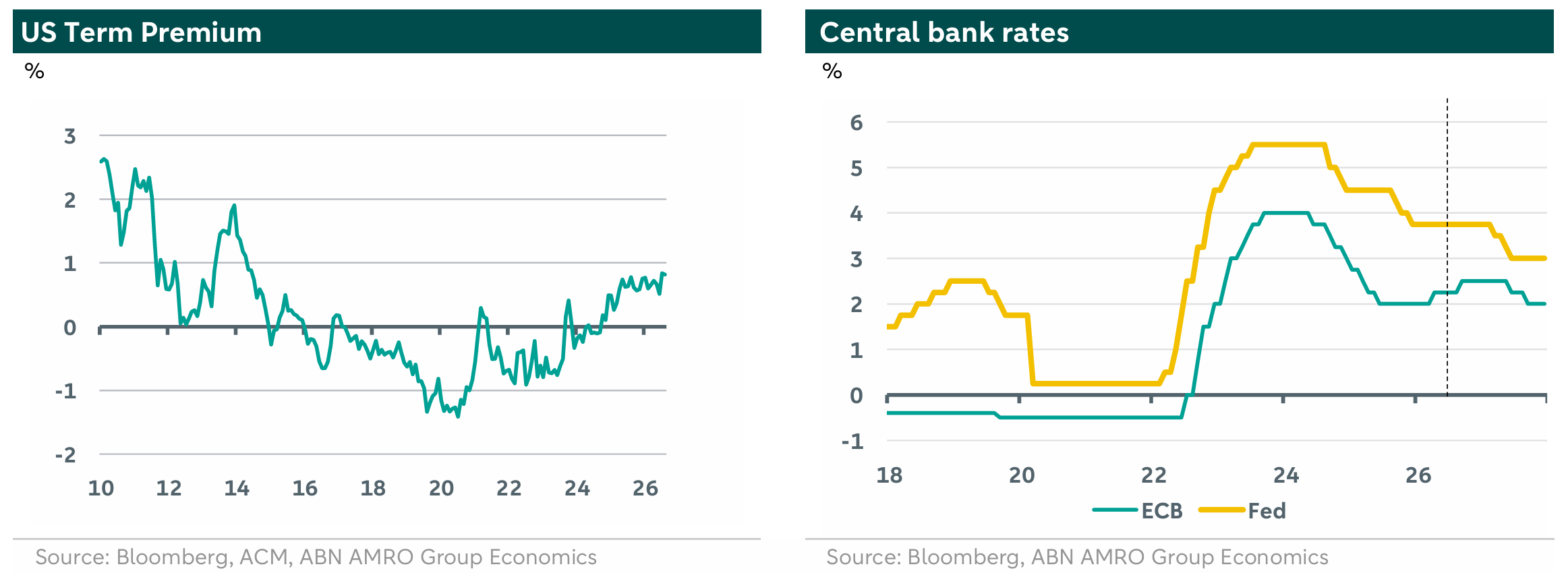
Finally, term premia on most estimates are not particularly high from a historical perspective currently. One well known measured developed by Fed economists (Tobias Adrian, Richard Crump, and Emanuel Moench – or ACM) currently stands at 0.8% for the 10y US Treasury note. It is worth noting that the long-term historical average of this series is 1.4%. So there appears to be scope for further rises in risk premia against this background.
What does all this mean for outright Treasury yields?
Treasury yields depend not only on term premia but also on market expectations for the future path of the Fed’s policy interest rates. And this is where there might eventually be some market relief. Markets are currently pricing in around 40bp of rate hikes over the next year. Our house view is that the Fed will be on hold over the coming months but will eventually cut interest rates from March of next year, with three rate cuts in total. This reflects our view that inflationary pressures will gradually ease, while the labour market will soften. The shift in interest rate expectations implied by our Fed view would have a strong downward impact on bond yields, offsetting the upward impact from rising term premia on balance. So we will likely see the impact of rising term premia in an ongoing steepening of the yield curve rather than higher outright yields in the coming months.
What is the situation in European government bond markets?
Term premia tend to be highly correlated globally, so one could expect an upward pull from US developments. More importantly, there are a number of European countries that are also stepping up bond issuance, while the Eurosystem continues to reduce its holdings. German government bond issuance is soaring this year and it will do so again next year. Although we expect term premia to rise and curves to steepen, as in the US, we also expect German government bond yields to decline over the coming months. Our base case for the ECB is one more 25bp rate hike in September, while eventually during the course of next year we expect it to reverse course with 50bp of rate cuts. In contrast, markets are expecting 60bp of rate hikes over the next year. So as in the US, the downward shift in interest rate expectations should offset the upward impact from rising term premia on balance on German government bond yields. Perhaps the bond market to watch most closely is France, where the poor fiscal outlook and political uncertainty will form a nasty cocktail driving its yields spreads over Germany higher. In addition, France is currently not eligible for the TPI, which is the ECB’s bond buying programme designed to come into action to curb unwarranted spread rises. This is because of the poor stated of the country’s public finances in general, but also because it is in the excessive deficit procedure.