Transaction Trends - Black Friday eats into Sinterklaas purchases
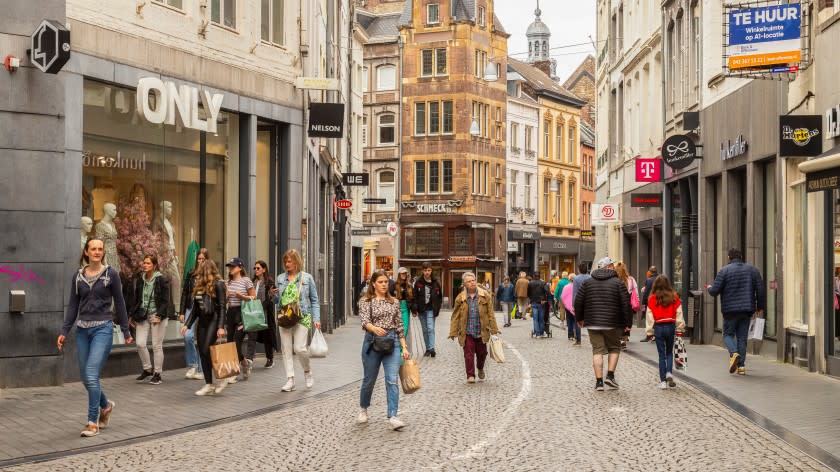
The Black Friday period is used by many Dutch people to make purchases, often with an eye on Sinterklaas and Christmas. During this period, consumers spend significantly more than in the past, when the days around Sinterklaas were still the main shopping days. To avoid peak pressure, more retailers are starting earlier in November with offering deals, primarily attracting customers through the internet.


Gerarda Westerhuis
Sector Economist
Black Friday, an annual shopping event originating from the United States, takes place on the day after Thanksgiving, the fourth Thursday in November. It marks the informal start of the holiday shopping season and is renowned for its major discounts. In recent years, the event has gained increasing popularity worldwide. Since around 2015, Dutch retailers have also participated in Black Friday, making the phenomenon increasingly visible to the Dutch public. How much additional consumer spending is actually generated around this imported 'bargain day'?
For this research, we use a consumer survey and anonymized and aggregated transaction data from ABN AMRO. We analyze how much additional consumer spending households make during the period around Black Friday in the years 2016 through 2024. For 2025, we have included the most recent data up to and including Black Friday.
Promotional days are important for the holiday
The December holidays remain popular among Dutch people. According to the consumer survey conducted by ABN AMRO and research agency Q&A Retail with 2,000 respondents, 80 percent of Dutch people celebrate Christmas and 48 percent celebrate Sinterklaas. Of those who celebrate Christmas, 72 percent plan to buy gifts, while for Sinterklaas, this percentage is even higher at 85 percent.
Black Friday and Cyber Monday are increasingly playing a significant role in the December holiday preparations. Only 23 percent of consumers expect not to make purchases during these promotional days for Sinterklaas or Christmas. In 2023, this figure was still 27 percent, according to the consumer survey.
Young adults up to the age of 35 are especially likely to take advantage of these discount opportunities for their December holiday shopping. Young adults celebrate the holidays more often than older generations and are also more likely to buy gifts for these occasions. This partly explains why younger generations make more purchases during Black Friday compared to older individuals.
Nearly 37 percent of consumers use Black Friday and Cyber Monday to purchase gifts for both Sinterklaas and Christmas. Interestingly, the proportion of people who shop exclusively for Sinterklaas remains relatively low, despite the promotional days taking place shortly before December 5th. Only 12 percent focus solely on Sinterklaas during these days, while 29 percent take advantage of the deals exclusively for Christmas.
Households spend significantly more on Black Friday
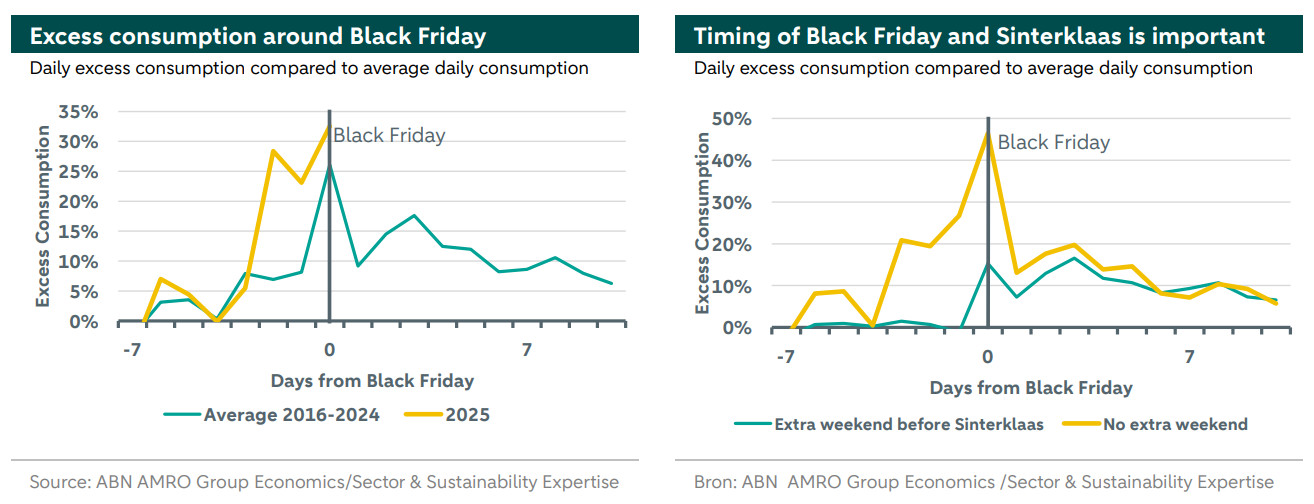
In the anonymized ABN AMRO transaction data, we indeed observe a clear spike in consumption on Black Friday. The graph below illustrates that households between 2016 and 2024 spent on average 25 percent more on Black Friday compared to the average consumption in the weeks prior to the Black Friday period. We refer to this as the ‘Black Friday consumption effect.’ Not only on Black Friday itself, but also on the surrounding days, we see higher consumer spending. There is a gradual buildup in the days leading up to Black Friday and an additional smaller peak on ‘Cyber Monday,’ the Monday following the weekend, which traditionally features significant online sales of electronics. The days after Cyber Monday still show elevated consumption, largely explained by the upcoming holidays, with Sinterklaas as the first in line.
This year, the peak on Black Friday is somewhat stronger than average, with approximately 30 percent additional consumption. What is more striking is that the Wednesday and Thursday preceding Black Friday were almost at the same level as Black Friday itself. The year 2025 thus appears to have been a strong year for Black Friday purchases. Since Black Friday fell relatively late this year, this was actually predictable.
When Black Friday falls late in November, this has two key effects. First, the average Dutch person has already received their salary a few days prior. This year, salaries were paid out on Tuesday. Salary payments always lead to additional consumption, something we account for in our analysis. This year, the ‘extra consumption’ on the salary payment day itself due to Black Friday was approximately 5 percent, while Wednesday and Thursday thereafter showed significantly higher consumption (see the left-hand graph below). Purchases clearly started after the receipt of salaries. The second effect of Black Friday occurring late in the month is that the bargain day falls shortly before Sinterklaas, leaving no extra weekend for making Sinterklaas-related purchases.
The timing of Black Friday with regards to Sinterklaas matters
The number of days between Black Friday and Sinterklaas varies each year. Black Friday always takes place on the day after Thanksgiving, while Sinterklaas is primarily celebrated on December 5th. When Black Friday falls on November 23rd, the earliest possible date in November, there are 12 days between the two events. In contrast, only 6 days remain when Black Friday occurs on November 29th, the latest possible date for Black Friday in November.
This variation has significant implications for consumer behavior. When Black Friday is closer to Sinterklaas, purchases are more concentrated around Black Friday; consumption is on average nearly 50 percent higher on Black Friday itself, compared to approximately 15 percent when there is an additional weekend between Black Friday and Sinterklaas. In other words, the ‘Black Friday consumption effect’ is significantly amplified when there is no extra weekend.
Black Friday and Cyber Monday are mostly an online phenomenon
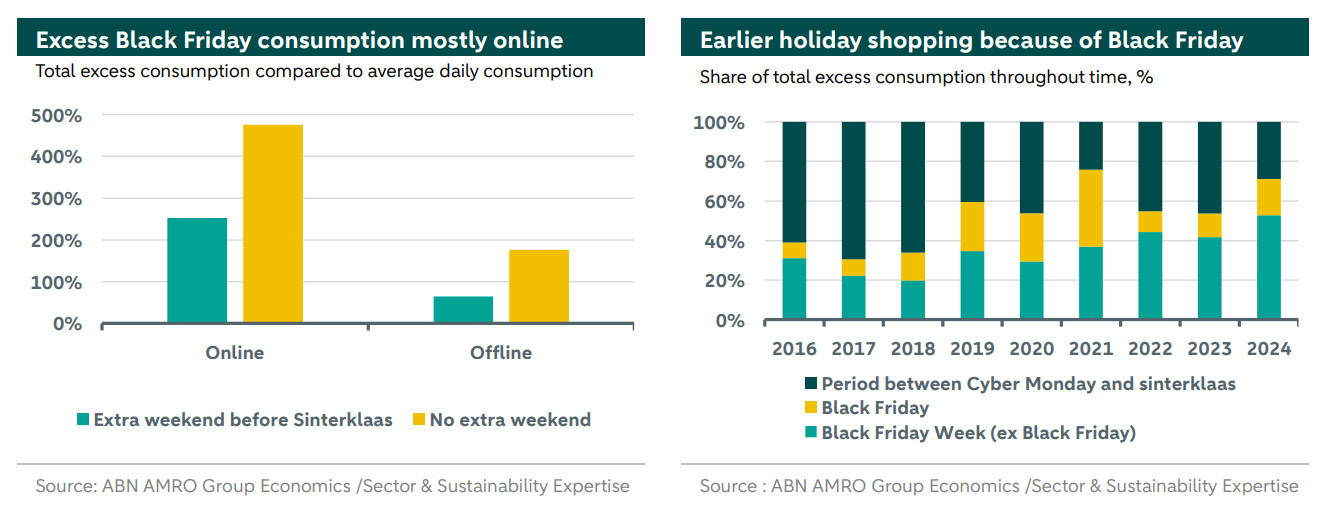
Although Black Friday in the U.S. was originally a predominantly offline phenomenon, our analysis shows that sales today largely take place online. In the left-hand graph below, we analyze the total extra consumption during the Black Friday period, again averaged over 2016–2024, with a breakdown between online and offline purchases. As with the graphs above, the data is expressed as the average consumption on one day; 200 percent therefore implies that the total extra consumption corresponds to the amount usually consumed in two days.
It turns out that the ‘Black Friday consumption effect’ applies to both online and offline purchases, with store visits being more popular when Black Friday falls shortly before Sinterklaas. In such cases, spending in physical stores is nearly three times higher compared to when there’s an extra weekend, while online purchases are only twice as high.
A shift in the moment of purchase
The right-hand graph above shows that the share of extra consumption on Black Friday itself and during the week before Black Friday has increased in recent years, at the expense of the period between Black Friday and Sinterklaas. While the share of extra consumption between Cyber Monday and Sinterklaas was still 60 percent in 2016, this has dropped to less than 30 percent in 2024. Adjusted for inflation, we see no significant increase or decrease in the total extra consumption over this period; instead, we observe a shift in the timing of purchases. From 2019 onward, Black Friday (the day itself) saw a surge, particularly during the COVID period. Since 2022, however, the peak on Black Friday itself has been significantly reduced, with purchases increasingly spreading to the week before Black Friday.
Nowadays, some stores begin their Black Friday promotions as early as Singles Day on November 11, or even starting from November 1 with Black November promotions. An important reason for the early start is to distribute the workload, allowing parcel delivery services to better manage the significant peak in the last quarter of the year. This extended period also makes it easier for consumers to spread out their holiday shopping.
The results for 2025 confirm all these earlier patterns. We observe that Black Friday has shifted from a sharp peak to a flat plateau of a longer purchasing period. Purchases began after salary payments and appear to be fairly well spread out. Total extra consumption seems high compared to the historical average but is largely consistent with other years where there was no extra weekend before Sinterklaas. Many of these purchases are found in the shoe today.