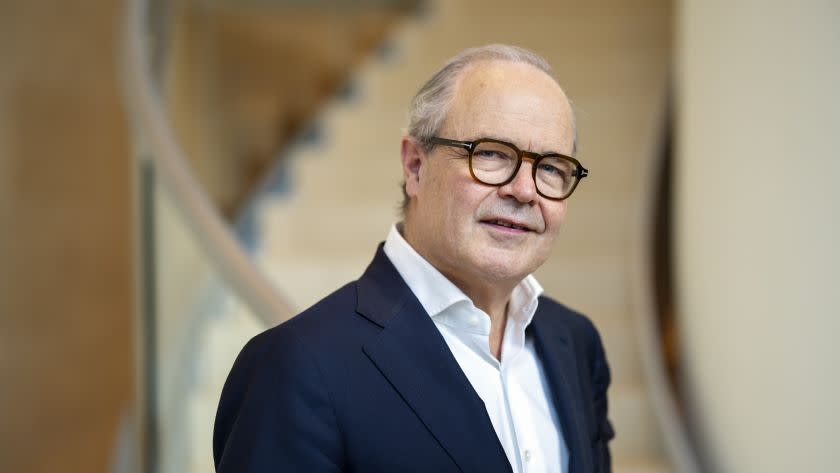
“The Risk department is now positioned closer to the heart of the bank”

Interview with our Chief Risk Officer
One year into her role as Chief Risk Officer, Serena Fioravanti reflects on achievements in 2025 and shares her vision of the bank as a ‘stable island’ in a volatile world. “Our de-risking is clearly bearing fruit and we are making significant progress on optimising our capital allocation,” she says. “Our stability and predictability give us the right to grow again.”
Looking back, how would you sum up your first year at the bank?
“It has been an intense but very rewarding year. We implemented the Basel IV capital rules and finalised the move to standardised credit risk approaches for certain parts of our portfolio. At the same time, we began reshaping the Risk organisation around its four strategic pillars: simplicity, execution focus, risks that matter and risk culture. This meant introducing a new organisational structure, shifting resources towards the capabilities we need for the future and supporting major strategic developments such as the integration of Hauck Aufhäuser Lampe (HAL) and preparations for the intended acquisition of NIBC.”
It was a turbulent year for global business. What’s your view on ABN AMRO’s performance in that environment?
“2025 was a good year for us. When the world around us felt unstable and geopolitics dominated the headlines, ABN AMRO provided stability and predictability. We experienced very few credit losses and even felt confident enough to lower our through-the-cycle cost of risk. This reflects our confidence in the quality of our loan book and our ability to weather economic downturns. In short, we proved we can be a stable island in an unpredictable environment, which earns us the right to think bigger, bolder and better – by taking selective, controlled risks that support the strategy.”
What is behind that stability?
“The de-risking of the bank is clearly bearing fruit: we now focus on markets in Northwest Europe that we know very well, our clients tend to be loyal and our portfolio is largely collateralised. Completing the work on Basel IV and on our credit risk models has also made our capital framework more predictable.
On top of that, we freed up risk-weighted assets (RWA), which is the basis for calculating how much capital weneed to hold against our loans. We achieved this by improving our loan data and through several portfolio optimisation transactions, including significant risk transfers. These transactions allow us to move part of the credit risk on corporate loans to institutional investors. It’s an effective way to contain our RWA and shift capital to areas that better fit our growth strategy.”
Talking about growth, how do you view the intended acquisition of NIBC?
“From a risk perspective, NIBC is a strong match for us. Most of its business consists of mortgages and savings products in our home market. The same applies to its corporate portfolio: it is focused on regions and sectors in which we already have a strong presence. We also work with similar systems and providers, which should support a smooth integration. Of course, we will look closely at the portfolio details and regulatory expectations, but overall it is a business that we know and can manage well.”
Which emerging risks are you most focused on?
“While we feel very comfortable with our financial risks – credit quality, capital and cost of risk – the non-financial risks are becoming more prominent and complex. IT resilience remains front and centre. But this now goes beyond cyber threats; it also includes the risk linked to third-party dependencies. Geopolitical tensions could force suppliers to change course, creating constraints around data, access or continuity. Not so long ago, this scenario would have been unthinkable. But the past year has taught us that we must be prepared, so that we can continue to serve our clients whatever happens.”
What role does Risk play in supporting the bank’s new strategy?
“Since joining in 2024, I have focused on making Risk Management a simpler and more execution-driven organisation that helps the bank grow. Risk used to be a quality assurance function at the end of the line. Today, we are an execution partner positioned right at the heart of the bank. We get involved earlier, and simplifying the way we work means we can deliver more effectively. In short, we have moved much closer to the business, helping the bank to take the right risks in the right places.”
This clearly echoes the first three pillars of the Risk strategy: simplicity, execution focus and risks that matter. The fourth pillar is risk culture. Why is this so important?
“Culture brings it all together. ABN AMRO has always felt like a family to me. People are collaborative, they invite each other in and they care. There is a strong culture of discussion and exchange, which encourages everyone to speak up. In Risk, we deal with everything from credit transactions and models to cyber risk, operational resilience and regulatory requirements. We cannot be experts on everything, so we need to rely on people with different skills and perspectives to bring important issues to the surface.
A sound risk culture also requires accountability and decisive leadership. You listen to the various points of view, then you make a decision and you stick to it. A tough but necessary decision we took last year was to reduce our workforce, which also affected Risk colleagues. That calls for accountability too – you need to be transparent and support colleagues as they move to new roles or career paths.”
In closing, what are your top priorities in the year ahead?
“We will support controlled growth by strengthening resilience to emerging risks, enabling capital-efficient growth and focusing on the risks that matter. By keeping things simple, making clear choices and executing decisively, we will help the bank move confidently into its next phase.”