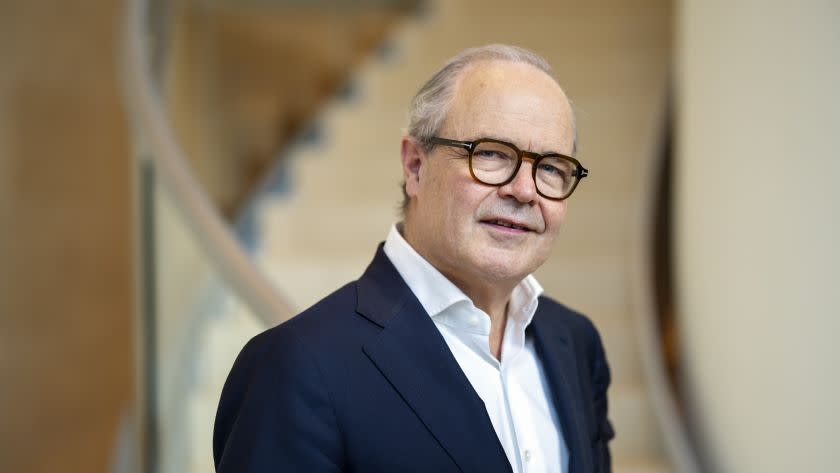
“We are definitely on the right path”

Interview with the Supervisory Board Chair
In his final interview as Chair of the Supervisory Board, Tom de Swaan looks back on an eventful year for ABN AMRO. He discusses the bank’s performance amid geopolitical turbulence and reflects on key developments, including the arrival of Marguerite Bérard as CEO, the new strategy and the intended acquisition of NIBC Bank. “In an uncertain world, ABN AMRO is doing very well – and we are clearly on track.”
2025 was a tumultuous year for global business. How do you look back on it?
“If we look at the world around us, the year was marked by continued uncertainty. We are seeing persistent conflicts in the Middle East, Ukraine and elsewhere, claiming casualties every day, and a new administration in the United States that is predictable in its unpredictability. What I’m most concerned about are the cracks in the international system we created after World War II to keep us safe. Institutions such as NATO or the United Nations – we all realise that these multilateral organisations are of vital importance to an open economy like the Netherlands.”
How do you view the bank’s performance in 2025 and what do you see as highlights?
“First of all, the impact of the global turbulence on ABN AMRO was relatively limited. We saw strong topline performance, helped by the benign macroeconomic environment in Northwest Europe. Costs are clearly coming under control and the bank’s capital optimisation is progressing well. For the Supervisory Board, the most important event was the arrival of Marguerite Bérard as the new CEO in April, which injected a completely new energy into the organisation. We are also very pleased with the closing of the acquisition of Hauck Aufhäuser Lampe (HAL) and the intended purchase of NIBC. All in all, the bank had a gratifying year that provides a great starting point for the implementation of the new strategy.”
What was the Supervisory Board’s role in creating the new strategy?
“After appointing the new CEO, which is an important task for a Supervisory Board, we were closely involved in shaping the strategy. Throughout the year, we had fruitful discussions with the broader leadership team about the new strategy, culminating in the Capital Markets Day at the end of November. The outcome is a strategy focused on profitable growth and value creation, which we believe is absolutely the right one for the bank. That said, it’s not rocket science. From strengthening our position in wealth management and Dutch retail banking to supporting family wealth and businesses and driving key European transitions, it’s essentially sharpening the strategy we already had. One of the differences is that our Clearing business has also become an important focus for ABN AMRO. I’m very pleased about that, because I think it’s a very good business. Clearing is an innovative financial product and a profitable and relatively low-risk activity that gives the bank a global dimension.”
You already mentioned the intended acquisition of NIBC. Was it an easy transaction for the Supervisory Board to approve?
“NIBC is an interesting deal from a financial point of view, and the strategic rationale is crystal clear as it further strengthens our leading position in the Dutch mortgage market. The Supervisory Board’s analysis of the transaction was relatively simple. NIBC is a Dutch savings bank with a large mortgage portfolio and a small corporate book, so their balance sheet is a very straightforward one for us. The whole transaction was completed within the space of three months, which included the summer month of August.”
How would you describe the new CEO’s initial impact on the bank?
“The reaction to Marguerite taking over as CEO has been very positive, both internally and externally, and her initial impact is impressive. The NIBC transaction demonstrated our talent and our ability to execute a transaction of this kind swiftly and to the satisfaction of all parties involved. Another example is how the bank has already started to deliver on its strategic priorities. The planned reduction of approximately 20% of the workforce by 2028 is well underway, which helps contain costs, and the progress made on optimising risk-weighted assets is promising. All these things add to the renewed vigour that I discussed earlier. And to be clear, I’m not referring to Marguerite alone. The entire leadership team is generating this new energy and has been able to feed it into the organisation.”
What should the Supervisory Board focus on in 2026?
“We need to establish a clear reporting system to keep track of how the strategy implementation is progressing. One of the vital things to watch is employee engagement, which is always at risk when you announce such a substantial workforce reduction. We must ensure that we maintain a pleasant work environment and preserve people’s willingness to put their best foot forward. The leadership team needs to keep explaining why it’s doing what it’s doing. Because change is not easy, and we are only at the start of the process.
The Supervisory Board will also continue to closely monitor the bank’s relationship with regulators and its efforts to contain risk-weighted assets. In 2025, the bank started using significant risk transfers to shift some credit risks to institutional investors and is increasingly benefitting from investments in data management. We are making meaningful progress, but we’re not there yet.
Other areas of attention in 2026 are the ongoing integration of HAL, the finalisation of the NIBC deal and the promotion of BUUT and BUX, which should help us attract new clients and boost fee income. All in all, we have a lot on our plate, but it’s a positive picture.”
In closing, how do you look back on your eight-year tenure as Supervisory Board Chair, and how do you feel about the future of the bank?
“I’ve enjoyed it, though it has been quite a ride. The bank has gone through tumultuous times, from the leadership changes prior to my starting to the anti-money laundering settlement and the pandemic, which required all of us to adapt to a new way of working. All credit to our people, who remained committed to the bank amid continuous change and disruption.
Looking ahead, I couldn’t be more confident about the future. We have an extremely capable leadership team, dedicated staff, a strong brand that people love and an increasingly outward-looking and entrepreneurial culture, culminating in a satisfactory 2025. We’re definitely on the right path. In that respect, it’s safe to say that my tenure is ending on an upbeat note.”