Euro core inflation set for jump, but should fall sharply next year
Core inflation rate in the eurozone to jump higher in August. On Tuesday, the flash estimate for eurozone inflation in August will be published. Global Central Banks: Successfully avoiding a tantrum. Despite a slowdown or even an end of asset purchases coming into sight, the Fed and ECB seem to have successfully avoided a ‘taper tantrum’


Euro Macro: Core inflation rate to jump higher in August - On Tuesday, the flash estimate for eurozone inflation in August will be published. The core inflation rate is expected to jump higher, to around 1.5%, up from 0.7% in July. Our forecast is in line with the consensus estimate. This expected jump in core inflation mainly stems from shifts in seasonal discount sales of clothing and shoes in a number of countries (e.g. Italy, France, the Netherlands, Belgium) in the summer of 2020, which temporarily reduced core inflation in July 2021. The decline in eurozone core inflation in July happened despite a jump in Germany’s (core) inflation rate that month, due to an upward base effect of the temporary cut in the German VAT rate in July 2020. In short, base effects from events that happened a year ago, are currently playing a dominant role in the eurozone core inflation rate.
The large impact of the base effects in the individual countries also became evident the first member states’ August inflation rates that were published today. To begin with, HICP inflation in Germany rose to 3.4% in August, up from 3.1% in July. The details have not yet been published, but regional data suggest that the rise was due to a rise in core inflation (to around 2.0%, up from 1.8% in July) and a further upward impact from energy price inflation. Next, Spain reported a jump in HICP inflation to 3.3%, up from 2.9% in July. According to Spain’s statistical bureau the rise was mainly due to higher energy price inflation, with the core rate rising by 0.1 percentage point to 0.7%. Finally, the first estimate for HICP inflation (only headline) in Belgium was a stunning 4.7% in August, up from 1.4% in July. Belgium’s statistical bureau mentions the shift in discount sales in 2020, as the main factor behind the jump.
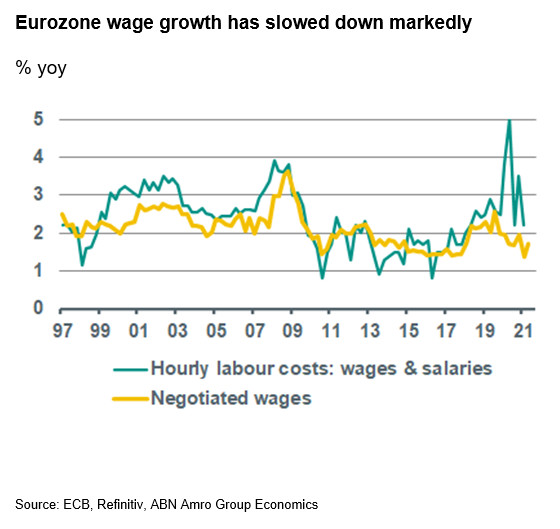
Looking ahead, core inflation is expected to remain elevated at a level of around 1.5% throughout this year. Base effects could continue to result in quite some volatility, particularly in November-December as new lockdown measures resulted in shop closures in a lot of countries the year before. As from January 2022 onwards, we expect eurozone core inflation to drop lower again, likely to levels below 1%. Importantly, the temporary factors mentioned above will drop out of the equation. More fundamentally, underlying inflationary pressures remain subdued as a lot of slack has built up the eurozone economy, most notably in the labour market. Indeed, employment still was 2.6 million below pre-pandemic levels in 2021Q2, despite the wide use of temporary employment schemes. In Germany and France combined some 2 million people still were in temporary employment schemes at the start of this summer. The large amount of slack in the labour market has also limited negotiated wage growth (the wage measure preferred by the ECB) since the start of the pandemic (see graph). We think that the downward impact on core inflation from economic slack will outweigh any upward impact from the recent rise in commodity and intermediate goods prices filtering through. (Aline Schuiling)
Global Central Banks: Successfully avoiding a tantrum - Despite a slowdown or even an end of asset purchases coming into sight, the Fed and ECB seem to have successfully avoided a ‘taper tantrum’. In our view, this reflects strong communication, which has credibly broken the link between the trajectory for a wind down in net asset purchases and higher policy rates. Indeed, in his Jackson Hole speech, Fed Chair Jerome Powell announced that ‘if the economy evolved broadly as anticipated, it could be appropriate to start reducing the pace of asset purchases this year’. However, far from a tantrum, financial markets reacted positively to the comments. This is because Mr Powell made it explicit that tapering does not signal that rate hikes are on the cards any time soon. He noted that ‘The timing and pace of the coming reduction in asset purchases will not be intended to carry a direct signal regarding the timing of interest rate lift off, for which we have articulated a different and substantially more stringent test’.
On the other side of the Atlantic, the ECB has also managed this process in a similar way. Asset purchases are unlikely to end next year as the APP will continue, but a wind down of the PEPP would imply a significant slowdown in the pace of net purchases. Nevertheless, over recent weeks, policy rate hike expectations have been falling. This reflects the ECB’s new forward guidance on policy rates, which has raised the bar for a rate hike. This was a point also made by the French central bank Governor today. Francois Villeroy noted that ‘Powell marked a disconnect in time on decisions on purchases and later on the rates, and he even suggested much later’. He went on to say that this ‘disconnection probably applies on both sides of the Atlantic’. We see the Fed policy rate remaining on hold until sometime in 2023, while the ECB’s policy rate could remain steady through 2024. (Nick Kounis)