Carbon Market Strategist - EU ETS review signals less scarcity and more industrial policy

The EU ETS review reduces long-term allowance scarcity while EU's climate targets remain unchanged. Supply-side reforms dominate the package, with changes to the cap trajectory and Market Stability Reserve potentially adding nearly 2 billion allowances by 2040. New sectors and activities increase EUA demand, but their impact is gradual and outweighed by additional supply flexibility. Energy-intensive industries, removals developers and Article 6 projects stand to benefit, while long EUA scarcity positions face pressure. We expect EUA prices to be at a lower level but remain structurally elevated with an upward trajectory if the review to be fully adopted. Prices are expected to reach 91 EUR/tCO₂ in 2030 and 164 EUR/tCO₂ in 2035 under the review scenario.

On July 17, the European Commission (EC) published its proposal for the long-anticipated review of the EU ETS. The review seeks to balance competitiveness concerns with the need to meet emission reduction targets. While the proposal still requires approval by the European Parliament and Council, markets have reacted positively, relieved by the clearer direction for Phase 5 of the EU ETS spanning 2030 to 2040. EUA prices initially surged by 9%, reaching 86.6 EUR/tCO2, before stabilizing around 82 EUR/tCO2 in the weeks that followed. Lower auction volumes, following the completion of REPowerEU funding, have continued to exert upward pressure on prices, while adverse weather conditions have reduced nuclear output during periods of heightened demand, increasing reliance on conventional fossil power generation and supporting prices. In the long term, the review is expected to moderate the upward trend in carbon prices, shifting focus toward industrial policies, subsidies, and targeted support mechanisms to achieve the 2040 climate target, rather than depending solely on carbon allowance scarcity.
In the following sections, we take a closer look at the changes to the supply and demand of allowances brought about by the review in the coming years. We also identify the sectors that are expected to benefit or face pressure as a result of these changes. Lastly, we present an overview of potential price impacts.
The EU ETS review
The review introduced several changes that have a lasting impact on the fundamentals of the EU ETS. The current proposal reshapes the market by implementing a less aggressive reduction in the supply of allowances, providing increased support for clean industries and the green transition, and adopting a more lenient approach to the Market Stability Reserve (MSR) and the allocation of free allowances.
More allowance availability
Specifically, the review proposes a reduction in the Linear Reduction Factor (LRF) to 3.7% for the period between 2031 and 2035, followed by 1.7% between 2036 and 2040 if international credits become available, or 2.7% if they are not, compared to the previous LRF of 4.4%. This lower reduction factor would lead to an increase in the supply of allowances compared to the current policy scenario, thereby lowering the expected rise in carbon prices in the coming years.
Additionally, free allowances are extended beyond 2030 with a stronger, conditional link to investments in decarbonization. This approach gives industries more time to complete their transition while at the same time encouraging them to invest in decarbonization efforts. Furthermore, the phase-out of free allowances for sectors covered by the Carbon Border Adjustment Mechanism (CBAM) has been slowed down, with the deadline extended to 2038 (previously set for 2034). These reforms are expected to lower projected EUA demand from industry and slow the pace of EUA price increases.
The review incorporates a plan to mobilize EUR 100 billion through the new Industrial Decarbonization Bank to support industries in their efforts to decarbonize and invest in cleaner technologies. Additionally, the proposal strengthens support for companies investing in the green transition while maintaining continued assistance for ensuring a fair transition across Europe. These measures are intended to accelerate the clean and industrial transition, which could reduce future demand for allowances if successful.
The proposal introduces two key changes to the Market Stability Reserve (MSR), which governs the flow of allowances between the reserve and the market. First, the annual intake rate of surplus allowances into the reserve is reduced from 24% to 12%, leaving more allowances in circulation, which again should dampen future carbon price rises. Second, the calculation of withdrawal and release thresholds is revised to provide greater flexibility, with the surplus threshold for assessing market tightness recalibrated to start at a lower baseline. Together, these adjustments increase allowance availability, reduce the scarcity effect of the reserve, and enhance market stability and flexibility. As a result, the MSR reforms are expected to smooth price fluctuations (keep carbon price increases in check), lower market volatility, and reduce uncertainty and risk premiums, fostering a more predictable and balanced emissions market.
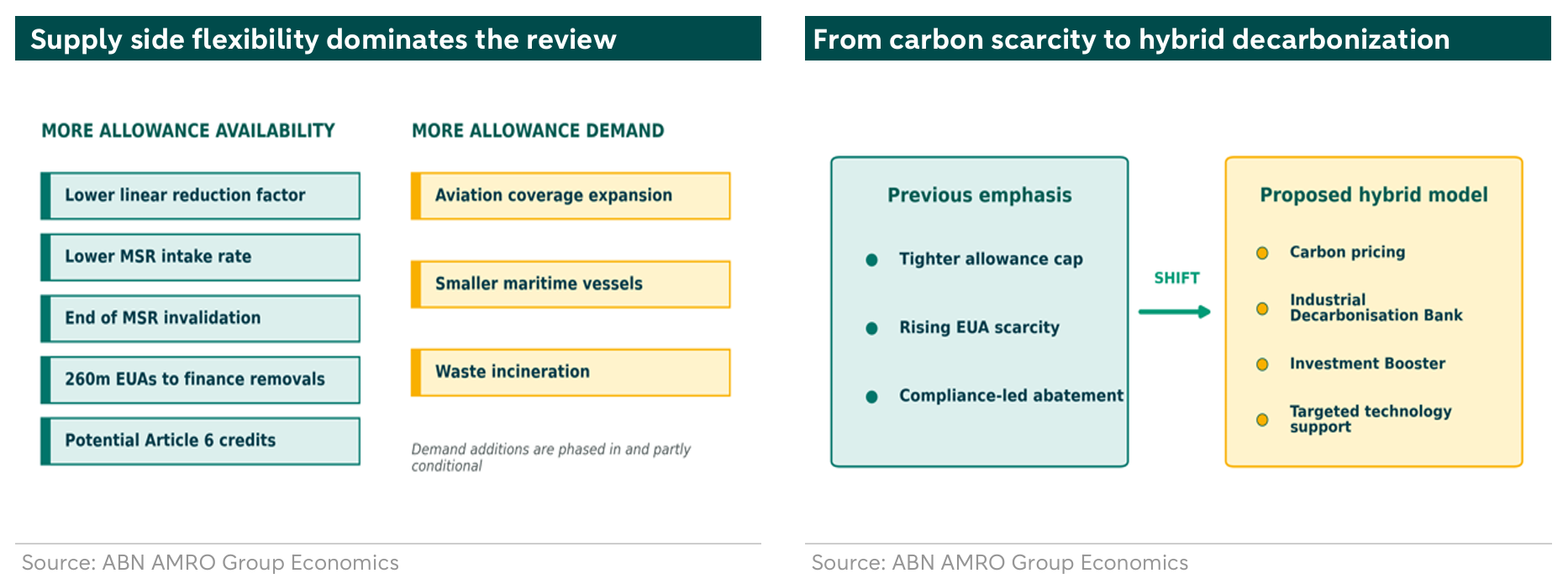
Moreover, the proposal introduces, for the first time, compliance-backed demand for permanent carbon removals within the EU ETS. Up to 250 Mt of CRCF-certified removals could be integrated between 2030 and 2040, financed through the auctioning of 260 million additional allowances. While this provides an important demand signal for BECCS and DACCS developers, it also increases effective allowance supply. Current estimates suggest that European removal capacity falls considerably short of the targeted volumes, suggesting that domestic supply of permanent removals may remain significantly below compliance demand during the early implementation years.
More allowance demand
The new proposal continues to exclude international flights outside the EU, UK, and Switzerland to support the development of the global Carbon Offsetting and Reduction Scheme for International Aviation (CORSIA). However, it expands coverage in two ways: starting in 2029, flights landing in countries within 5,000 km of the EU will be included to address competitive imbalances with non-EU hub airports, and business/private flights will be covered regardless of destination. A review in 2032 will assess the feasibility of full coverage, contingent on CORSIA's progress. Additionally, 110 million allowances are allocated to support the adoption of EU-produced sustainable aviation fuel (SAF), increasing demand for EUAs while simultaneously promoting SAF development.
Moreover, starting in 2031, waste incineration will be incorporated into the EU ETS, and maritime coverage will be expanded to include smaller vessels. These changes are expected to increase demand for EUAs, which could lead to higher EUA prices if the growth in allowance supply does not keep pace with the rising demand.
The review indicates growing openness to international carbon credits after 2035. The European Commission has proposed the possible purchase of up to 260 million tons of high-quality Article 6 credits between 2036 and 2040. While the specifics of implementation are still unclear, this proposal adds another layer of compliance flexibility, further easing the expected scarcity in the EU ETS. Additionally, it sends a significant long-term demand signal to emerging Article 6 markets worldwide.
Overall, the review appears to bring about a structural reduction in EUA scarcity. The adjustments to the cap pathway and the Market Stability Reserve (MSR) have a significantly larger impact on market balance compared to the removals provisions, potentially adding nearly 2 billion allowances by 2040, according to Sandbag estimates (). This substantial increase in allowances is likely to reduce the scarcity premium built into long-term EUA prices. Accordingly, the review signals a shift from a carbon-price-led decarbonisation model towards a hybrid framework combining carbon pricing, industrial policy and direct public support. The Industrial Decarbonisation Bank and Investment Booster imply that a larger share of decarbonisation costs will be financed through public mechanisms rather than exclusively through rising EUA prices.
Who are the winners and losers from the proposed review?
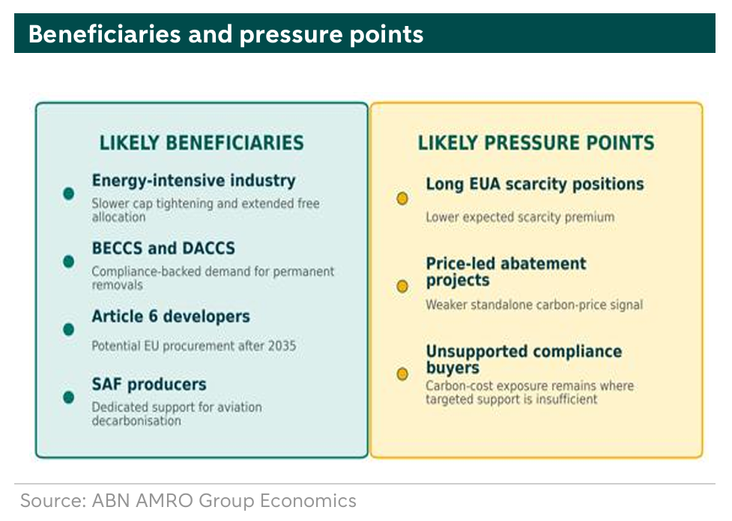
The review redistributes carbon market effects rather than removing compliance costs all together. Thus, it highlights clear winners and losers across the carbon market value chain.
Energy-intensive industries like steel, cement, chemicals, and refining benefit the most financially due to slower cap tightening, extended free allowances, and more flexible policies that lower compliance costs and slow down the rise in carbon costs. However, it could well slow their transition. Companies developing carbon removal solutions, such as BECCS and DACCS, also gain from the creation of up to 250 million tons of compliance-backed demand for permanent carbon removal projects. Developers working under Article 6 stand to benefit from potential future EU demand for high-quality international carbon credits. Additionally, producers of sustainable aviation fuel (SAF) may receive dedicated support linked to aviation decarbonization efforts.
On the other hand, investors and market participants focused on long-term EUA (European Union Allowance) scarcity could face challenges. Reforms such as a lower Linear Reduction Factor, changes to the Market Stability Reserve (MSR), and increased policy flexibility reduce expected scarcity and dampen the long-term premium on carbon prices. More generally, industries relying on high future EUA prices to justify their decarbonization investments may encounter weaker market signals. A growing portion of the transition effort is shifting from carbon pricing to subsidies, industrial policies, and targeted support mechanisms, which could impact their plans.
Impacts on long term price trajectory
In our revised Baseline outlook back in May (see here), we deliberately focused on the demand side of the market as uncertainty around EU ETS review was high until the review of the ETS was published in July. In this section, we reassess price impacts taking into account the most recent information regarding the review proposal and possible supply and demand impacts. We conduct our analysis using EUCPM 2.2 which integrates updated supply and demand dynamics within the EU ETS market as of 22 June 2026. We alternate assumptions regarding auctions and free allocations, which are derived using a bottom-up approach, to account for proposed changes under the ETS review. On the demand side, we utilize actual transaction logs that BNEF employs to project business-as-usual emissions. Additionally, we account for a further decline/increase in emission demand in relevant sectors, along with higher abatement costs due to the impact of the Iran war, and the inclusion of removals by 2030.
From a carbon price outlook standpoint, the review leans more bearish than bullish. Supply-boosting measures—such as the slower cap reduction, reduced MSR intake rate, increased flexibility through removals, and potential international credits—are clear and implemented early on. In contrast, demand-boosting measures, like the inclusion of aviation, shipping, and waste incineration, are introduced gradually and are partially conditional. Consequently, the review is expected to diminish some of the scarcity premium currently reflected in long-term EUA prices, while still supporting a price environment that remains structurally higher than today's levels.
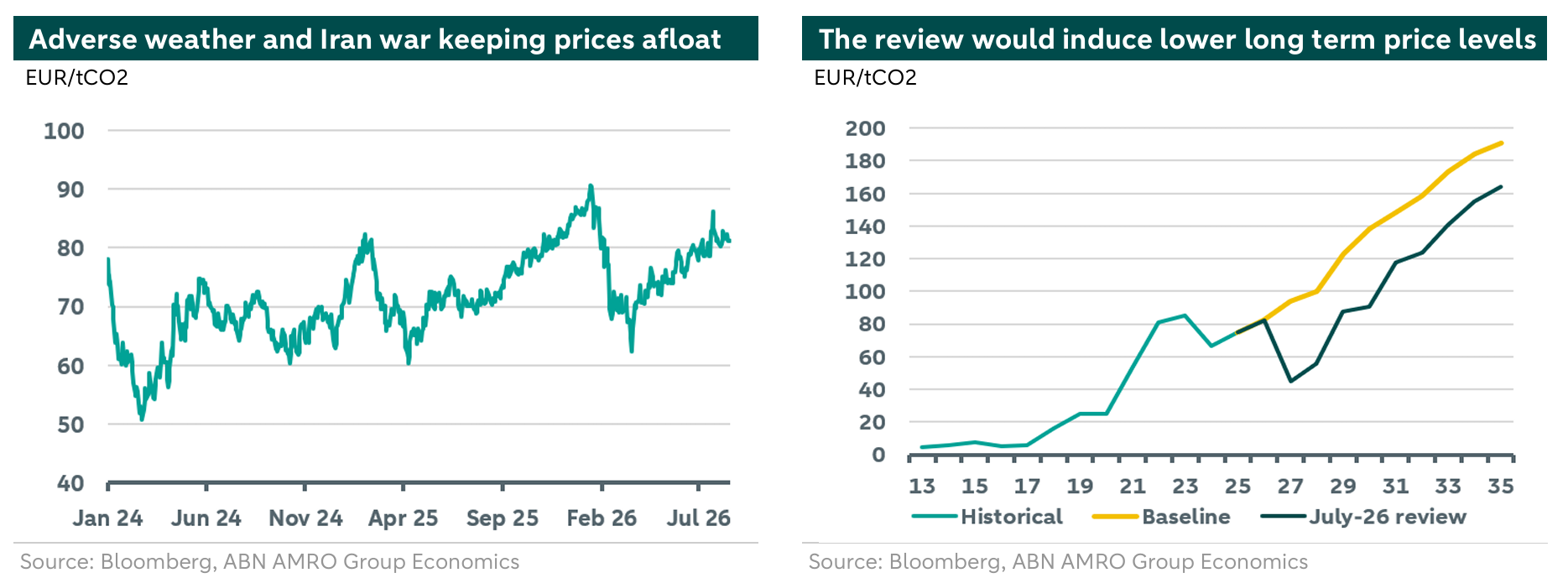
The chart on the right depicts EUA price outlook under our Baseline scenario in May and a full adoption scenario for the review in its current form assuming availability of international credits in late 2040. While EU ETS prices are still projected to rise in the coming years, the review reflects a slower trajectory, driven primarily by faster industrial transition, lower emissions demand, and less tight supply in phase 5 compared to the Baseline.
As anticipated, the review reduces EUA prices compared to our latest baseline. Prices are at a lower level but remain structurally elevated with an upward trajectory, driven by the unchanged 2040 climate target and the inclusion of additional sectors in the system. Specifically, under the review, EUA prices are now forecast to reach 91 EUR/tCO2 in 2030, compared to 138 EUR/tCO2 in the May baseline, and 164 EUR/tCO2 in 2035, versus 191 EUR/tCO2 previously projected. The plunge in 2027 and the larger impact visible by 2030 compared to 2035 reflect the immediate repricing of long-term scarcity expectations by the market rather than the physical supply effect of the reforms, most of which occur after 2030.
Short-term outlook
The market has reacted positively to the proposed review, as the clearer supply-side outlook reduces uncertainty and enhances market stability. However, the short-term outlook remains shaped by geopolitical tensions and weather-related factors. On the supply side, the cessation of the last tranche of the REPower EU feeding into auctions has led to a 20% drop in auction volumes, exerting upward pressure on prices. Simultaneously, heat waves and low river levels have constrained nuclear output during peak demand periods, prompting a shift toward conventional generation, increasing gas and allowance demand, and sustaining price levels.
Carbon prices may continue to receive support in the coming months as elevated European gas prices persist, especially with the approach of the heating season, if the Strait of Hormuz remains disrupted with vessel flows slow to normalise. Furthermore, demand is set to rise ahead of the surrender deadline at the end of September, particularly as 2026 marks the transition to 100% compliance obligations for maritime shipping emissions and the phase-out of free allocations for intra-European aviation, boosting net surrender demand. Consequently, the carbon market is expected to remain vigilant, monitoring developments around the Iran war and adverse weather conditions. Based on these dynamics, we have upheld our Q3 outlook, with EUA prices forecast to average 83 EUR/tCO2 in Q3 and 86 EUR/tCO2 in Q4, translating to a yearly average of 82 EUR/tCO2 for 2026. Despite existing challenges, we anticipate the carbon market to stay above 80EUR/tCO2 in early 2027, pending further clarity on the adoption or amendment of the proposed review by the European Parliament and Council.