Carbon Market Strategist - Revised outlook amid anticipated structural shifts

The initial surge in EUA prices in 2026 is reversed as sentiment shifted due to the upcoming ETS review and geopolitical tensions. We revise our Baseline long term outlook downward to 138 EUR/tCO2 by 2030 and 191 EUR/tCO2 by 2035 due to weaker demand and heightened geopolitical uncertainty. Linking the EU and UK ETS in 2028 would slightly lower prices, while carbon removals inclusion in 2031 would trigger a sharp drop in prices before recovering by 2035. EUA prices for 2026 are revised downward, to an average of 82 EUR/tCO2, reflecting weaker demand, geopolitical volatility, and policy-driven market uncertainty.

Introduction
The European carbon market started 2026 on a strong upward trajectory, driven by expectations of tighter supply and robust demand. However, this momentum shifted as sentiment changed in anticipation of the July 2026 review of the Emissions Trading System (ETS), which became increasingly politicized. Discussions within the European Commission (EC) and among policymakers focused on potential interventions in the EU Emissions Trading System (EU ETS) aimed at alleviating pressure on struggling industries. Meanwhile, rising tensions in the Middle East introduced additional uncertainty regarding demand projections. Consequently, EUA prices have declined in recent weeks, reflecting expectations of slower demand growth, more lenient implementation, and less aggressive supply tightening. Overall, these developments are set to have a structural impact on the fundamentals of the EU ETS in both the short and long term, necessitating a reassessment of the market outlook.
In this note we revise our long-term outlook for EU ETS allowances under several scenarios using Bloomberg's EU ETS Carbon Pricing Model (EUCPM 2.1). Our motivation for using this model is outlined in our previous long term outlook here. We limit our analysis to three scenarios based on several market and regulatory developments that took place since our last forecast in September 2025. We start with changes to our Baseline scenario followed by two scenarios reflecting the linkage between UK ETS and EU ETS and the inclusion of carbon removals. We end this note with a revision to our short-term outlook.
Baseline scenario
Our Baseline scenario, EUCPM 2.1 integrates updated supply and demand dynamics within the EU ETS market as of March 2026. Since precise changes in supply remain uncertain until the review of the ETS is published in July, we base our analysis on BNEF’s assumptions regarding auctions and free allocations, which are derived using a bottom-up approach. On the demand side, we utilize actual transaction logs that BNEF employs to project business-as-usual emissions. Additionally, we account for a further decline in emission demand, reflecting a slower growth in European GDP, along with higher abatement costs due to the impact of the Iran war.
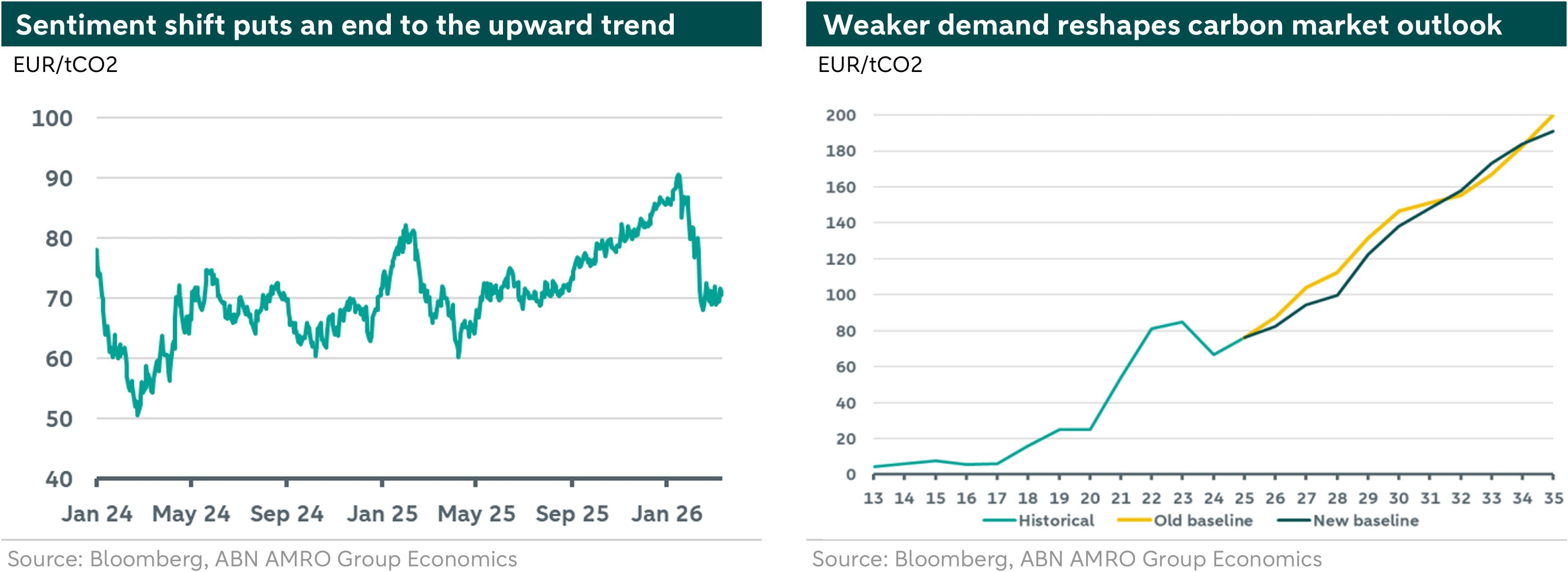
The chart on the right compares the old and new Baseline outlooks for EUA prices. While EU ETS prices are still projected to rise in the coming years, the revised Baseline reflects a slower trajectory, driven primarily by lower emissions demand, which outweighs the reduction in auctioned allowances compared to the old Baseline. Prices are now forecast to reach 138 EUR/tCO2 in 2030 (previously 145 EUR/tCO2) and 191 EUR/tCO2 in 2035 (previously 200 EUR/tCO2).
UK-ETS linkage and inclusion of carbon removals scenarios
Since September 2025, efforts to link the EU ETS and the UK ETS have progressed towards detailed technical negotiations. After the May 2025 "Common Understanding," the European Commission received formal authorization from the EU Council in late 2025 to initiate discussions. These talks focus on aligning regulatory frameworks, particularly as both systems will expand to include the maritime sector in 2026 and prepare for the rollout of their respective Carbon Border Adjustment Mechanisms (CBAM). Although establishing a full link remains complex, recent developments highlight a mutual commitment to mitigating carbon leakage and ensuring price stability between the markets.
At the same time, the integration of carbon removals into the EU ETS has reached a pivotal legislative stage. In February 2026, the European Commission adopted its first delegated regulation under the Carbon Removals and Carbon Farming (CRCF) framework, introducing certified methodologies for permanent removal technologies such as Direct Air Capture (DACCS) and Bio-CCS. This regulatory groundwork is essential for the Commission’s July 2026 review, which will evaluate how certified negative emissions can be incorporated into the ETS market. The policy debate, further intensified by the EU’s new 90% net emission reduction target for 2040 adopted in March 2026, centers on "limit and learn" approaches. These strategies aim to allow hard-to-abate industries limited use of removal credits for compliance, while prioritizing direct industrial decarbonization as the primary goal.
The remaining of this section outlines the results of two scenarios and their price impacts compared to the new Baseline. The first scenario assumes that the linkage between the EU ETS and UK ETS will take place in 2028. Assuming no Carbon Pricing Support (CPS) in the UK power sector, based on recent regulations that have abolished the CPS. The second scenario considers the inclusion of carbon removals starting in 2031, as these removals are expected to play a key role in Phase V of the EU ETS. By 2031, removals will be essential for balancing residual emissions from hard-to-abate sectors to meet the EU's 90% net reduction target for 2040.
Results on the left chart below show that linking the EU ETS and UK ETS in 2028 would lead to slightly lower EUA prices compared to the new Baseline scenario. This is due to increased allowance supply and arbitrage between the systems, with UK ETS's lower marginal abatement costs causing price convergence. Impacts are felt as early as 2026 as the model accounts for emission reductions from the UK Marginal Abatement Cost Curve (MACC) two years ahead of the implementation year. Overall, the price change reflects shifts in allowance supply, demand, and the Market Stability Reserve (MSR).
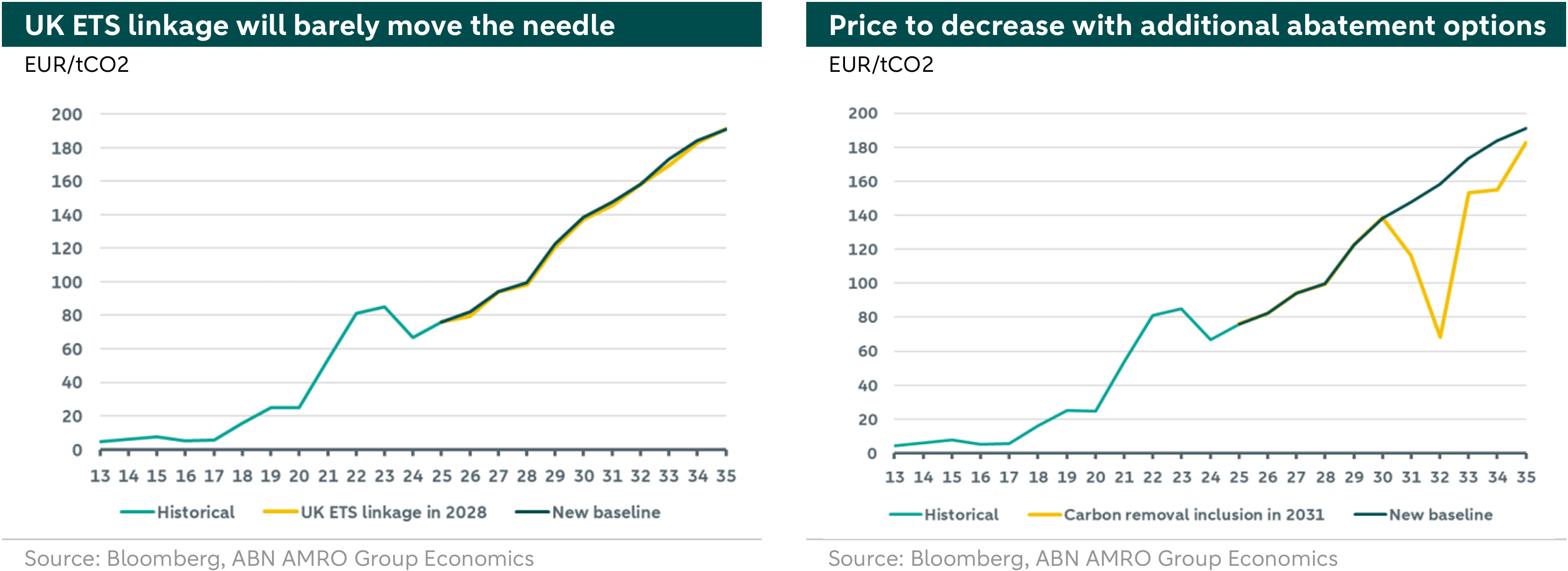
The right chart shows that EUA prices remain consistent with the Baseline scenario until removals are introduced in 2031. At that point, removal projects—particularly cheap nature-based solutions—are allowed for emission reductions, introducing cheaper abatement options into the MACC. Integrating carbon removal credits into the EU ETS reduces allowance prices by increasing compliance options and lowering demand for allowances. The inclusion would lead to a temporary price collapse, dipping to 68 EUR/tCO2 in 2032 under the removals scenario in comparison to the new Baseline, reflecting a liquidity shock as cheaper removal credits act as a compliance "safety valve" against allowance scarcity. Prices then converge back to 183 EUR/tCO2 by 2035 as the tightening cap exhausts low-cost removals, driving prices higher to meet the marginal costs of deep industrial decarbonization.
Short-term outlook
As mentioned in the introduction, 2026 has taken an unexpected turn, as several developments have shifted market sentiment, halting the previously upward trend in EUA prices. Weakening demand outlooks across most sectors, compounded by the ongoing Middle East conflict, have fueled uncertainty, dampened confidence in sustained demand growth, and introduced significant volatility into the emissions market. Accordingly, the EU ETS has been dominated by geopolitical volatility, thin liquidity, and policy-driven repricing, with prices oscillating between the low-60s and high-70s EUR/tCO2. Structural liquidity weakness has heightened sensitivity to headlines and positioning flows rather than compliance demand.
At the same time, political pressures to ease EU ETS stringency have grown, with discussions surrounding benchmark freezes, MSR reforms to prioritize price stability, and proposals to fund industrial decarbonization via ETS allowances, such as the EUR 30bn “Investment Booster.” While these policy signals confirm the EU’s commitment to emissions trading, they also indicate increased flexibility and reduced tolerance for high carbon prices, further influencing market dynamics and investor sentiment.
Given the recent developments, we expect the carbon market to remain in a “standby” mode in the coming weeks, closely monitoring the Iran war and potential regulatory or policy changes. As a result, we have revised our carbon price outlook downward for Q2 2026, with EUA prices now projected to average 80 EUR/tCO2 (was 83 EUR/CO2). While current challenges persist, we anticipate the upward trend to regain momentum in subsequent quarters as uncertainty diminishes. However, this recovery is expected to be slower than previously forecast, reflecting a more significant reduction in demand. EUA prices are expected to average 83 and 86 EUR/tCO2 for Q3 and Q4, respectively. This would entail an average of 82 EUR/tCO2 for 2026.