Rates Strategist - How do oil and gas shocks impact bond markets?

Due to the war in Iran, oil and gas prices have risen significantly since the start of this month, resulting in falling equity prices and rising bond yields across the globe. The way in which both, ECB expectations and the bond market respond to an oil and gas price shock varies depending on the situation (see for example chart below). In this note, we aim to disentangle how different oil and gas shocks impact ECB expectations and Bund yields, based on available academic research. This helps market participants to understand what to expect from Bund curves in the short- and long-term following an oil or gas shock.

Energy shocks influence market participants’ ECB expectations and Bund yields differently depending on the type of shock
Oil shocks that are demand‑driven push rates sharply higher, while inventory (speculative) oil shocks trigger flight‑to‑quality declines
Oil supply shocks raise inflation and thus ECB expectations, but the accompanying growth drag limits the magnitude of longer‑term yield increases
Gas supply shocks are more inflationary and persistent than oil shocks, creating a stronger “gas premium” in Bund yields over time
Gas shocks initially cause muted or slightly negative Bund yield reactions due to slow inflation pass‑through, before driving a sustained rise in both short‑ and long‑term yields
Current market dynamics suggest an oil-led supply shock dominates, implying short‑term bear‑flattening followed by potential bear‑steepening as gas‑driven inflation slowly materializes
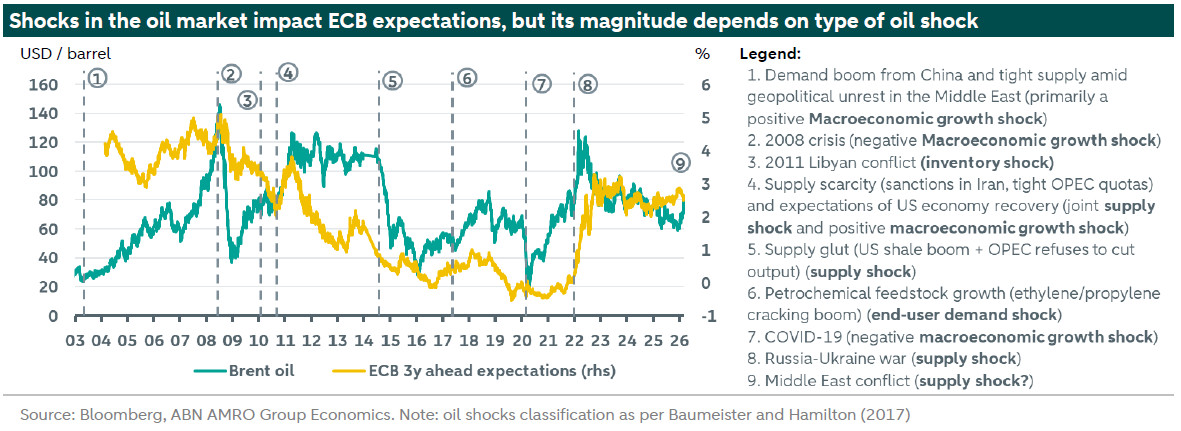
How do different oil shocks move rates?
Baumeister and Hamilton (see note ) split oil shocks into four categories: an oil supply shock, an economic activity shock (which we will hereby refer to an macroeconomic growth shock), an oil consumption demand shock (which we will call end-user oil demand shock), and an inventory demand shock (which we will call inventory shock).
The table below summarizes the difference between each shock.
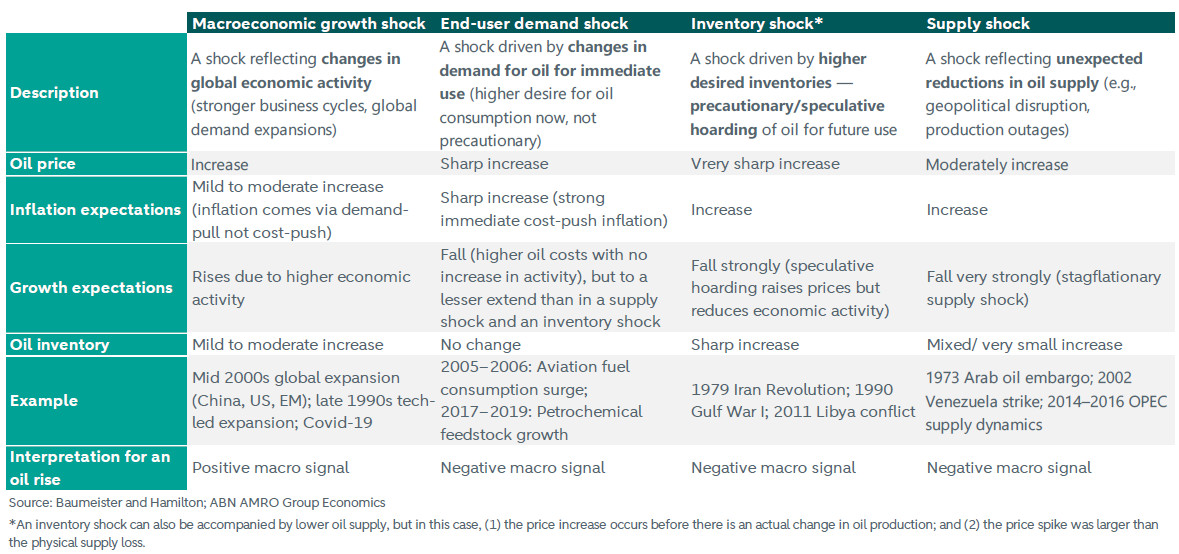
Using Baumeister and Hamilton’s classification of each shock, the current situation in the Middle East could either point to an inventory shock or to a supply shock. A supply shock only occurs when there is a physical decline in oil production, while the inventory shock occurs when market participants expect future disruptions in the oil market and begin to stockpile oil today. When the conflict broke out, it would perhaps fit better into the inventory shock. However, the inability to move oil across the Strait of Hormuz resulted in a real decline in oil production as storage facilities quickly filled up. That would imply the conflict quickly moved to become a supply shock.
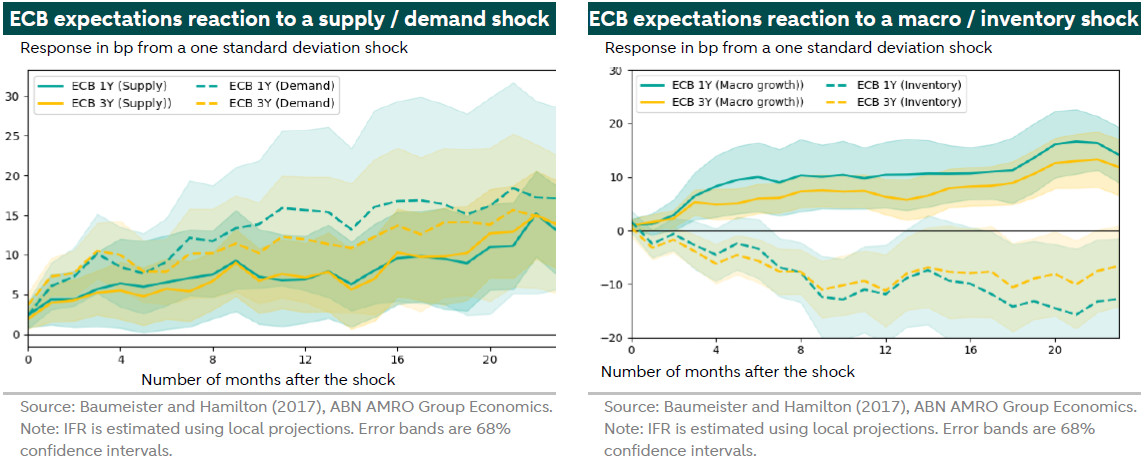
By using Baumeister and Hamilton methodology for quantifying oil shocks, we use an impulse response function (IRF) to understand the response of the 1y and 3y ECB expectations, as well as the 2y and 10y Bund yield to the four oil shocks. The idea is to understand the movement in market participants’ expectations for ECB policy rates when there is a positive one standard deviation movement in the shock series. The shock series is derived by Baumeister and Hamilton using a combination of historical data on for example, oil prices, economic activity and oil production.
We will first start with ECB expectations. This is summarizes below.
Macroeconomic growth shock: A macroeconomic growth shock produces the strongest and cleanest upward reaction in ECB rate expectations. Both the 1‑year and 3‑year horizons jump immediately and remain elevated, with the 1‑year rising more sharply. The response is also front‑loaded: markets price in most of the adjustment in the early months, followed by a plateau and only a mild secondary drift upwards. The reason is straightforward: this type of shock raises both (demand-pull) inflation and growth expectations, implying the expectations for a more aggressive (and earlier) rate hike cycle to both reduce inflation and cool down the economy. Short‑term policy expectations respond more because the ECB is assumed to act rapidly to prevent overheating. Longer‑term expectations also rise, but to a lesser degree, as markets anticipate that growth normalizes further out and that much of the policy action will be concentrated in the near term.
End-user demand shock: Under an end-user demand shock, there is a gradual, but large increase in ECB rate expectations, both in the 1y and 3y. This type of shock has a large and more persistent impact on inflation, while the growth contraction is less than in other shocks.Hence, markets expect higher policy rates for longer, which is why the 3‑year response ends up larger than under either a macroeconomic growth shock or a supply shock. The 1‑year still reacts more than the 3‑year in the initial phase, reflecting the ECB’s tendency to respond quickly when inflation pressure increases. As the economy slows down, the immediate need for ECB to tighten diminishes. However, because this slowdown is milder than in the other shocks, policy rates still need to be set higher than in the other scenarios.
Inventory shock: This is the only shock generating a clear and immediate downward jump: both 1y and 3y ECB expectations drop sharply in the first months. This reflects the classic mechanics of precautionary or speculative inventory build‑ups: they are associated with risk‑off sentiment, heightened uncertainty, and downward revisions to growth prospects. Investors shift into safer assets, pushing down yields and increasing expectations of a looser monetary policy stance. The shock also signals a risk of weaker long‑term economic performance, which weighs on the 3‑year horizon as well. Because the shock directly lowers both growth expectations and risk appetite, the downward shift occurs quickly and is sustained across horizons.
Supply shock: An oil supply shock leads to a gradual increase in both 1y and 3y ECB expectations. Under such a shock, inflation rises, which pushes ECB expectations up, but the accompanying drag on growth is the strongest among the shocks considered. As a result, although the ECB is expected to tighten policy in the short term to address higher prices, markets also anticipate that the central bank will be more cautious further out because of the negative impact on economic activity. This “look‑through” behaviour—tightening in the near term while leaning less heavily on future policy—explains why the 3‑year response is smaller. The overall rise in ECB expectations is also smaller than in the end‑user demand shock or macroeconomic growth shock because the inflation impulse is partly offset by weaker growth.
Next, we will examine the behaviour of the 10y Bund and the 2s10s curve steepness. Our findings are summarized below and shown in the charts on the next page.
Macroeconomic growth shock: The macroeconomic growth shock generates a clear divergence between long‑ and short‑term German government bond yields. Both, the 10y and 2y Bund yields rise immediately, but the 2y rise is more pronounced as markets expect a forceful, front‑loaded ECB tightening cycle (consistent with a demand-pull inflation). This produces a classic bear flattening, perfectly mirroring the ECB IRFs: short‑term expectations react aggressively to overheating demand, while long‑term yields increase more moderately as markets anticipate eventual normalization of growth. Later in the cycle, when markets start to expect the ECB to move to a loosening monetary policy cycle, yields start to fall and the curve begins to bull steepen.
End-user demand shock: The end‑user demand shock results in the largest rise in long‑term Bund yields, consistent with the strongly inflationary nature of this shock in the ECB IRFs. The 10y Bund yield increases steadily, while the 2s10s spread tightens, showing that the curve bear flattens as short‑term yields catch up due to expectations of a prolonged period of elevated policy rates needed to counter persistent inflation. The flattening is less pronounced than in a macroeconomic growth shock as markets expect a less tight monetary policy, consistent with a shock that pushes inflation higher for longer while growth softens only gradually.
Inventory shock: The inventory shock produces a characteristic flight‑to‑quality reaction: the 10y Bund yield drops sharply, and the 2s10s spread widens, generating a bull steepening. This is directly parallel to the ECB IRFs, where this was the only scenario delivering an immediate and broad-based decline in rate expectations. As time passes, the long end continues to fall more than the short end, reflecting weaker long‑run growth expectations and fading prospects for policy tightening. After several months, the curve begins to bull‑steepen modestly, as the short term declines at a slower pace than the depressed long end.
Supply shock: The oil supply shock pushes both the 10y Bund yield and the 2s10s spread higher - a reaction to the shock pushing ECB expectations higher. However, the magnitude of such rise is lower than in the end-user demand shock, and more gradual than in the macroeconomic growth shock. As we explained in the ECB expectation section, this is a result of a shock that lowers growth while also rising inflation - the latter to a lesser extent that a shock resulting in demand-pull inflation. The curve undergoes a bear flattening: short‑term yields face upward pressure from inflation concerns, while long‑term yields rise less because markets expect weaker long‑run growth due to the negative economic drag of higher energy costs. The mildness of both the rise in yields and the flattening matches the ECB interpretation that central banks “look through” supply-driven inflation when growth risks intensify.
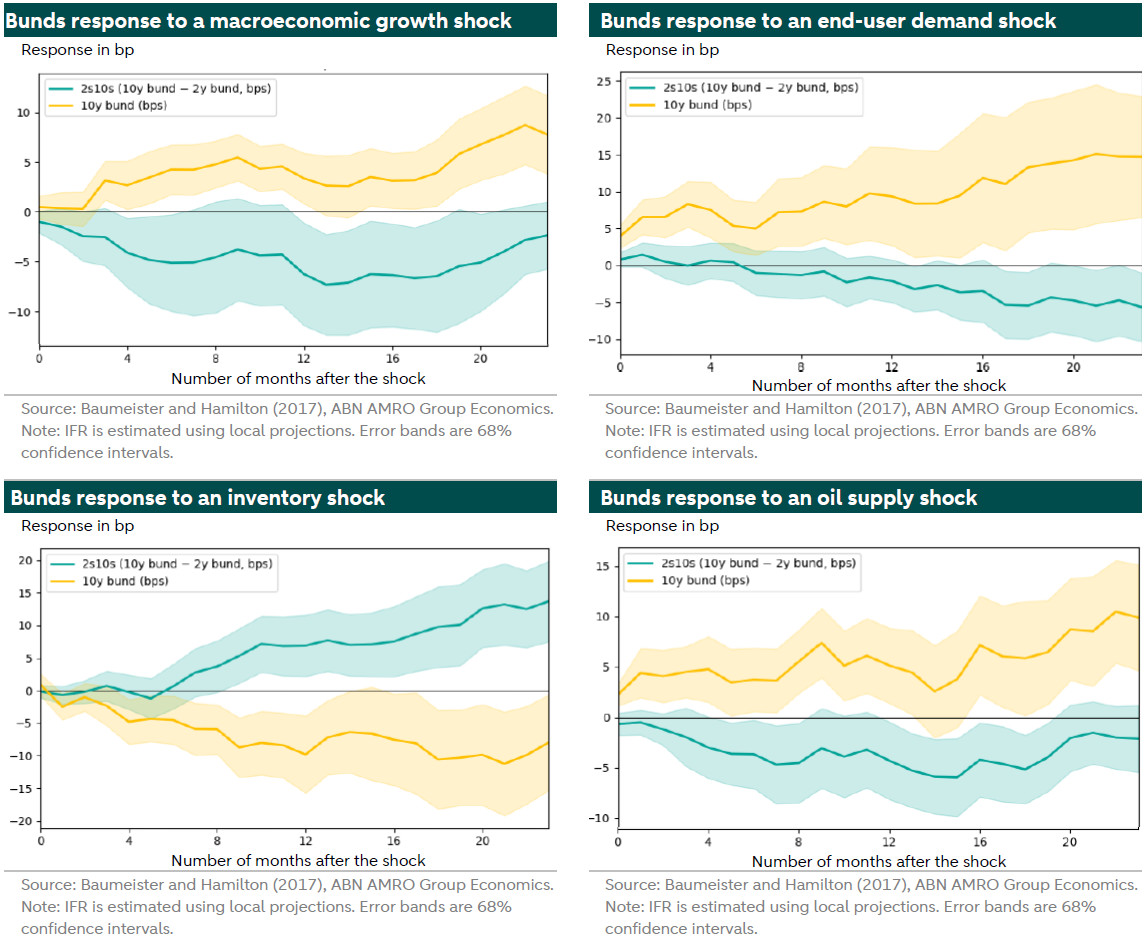
The IRF exercise also allows us to isolate the impact of the oil shock into Bunds. For example, in the case of an oil supply shock, we would see 10y Bund yields drifting around 5bps wider following the first 12 months after the shock. This implies that, all else equal, the Bund yields are 5bps higher than at the moment of the shock, and this difference is caused only by the structural shock itself (all other layers of the shock – risk sentiment, policy rates, liquidity for instance – are disregarded). Such analysis allows us to quantify the “oil premium” isolated from, for example, higher ECB expectations.
What about gas shocks?
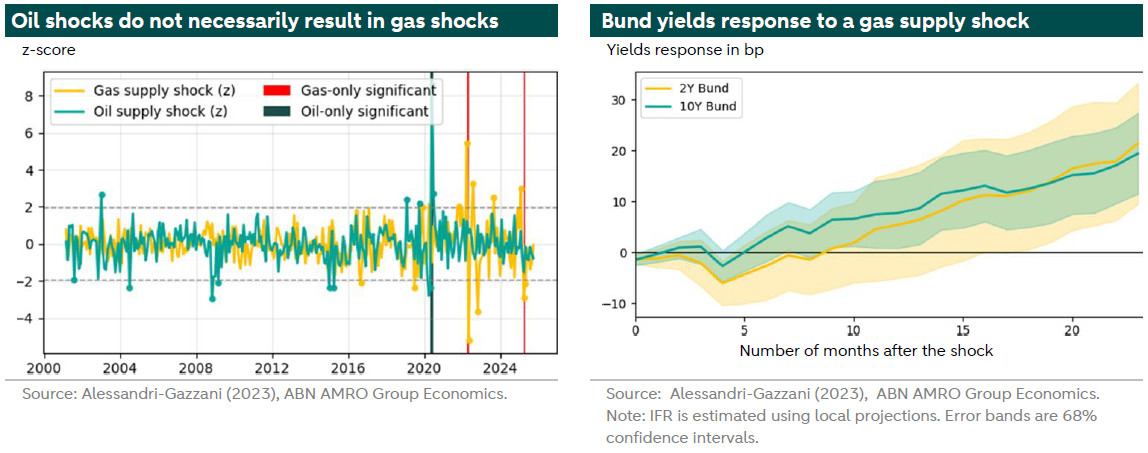
Lastly, we move away from oil in order to analyse the impact of higher gas prices. The latter is relevant as there are periods where the energy shock is restricted to only one of the two markets. For example, in 2020, extreme volatility in oil prices during COVID and Saudi-Russia price dispute resulted in a shock in the oil market, which was not accompanied by a shock in the gas market. On the other hand, the Russia-Ukraine war in 2022 caused a major gas supply shock while the impact in the oil market was significantly milder (see left chart below).
For this part of the analysis, we use the methodology of Alessandri-Gazzani (2023) () for estimating gas supply shocks. According to the authors, a negative supply shock (lower supply, higher gas prices) has a stagflationary effect on the eurozone economy, with larger propagation to core prices (inflation) than when compared to oil shocks. The latter occurs because of the immediate impact of gas prices on electricity prices. More specifically, electricity prices rises three times more under gas shocks than after oil shocks (see Alessandri-Gazzani, 2023).
Not surprisingly, our conclusions are very similar to the ones under an oil supply shock. There are two key differences when comparing oil supply shocks with gas supply shocks. First, the “gas premium” is significantly higher than the “oil premium”. That implies that the impact of a gas shock on Bund yields is more pronounced than in the case of an oil shock. That makes sense given the higher importance of gas price movements into inflation (see Alessandri-Gazzani, 2023).
Second, in the case of a gas shock, the immediate market reaction is a slight decline in Bund yields and ECB expectations, resulting in a mild bull steepening, although the reaction is relatively noisy. Alessandri-Gazzani (2023) attribute that effect to the slow propagation of gas supply shocks (aided by features of the gas markets, such as contract indexation seasonality, retail price regulation and storage dynamics). Hence, according to the authors, energy inflation and core inflation only peak around 12 to 24 months after the gas shock, respectively. Because inflation pressures emerge slowly, the policy rate reacts sluggishly. That is aligned with the ECB stance back in 2022 deeming the inflation to be transitory. With muted monetary policy response, markets might price some flight-to-quality or growth concerns, which results in a quiet or slightly negative response of Bunds in the first months following the shock.
Beyond 6 months, however, the response becomes more pronounced, whereby both, 2y and 10y yields start to rise. That occurs as the higher energy prices start to pass through, gradually but long lasting. This results in a gradual but constant rise in ECB expectations, pushing Bund yields up. Furthermore, the curve also bear steepens, with the 10y Bund yield rising more than that of the 2y. That is because the inflation persistence increases long‑term inflation expectations, which mechanically drives up the term premium rather than triggering immediate ECB policy reaction, pushing the 10y bund yield up more than the 2y.
It is important to note that our conclusions are not distorted by the 2022 gas shock. We reach the same results when separating pre‑ and post‑2022 shocks. Alessandri‑Gazzani also show their findings are not driven by 2022, given that they broad sample and obtain the same qualitative results even when excluding that year. Since our Bund and ECB responses align with the inflation and growth dynamics documented by Alessandri–Gazzani, we can confidently conclude that our results are not distorted by the 2022 episode.
Conclusion
As we previously noted, current market dynamics suggest that we are likely facing both an oil supply shock and a gas supply shock, with the impact up until now dominated by the oil‑led shock. This aligns with the price projections from our energy economist under a scenario in which the conflict in the Middle East proves long‑lasting (see here). That is also supported by the observed market reaction following the conflict outbreak: the rise in Bund yields and in ECB policy expectations immediately after the conflict broke out is consistent with the behavior typically observed under an oil supply shock. If a gas supply shock had been the dominant driver, we would normally expect at least a temporary flight‑to‑quality, especially at the long end of the curve.
As such, if the conflict remains unresolved for longer than anticipated, markets should expect the yield curve to bear‑flatten sharply in the short-term (which already occurred, see ), and that flattening should likely to persist for several months. As the conflict drags on and higher gas prices gradually feed into core inflation—as gas supply shocks tend to have a larger but slower pass‑through to underlying inflation than oil shocks—yields would be expected to continue rising, eventually giving way to a bear steepening once inflation pressures become more entrenched.