China - Exports support growth, supply-demand imbalances still rising

Real GDP growth slowed to 3-year low of 4.5% y/y in Q4 as expected, annual growth of 5% ‘on target’. Divergence remains: Exports and industrial production solid, offsetting weak investment and retail sales. Risks around fragile US-China truce resurface; targeted support shifts from consumption to investment.

Real GDP growth drops to three-year low in Q4-2025
As expected, real GDP growth slowed further in Q4-25 to a three-year low of 4.5% (Q3-25: 4.8%), in line with our and consensus expectations. Quarterly growth picked up slightly, to 1.2% q/q s.a. (Q3-25: 1.1%). Full-year GDP growth in 2025 came in at 5.0% (same as in 2024), in line with the growth target and our forecast. The contribution of net exports to growth in 2025 was reported at around one-third, the highest since 1997. Going forward, we assume quarterly growth in the first half of 2026 to benefit somewhat from the (filtering through of) targeted stimulus amidst still solid export growth. We expect full-year growth to slow to 4.7% (was 4.6%) in 2026 and 4.4% (4.3%) in 2027.
December data point to rising supply-demand imbalances
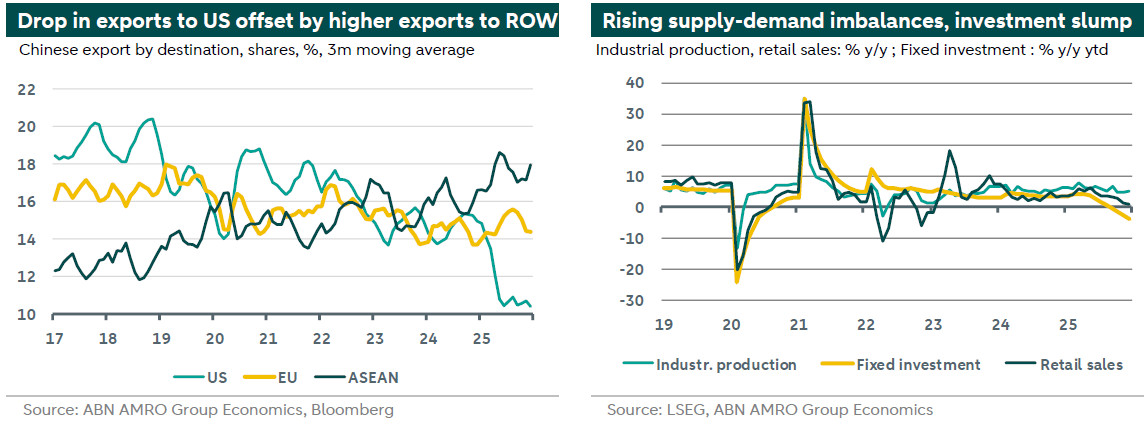
December macro data were a mixed bag, pointing to rising supply-demand imbalances. PMIs indicated a pick-up in momentum, with the two composite PMIs improving both for the first time since September (see here). Construction was a key driver, reflecting the filtering through of targeted stimulus. Foreign trade came in stronger than expected. Export growth rose to 6.6% y/y, with trade rerouting/diversification to non-US markets still more than offsetting the drop in exports to the US. Over the whole of 2025, direct exports to the US are down by 20% (with the US export share falling to ±10%), but exports to ASEAN and the EU are up by 15% and 8%, while China’s overall trade surplus rose to a record USD 1.2trn. Imports also beat expectations (+5.7% y/y in December), despite ongoing signs of weak domestic demand. Retail sales slowed further to a post-pandemic low of 0.9% y/y. The supply side remains much stronger, with industrial production accelerating to 5.2% y/y . Meanwhile, the property sector is still in the doldrums, with the annual slump in both property investment and residential property sales deepening further. The unemployment rate was steady at 5.1%. On the inflation side, CPI rose to a 3-year high of 0.8% y/y, driven by base effects from end-2024 and a correction in food prices, but remains low. Core inflation was steady at 1.2% y/y. Producer prices stayed in deflation territory (for the 39th month in a row), although the annual pace of deflation eased, to -1,9% y/y.
Stimulus will likely remain ‘targeted’; shift from consumption to investment support
Last October’s agreement between Trump and Xi marked the continuation of a US-China truce, with tariffs cut and chokepoint restrictions (rare earths, semiconductors) postponed – also check our 2026 Outlook and podcast. Risks around this fragile equilibrium remain, with for instance Trump’s recent 25% tariff threat to countries trading with Iran. What is more, the recent US intervention in Venezuela, and US tensions with NATO partners around Greenland, may affect Beijing’s calculus regarding Taiwan, although we believe one-on-one comparisons between US/Venezuela (or Greenland) and China/Taiwan are flawed. In our base case, we still expect the US-China trade truce to remain broadly in place in 2026. As China’s export engine still functions, we stick to our view that we should not expect a support ‘bazooka’, but adherence to targeted stimulus – with the focus shifting a bit from consumption support to investment support (also see here). We also expect more piecemeal monetary easing in the form of mini policy rate and RRR cuts.