China - Growth momentum improves; more targeted support coming

Some signs of improving growth momentum, as fiscal support is filtering through. Beijing comes with some additional targeted support measures to safeguard growth. Trump and Xi preserving the guardrails; EU-China trade relations at a critical juncture.

Some signs of improving growth momentum, as fiscal support is filtering through
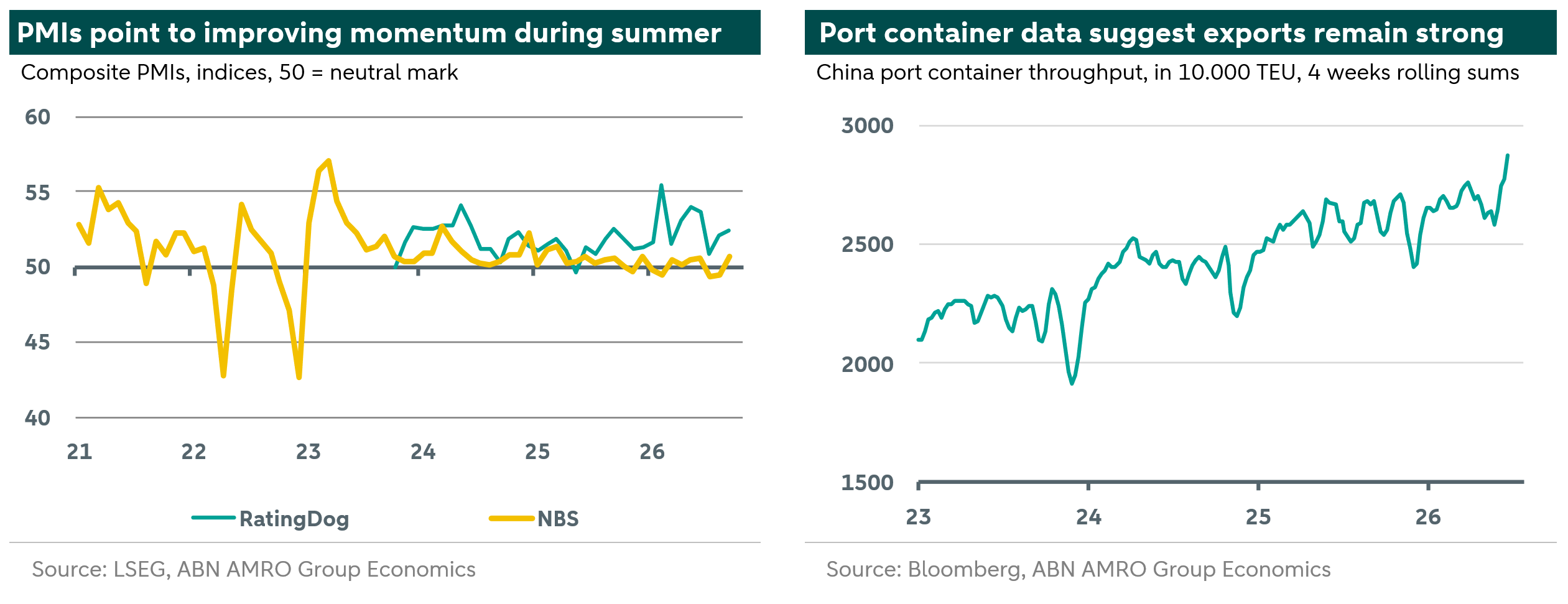
Following relatively weak July/August data, recent PMI surveys point to improving growth momentum over the summer, as witnessed by a recent pick-up of the composite PMIs from both NBS and RatingDog. Both composite PMIs are now back in expansion territory, for the first time since June. The filtering through of government support (after ‘fiscal underdelivery’ in Q1) is a driver of this: the official construction PMI rose by 3.4 points in September after hitting a post-pandemic low in August. Tailwinds from the global AI/tech boom continue: export and import growth remains strong, and port container throughput data point to a clear pick-up in September. Still, the latest macro data show rising imbalances, with industrial production accelerating, retail sales slowing, and the investment slump deepening. On the energy front, oil imports recovered further in August, but remain well below pre-Iran conflict levels. Meanwhile, China reintroduced some export restrictions on refined oil products per 1 October, adding to global supply shortages.
Beijing comes with some additional targeted support measures to safeguard growth
Policymakers have recently tweaked their support stance somewhat, to ensure annual GDP growth will remain within the target zone of 4.5-5.0%. Recent official communication shows Beijing changed its stance from ‘implementing existing measures more fully’ to ‘come with a package of practical, effective additional policies to safeguard the goals for 2026’. The government will allow local governments to tap unused bond issuance quota from last year, and will likely approve additional bond issuance in Q4. The PBoC will expand some of its facilities to stimulate lending to infrastructure/technology (sectors included in the Six Networks infrastructure scheme), agriculture and SMEs, and will cut the rate on its pledged supplementary lending facility. A subsidy to first-time homebuyers should help to stabilise property markets. All in all, we think these additional measures, while a step in the right direction, remain targeted, and are more about safeguarding growth rather than forcefully strengthening demand/tackling imbalances.
Trump and Xi preserving the guardrails; EU-China trade relations at a critical juncture
As expected, the Trump-Xi meeting in Washington last month did not produce major breakthroughs and was more about ‘preserving the guardrails’, but at least confirmed both superpowers do not want to re-escalate tensions sharply now. The tariff/chokepoint truce was extended for only two months, but this could be extended further in follow-up meetings. Another goodwill sign came from a tariff reduction deal on USD 60bn for non-sensitive items such as farm products (an additional 7.5% overcapacity tariff has been delayed). In Europe, France and Germany joined forces by urging Brussels to take further steps against oversupply (‘China Shock 2.0’), including the possibility to cut access to EU markets if necessary. Meanwhile, the EU itself is considering import quota for hybrid cars. All this takes place in the run-up to bilateral talks after Brussels imposed an October deadline for tackling imbalances. While risks on this front are rising, and we will keep assessing EU-China trade relations, we still think Brussels will choose a gradual, tailored approach rather than a full-blown tariff war, given different intra-EU views and China’s options to retaliate harshly.