US - Narrower inflation, broader hiring

The downward revision of PCE inflation exceeded expectations, and showed pressures narrowing. The labour market is solid, but not hot. Hiring is becoming less concentrated. The latest data gives no urgency for the Fed to hike, and we continue to see one last hike in December.

Inflation pressures are becoming less widespread, while job creation is broadening beyond the few sectors that previously accounted for most gains. The common theme is improving breadth: fewer sources of inflation, and a wider range of sectors contributing to employment growth. At the same time, upward revisions to GDP confirm that activity has been more resilient than previously reported.
Second quarter GDP growth was revised up from 1.5% to 2.2%, reflecting stronger investment, government expenditure and consumer spending. The latter is now estimated to have grown at its fastest pace since the end of 2024. Together with an upward revision to first quarter growth, this raises our estimate for annual average growth, although it does not materially alter our outlook for the economy ahead.
The August PCE report provided further positive news. Headline and core PCE inflation rose by 0.31% and 0.25% m/m respectively, but the main development was a long-awaited methodological update. Revisions to computer software and accessories, portfolio management fees and legal services lowered the latest core inflation reading by 0.36 percentage points. This brought (core) inflation substantially closer to target, although it remains some distance away. Momentum also looks decidedly better: three-month annualised inflation is now running at around 2%, compared with 3% for the July reading under the previous methodology. While a decomposition into supply and demand driven inflation shows a gradual shift to more demand forces in play, we see inflation breadth narrowing, not just because of the revision, but even on the full revised series. The weighted share of categories running above 3%, a measure often cited by Fed Chair Warsh, declined substantially. Even if headline inflation strictly speaking increased in August relative to the revised July figure, the underlying pressure is much more narrow.
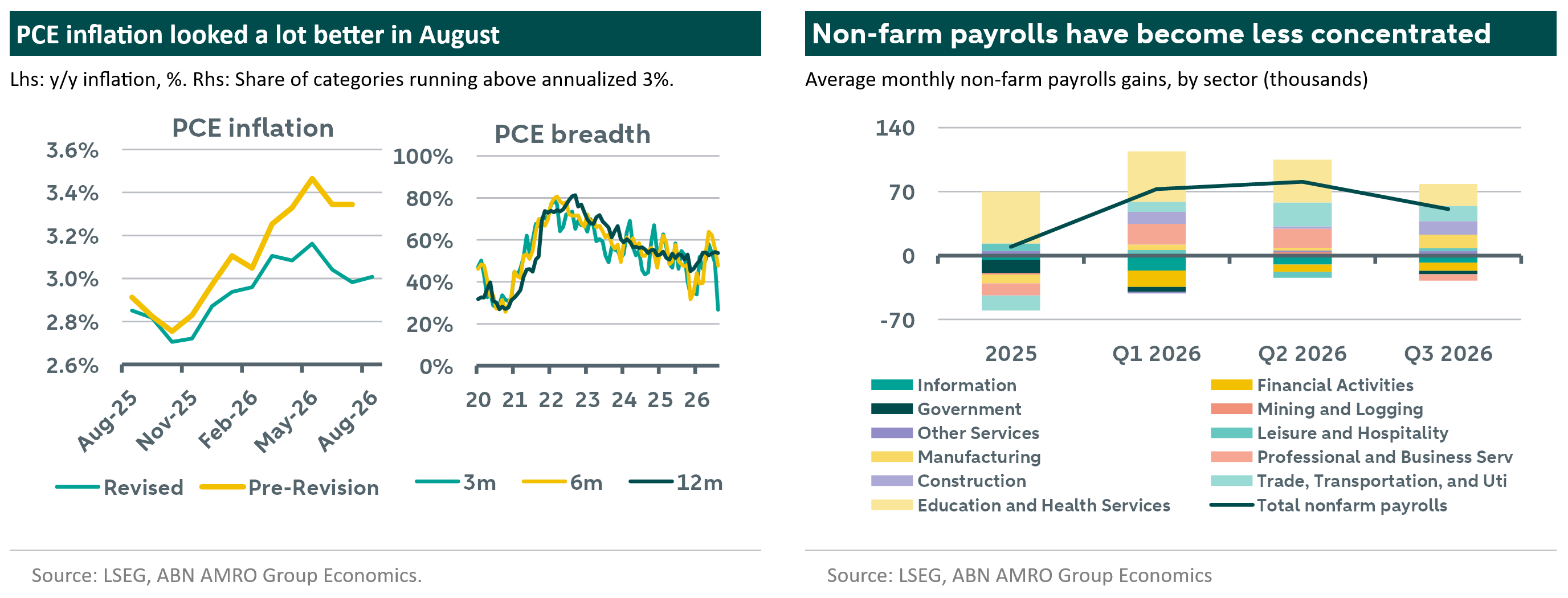
The labour market report was weaker at first sight. Non-farm payrolls rose by just 29k, below both consensus and our forecast, while the unemployment rate ticked up, partly because participation increased. We therefore see the increasing unemployment rate as a positive development, as a reversal of the downward trend in participation is a good sign of people seeing more opportunities. Moreover, beneath the headline figure, hiring is looking relatively healthy, especially compared to last year, but also earlier in the year. Job gains may have slowed relative to the start of 2026, but they are also far less concentrated. Whereas employment growth in 2025 and the first half of this year was driven disproportionately by education and health services and leisure and hospitality, gains over the latest quarter have been spread across a much broader range of sectors.
Taken together, the latest developments do not create urgency for back-to-back rate hikes. Inflation is too high, but narrowing, while job gains are solid, especially compared to supply, and less reliant on a few sectors. We continue to expect the Fed to hike once more in December and to keep rates at that level until the end of next year.