China - The outlook darkens

China's reopening rebound continues to fade, and headwinds have intensified

Reopening rebound fades, headwinds from slowing external demand and property have intensified
We cut our annual growth forecasts for 2023 and 2024 last month; risks stay tilted to the downside
PBoC continues with piecemeal monetary easing, further targeted support being rolled out
The reopening rebound in services/consumption has faded, headwinds from slowing external demand and property have intensified, and extreme weather has added to the growth headwinds. Further impacting confidence and sentiment is the scarring from previous stringent policies (Zero-Covid, regulatory crackdown), as well as ongoing signs of distress in property. Given all of these headwinds, we already cut our growth forecasts last month for 2023/2024, to 5.2% (from 5.7%) and 4.8% (from 5.0%) respectively, following disappointing Q2 GDP and activity data (also see here).
Macro data for July generally weaker than expected
Monthly activity data for July continued to disappoint. Annual growth of industrial production, retail sales and fixed investment slowed further, and the unemployment rate edged up marginally to 5.3% (June: 5.2%). The PMIs still point to a divergence between weak manufacturing and stronger services, but the gap is narrowing (with services PMIs coming down). Annual growth of exports and imports has fallen deeper into contraction territory, confirming weakness in both external and domestic demand. Monthly lending volumes dropped sharply in July, following a stronger than expected seasonal uptick in June. Cooling housing sales and (delayed) mortgage prepayments are pushing down net mortgage lending. With consumer confidence still weak and ongoing signs of distress amongst developers (with spillovers to the financial sector), as illustrated by recent problems of large developer Country Garden Group, the property sector is not out of the woods yet. Residential housing sales slowed to 0.7% yoy in July (June: 3.7%), while property investment fell even deeper into contraction territory.
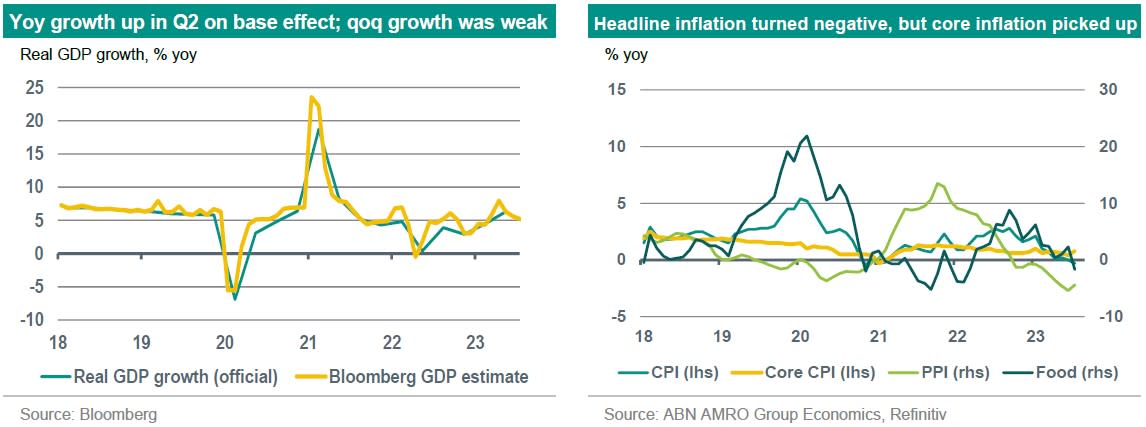
Headline inflation turned negative in July driven by food prices, but core inflation actually picked up
Headline CPI inflation came in at -0.3% yoy in July, the first negative number since February 2021. While this reflects weak domestic demand, food (particularly pork) and energy prices are key drivers as well. A strong base effect from a 26% jump in pork prices one year ago drove annual food price inflation into negative territory in July (-1.7% yoy). By contrast, core CPI rose to a six-month high of 0.8% yoy, although remaining relatively low. Meanwhile, producer price inflation (which correlates well with oil prices) seems to have bottomed out, with the annual decline easing to -4.4% yoy in July.
PBoC continues with piecemeal easing, government rolls out more targeted support
In mid-August, the PBoC cut its 1-year medium-term lending rate by another 15bp to 2.50%, and the 7-day reverse repo rate by 10bp, to 1.80%. This was coupled with a large liquidity injection into the banking system, and with measures to support the yuan’. We expect piecemeal monetary easing (mini rate cuts, bank RRR cuts) to continue. Also, Beijing is taking more measures in an attempt to stabilise the property sector, restore confidence among consumers/firms/investors, and support demand. We still think they will refrain from rolling out a ‘credit bazooka’, partly because they want to keep leverage in check, particularly in the property sector, and given constraints regarding local government finances and shadow banking.
This article is part of the Global Monthly of August 23