Daily Insight - Decomposing eurozone inflation
The jump in headline inflation to 3% yoy in August has seen the transitory vs permanent debate on consumer prices cross the Atlantic. Looking at the details of the rise of consumer prices as well as the underlying drivers suggest that this rise will indeed prove transitory.


Euro Macro: Commodity prices and taxes driving eurozone inflation - The jump in headline inflation to 3% yoy in August has seen the transitory vs permanent debate on consumer prices cross the Atlantic. Looking at the details of the rise of consumer prices as well as the underlying drivers suggest that this rise will indeed prove transitory. To be more precise, we expect inflation to collapse in 2022.
Let’s start with the big picture.
The chart below shows the contribution to inflation of the main components of the HICP in August compared to their pre-Covid levels (we take January 2020 for comparison). As can be seen, of the four main categories, the rise in inflation is driven entirely by energy and to a lesser extent core goods inflation. Services inflation is on balance modestly lower, while the contribution of food prices has been stable, though both items have displayed volatility in between.
There are good reasons to think inflation will fall back sharply. Take energy inflation. Oil prices rose sharply between November of last year and the middle of March. Since then, they have drifted up only slightly. Indeed, we think oil prices have peaked. If oil prices were to remain range bound, energy inflation will collapse in Q1 of next year.
Contribution to HICP inflation, ppts to % yoy rate
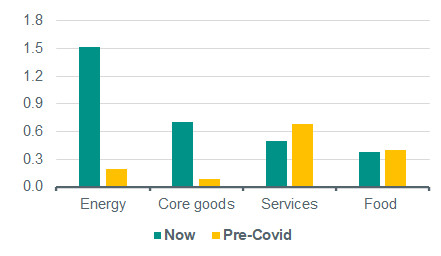
Source: Thomson Reuters Datastream, ABN AMRO Group Economics
Meanwhile, the rise in core goods price inflation has been widely linked to a well-known narrative related to supply-chain problems, rising freight rates and shortages of key components. A closer look at the details however suggests that this may not even be the most important part of the story. First of all, the big jump in core goods inflation between July and August seems to largely reflect a base effect in clothing and footwear prices, as there was a sharp fall in these items at the same point last year.
Second, a breakdown of producer prices (prices at the factory gate) suggests the rise in inflation in this category is closely related to commodity prices, which have also flattened out over recent months. We look at the German PPI data, as it is available at a decent level of granularity. Germany’s producer price inflation accelerated sharply from January 2020 onwards. The yoy rise in the PPI index increased to 10.4% in July 2021, up from 0.2% in January 2020. Looking at the details of the PPI index it turns out that the sharpest jumps were recorded in the energy PPI (yoy rate up by 21.4 percentage points) and the PPI intermediate goods ex-energy (+ 17 pps). The change in the rise in the PPIs for durable consumer goods (+ 0.8 pps between January 2020 and July 2021) and capital goods (+ 0.5 pps) was much more moderate the PPI for non-durable consumer goods (i.e. mainly food products) declined (-1.9 pps). When zooming in on the intermediate goods ex-energy component of the PPI it turns out that its acceleration is mainly due to a sharp jump in the component secondary raw materials (yoy rate up by 117 pps since January 2020), which is closely related to the costs of primary raw materials. So the jump in the yoy rise of producer prices primarily stems from higher energy and other commodity prices.
Another transitory factor that has been putting upward pressure on consumer price inflation more broadly is taxes. Most importantly, Germany cut its value added tax in the second half of last year and subsequently returned it to its previous level at the start of this year. This has led to a significant base effect, pushing up inflation, from July onwards. For instance, the ex-tax HICP inflation rate is currently 0.6 percentage points lower than the headline. This effect should fade in January.