Tightness in the gas market is becoming increasingly acute
TTF price estimates revised upwards. TTF gas prices are currently at their highest level ever. Gas stocks fill up only slowly with the winter season approaching. Pressure on oil prices looks set to increase.

ABN AMRO Group Economics
Author has left Group Economics, see text
Author: Hans van Cleef
Gas prices at record levels
Prices for TTF monthly contracts have reached their highest point ever. The tightness in the market is not only reflected in the Dutch benchmark: the Title Transfer Facility (TTF); the prices of Liquified Natural Gas (LNG) in Asia (Japan/Korea LNG = JKL) and the National Balancing Point (NBP) in the UK have also risen sharply. The apparent tightness in the market is due to a slow build-up of inventories in anticipation of the coming winter season.
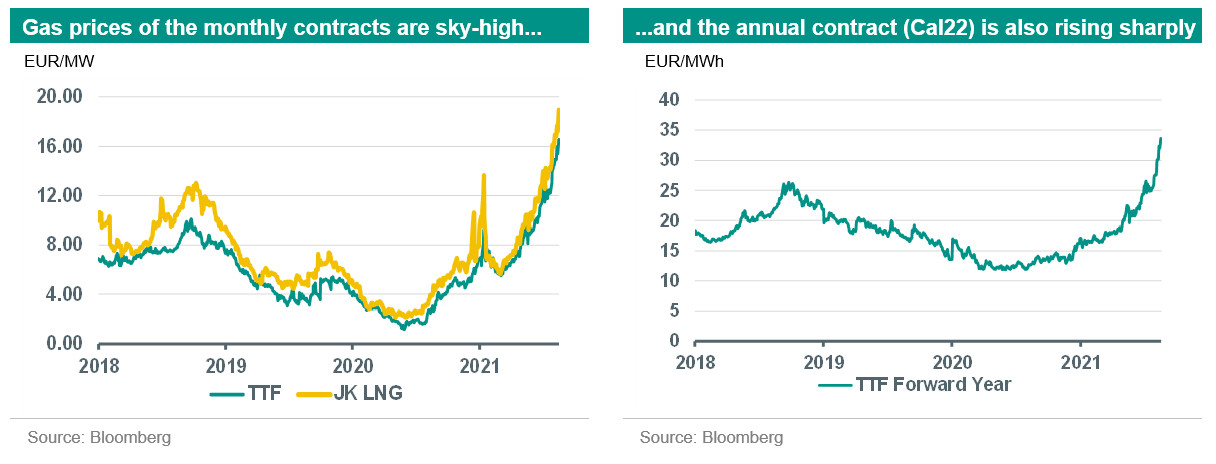
Stocks were already low after a harsher winter in gas-consuming countries in both Europe and Asia. The past few weeks have shown that gas exports from Russia to Europe have also been lower than usual. As a result, gas inventories are not nearly enough to face the coming heating season with confidence. This makes consumers and investors nervous. They are therefore going to hedge additional gas purchases on the futures market (current prices for future delivery) or speculate on price increases, which will put additional upward price pressure on contracts until spring 2022. For a couple of weeks, we see that this upward momentum in pricing is also spreading to the annual contract for 2022 (see graph above).
Low stocks and fall in imports from Russia
As the graph below shows, the build-up of gas stocks started late this year. The relatively cold winter, followed by a cool month of April, resulted in high demand for gas. As this year's wind output was also lower than expected, and coal-fired power stations are less attractive due to the high CO2 price, the demand for gas for power production also increased. As a result, stocks remained low for longer than in a typical heating season.
On top of that, inventories are now being filled more slowly than usual. This pattern was also seen last year, but did not lead to panic in the market at the time. The difference now is partly because the Netherlands is more dependent on gas imports now that domestic natural gas production has been phased out more quickly. Dutch offshore gas production is under pressure because existing wells are slowly but surely producing less and less. And investment in new gas fields in the Netherlands is encountering increasing resistance. Promised tax schemes to stimulate investment were finally implemented after a long delay, but the impact on investment has been limited. And this is while local gas production has considerably fewer disadvantages than importing gas from abroad.
Onshore, gas production is decreasing even faster. The most well-known is of course the Groningen gas field, of which Minister Wiebes decided in 2018 that production should be phased out as soon as possible and completely stopped by 2022. However, Minister Blok recently indicated that the minimum production of 1.5 billion cubic metres may have to be maintained for longer in order to maintain the back-up function of the Groningen gas field. This may already have to be used this coming winter if the reserves of low-calorific gas (Groningen quality used by Dutch households) are not sufficiently replenished and there appears to be a shortage at the time when demand peaks.
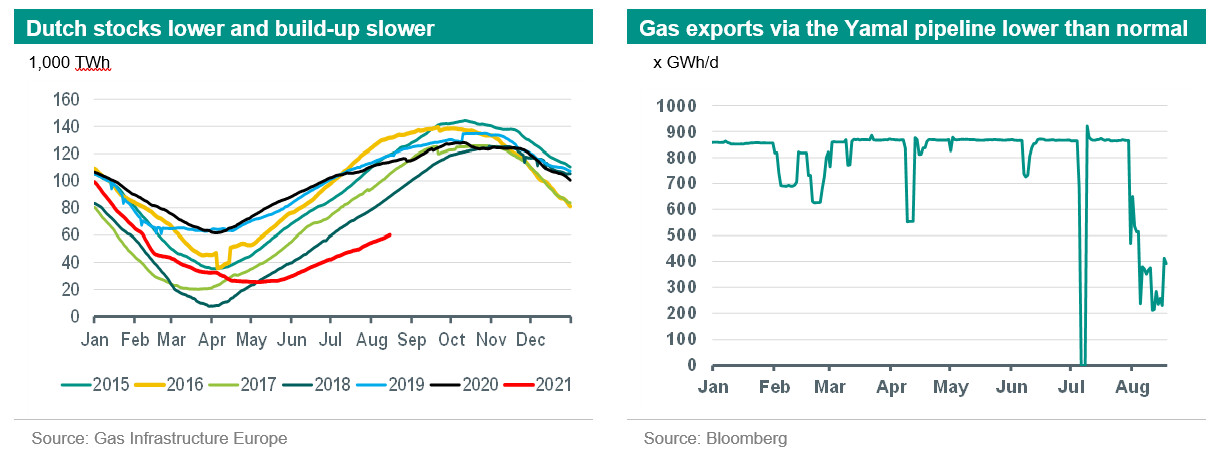
Lower national gas production has made the Netherlands dependent on gas imports from countries such as Russia, Norway and the United Kingdom. In addition, the Netherlands imports liquefied gas (LNG) from countries such as Qatar, Russia, Australia and Nigeria. However, the majority of European, and therefore Dutch, gas imports are via pipelines. Recently, imports from Russia have been under pressure. Gazprom is requesting (too) little pipeline capacity in Ukraine to bring gas to Western Europe. It is argued that this could be a political pressure point to complete the Nord Stream 2 pipeline. However, this politically sensitive project will actually be completed in the coming months. Other problems are also leading to less available pipeline capacity between Russia and Western Europe. A failure in a gas processing plant already caused problems in early August, while the Yamal pipeline (between Russia and Germany) has been showing lower throughput for weeks (see graph above), even beyond the regular maintenance period in July.
When it comes to LNG, the European gas market is in competition with the rest of the world. The advantage of LNG is that it can be shipped worldwide. As shown on the first page, the price of Asian LNG is usually higher than the price of TTF. This makes it very tempting for gas exporters to sell the gas initially to parties in Asia. To avoid being dependent on the spot market, India has just signed a contract for longer term LNG supplies (until after 2028, probably 10-15 years) with RasGas from Qatar. Mutual collateral allows the contract to be concluded at a low gas price. Contracts of this kind reduce supply on the spot market. This could drive prices higher if there is a surge in import demand.
Gas price forecasts revised upwards
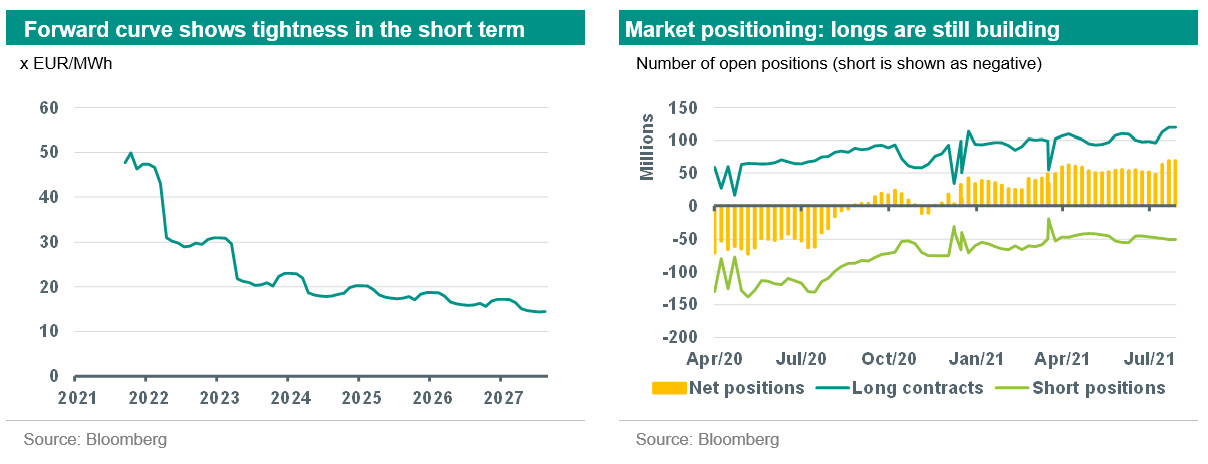
The tightness in the market, and the high prices for contracts with delivery in the relatively short term, can be clearly seen in the forward curve (a series of current prices for delivery in the long term). Whereas the contracts up to and including February are quoting above EUR 45/MWh, we see that the gas prices with delivery from next summer onwards are at EUR 30/MWh or lower. This shows that although the market assumes supply/stocks problems could lead to tightness during the coming winter season, it does not yet assume these problems will continue thereafter.
Market positioning shows that financial market participants think that prices have risen justifiably, and are still positioning themselves for a continuation of the price rally. This is reflected in the maintenance and further building of long positions (speculating on price rises). The net position has only increased further since the end of 2020 and is now at the highest point of the year. An assumption that prices were too low at the beginning of the year proved to be correct. There is no sign yet in the market positioning that the market sees an end to the tightness in the coming weeks. However, according to Gazprom, as much as 5.6 billion cubic metres of gas could be delivered to Europe this year via Nord Stream 2. That will not be enough to eliminate the shortages. However, it could be a reason for investors to take profits on their positions.
Although TTF gas prices may have overshot, given the current state of inventories, it is also unlikely that a substantial downward correction will occur in the short term. We think prices are elevated because some market participants fear possible physical shortages in the winter. This will not be the case as there is still the option to draw on back-up production capacity at the Groningen field. Obviously this is not desirable, and the Minister will only use this option in extreme cases. Nevertheless, this possibility of an emergency measure will ensure that we do not end up in the most negative scenario of physical shortages this winter. Also, as mentioned, the Nord Stream 2 pipeline will become operational in the fourth quarter, which may allow the Russians to export (even) more gas to North Western Europe. But the most important factor is and remains the weather. Unfortunately, it is not possible to predict whether we will have a harsh or mild winter. However, the market is now assuming the most negative scenario. Therefore, things can only turn out better than expected.
Nevertheless, the current situation is reason enough to revise our short-term estimates significantly upwards. We expect prices to remain at higher levels until early 2022 before the market can be reassured with some certainty. This reassurance will be accompanied by lower gas prices. And if stocks can return to their normal building pattern in 2022, prices will soon follow. See the table on p5 for the new estimates.
IEA lowers demand forecast for oil and foresees oversupply of oil by 2022
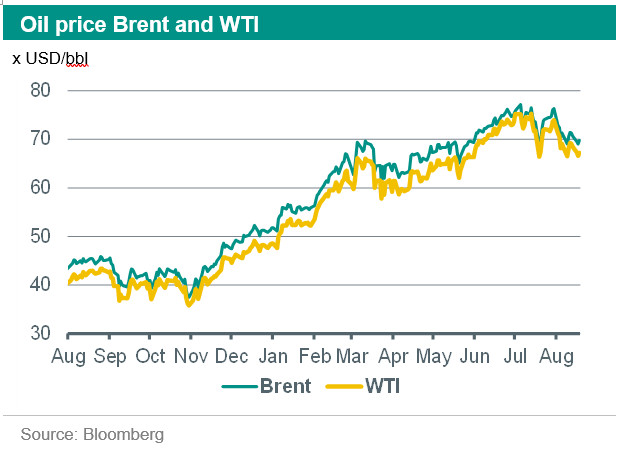
The International Energy Agency (IEA) monthly Oil Market Report expects global oil demand to continue to rise to an average of 96.2 million barrels per day (mb/d) in 2021 and 99.4 mb/d in 2022. By the end of 2022, oil demand is then expected to reach 100.2 mb/d, returning to pre-corona levels. However, the IEA expects an oversupply of oil to occur during 2022. This is due to the downward revision of oil demand forecasts, as new corona variants appear to have dampened the recovery in demand. Just a month ago, the IEA called on OPEC+ to increase production faster to meet demand. This call was, incidentally, recently reiterated by President Biden. Gasoline prices in the US have risen more than 40% in one year, with a gallon of gasoline now costing USD 3.50 on average in the US (up from USD 2.50 a year ago).
Oil supply will continue to rise to 96.7 mb/d by the end of this year, according to the IEA. That includes five months of 400,000 additional barrels of OPEC+ production per day. The remainder comes from an increase in production by non-OPEC+ countries. For 2022, the IEA expects non-OPEC production to rise by 1.7 mb/d. Over 1 mb/d of this will come from the US. If we assume that OPEC+ will continue to raise monthly production as agreed (+400 kb/d through April, +432 kb/d in the months to the end of 2022), this will lead to oversupply in the course of 2022.
In terms of expectations, the biggest uncertainties are the course of COVID-19 and its impact on oil demand, and US production. OPEC+ will stick to its agreements unless one of these factors turns out to be different from what is currently expected. Then OPEC+ will be forced to adjust its policy. They will continue to monitor developments on a monthly basis. The main risks are a resurgence of COVID-19, or some variant thereof, which would once again lead to new restrictive measures, or a downward adjustment to demand expectations. Furthermore, we ourselves assume a minimal increase in oil production from the US. If the IEA scenario - an increase in US production of +/- 1 mb/d – materialises, this would put additional downward pressure on oil prices. The above risks will lead to downward pressure rather than upward pressure. On balance, therefore, we are still comfortable with our current oil price estimates.