ESG Economist - Efficiency progress is a climate game changer
In this analysis, we examine the trend in emission intensity based on greenhouse gases in the EU-27. Emissions intensity indicates the level of greenhouse gas emissions per unit of activity. Energy and emissions intensity are expected to continue to decline, provided that the EU does not relax its climate policy too much.

Greenhouse gas emissions per unit of economic activity (emission intensity) provides insight into the efficiency and economic structure of countries; these vary greatly between EU countries and sectors
Emissions intensity in the EU-27 has been declining since 2008, but lower emissions intensity does not always mean a decrease in emissions
Between 2008 and 2024, emissions intensity in the EU-27 fell by 57%, while greenhouse gas emissions decreased by 31%
Between 2017 and 2023, fossil energy consumption in the EU fell by 10%, while energy efficiency and -productivity increased by 25%
Greater energy efficiency plays a crucial role in preventing greenhouse gas emissions, despite investment bottlenecks such as rising production costs and labour shortages
Business plays a crucial role in the energy transition by investments in low-carbon technologies and a focusing on innovation
Energy and emissions intensity are expected to continue to decline, provided that the EU does not relax its climate policy too much
Introduction
In this analysis, we examine the trend in emission intensity based on greenhouse gases in the EU-27. Emissions intensity indicates the level of greenhouse gas emissions per unit of activity. This is usually measured on the basis of an economic activity such as added value (gross domestic product, GDP), but it can also be related to output or population, for example. The main factors influencing emission intensity are efficiency improvements in energy and fuel consumption (the energy mix). This makes an analysis of this indicator valuable. Emissions intensity also provides a good insight into the position of countries and the trends between them. In addition, trends in emissions intensity are generally less volatile than absolute emissions.
Emissions intensity can vary greatly between countries, particularly due to differences in their energy mix. There are also major differences in emission intensity between energy-intensive sectors in different countries. This analysis highlights these differences. Greater use of low-carbon technologies by industry, greater energy efficiency, growth in productivity and/or investment in more renewable energy will ultimately improve a country's emission intensity. The EU-27's climate targets are ambitious in this regard until 2030. If this path to 2030 is followed satisfactorily (or partially), emission intensity will continue to improve in the coming years. We will discuss this further in the last part of this analysis. We end this note with a conclusion.
Trend in GHG emissions intensity EU-27
The trend in emission intensity not only provides insight into a country's efficiency improvements, but also partly reveals its economic structure. For example, an economy with a relatively large share of heavy industry has a much higher emission intensity than an economy that is largely based on the service sector. However, a decline in emission intensity does not always mean that there is an overall improvement for the climate. It may just as well imply an absolute increase in greenhouse gas emissions. This is the case when GDP grows much faster than the increase in greenhouse gas emissions. In that case, lower emission intensity may initially appear to be a positive trend, but the story behind the figures makes it clear that this is not necessarily the case. This is why absolute emissions and emission intensity often show little correlation with each other. Moreover, countries with high total GHG emissions often have relatively low emission intensity (and vice versa). All this shows that a decrease in emission intensity based on historical trends does not necessarily demonstrate progress in the sustainability of a country, sector or company.
The figure on the left below compares greenhouse gas emissions in the EU-27 with its emission intensity since 2008. Both indicators show a downward trend. Greenhouse gas emissions from economic activity in the EU-27 fell by 31% between 2008 and 2024, or almost 2% per year. Emission intensity fell more sharply over the same period, by 57%. This amounts to around 3.5% per year. The trends in both variables show that here too there is a decline in emission intensity combined with stable or slightly increasing absolute emissions. This is particularly the case in 2009 and in the period 2014 to 2018.
Emissions intensity in the EU-27 decreased by 28% in the period from 2017 to 2023 (the post-Paris Agreement period). This is the result of a decrease in fossil energy consumption and an increase in efficiency. For example, in the EU-27, total final energy consumption by economic activities in the post-Paris period decreased by 7%, with the fossil fuel share fell by 10% in the same period. Energy efficiency and productivity in the EU-27 increased by approximately 25% between 2017 and 2023. Globally, too, the decline in total emission intensity is more a result of reduced energy intensity (increasing efficiency and energy productivity) than of changes in the fuel mix. shows that since 2010, energy efficiency has prevented approximately 20% of additional greenhouse gas emissions and saved up to 20% of fossil energy imports in the countries affiliated with the IEA. The report also indicates that global investment in energy efficiency is expected to reach USD 800 billion by 2025. The IEA notes that cost increases, labour shortages and education are the main bottlenecks in accelerating energy efficiency.
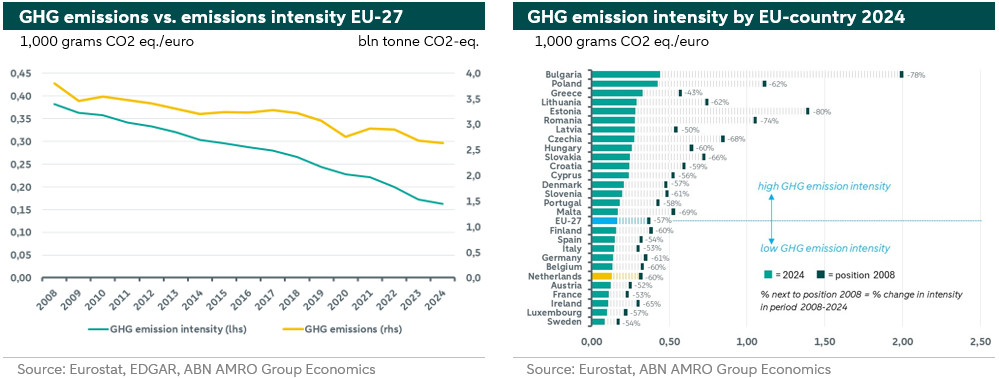
The countries with the highest emission intensity in 2008 – Bulgaria, Estonia, Poland, Romania and the Czech Republic – also saw the sharpest decline in emission intensity up to 2024. Bulgaria and Poland currently top the ranking with their relatively high emission intensity. The lowest intensity in 2024 in the EU-27 will be found in Luxembourg and Sweden. This is shown in the figure on the right above.
Comparing the emission intensity between the individual EU countries and the trends therein reveals the large differences between those countries. The figure on the right above shows that emission intensity varies greatly between EU countries. France, for example, has a relatively low emission intensity because the country is largely dependent on nuclear energy for its energy supply. Luxembourg also has a relatively low emission intensity. This is because industry accounts for a small share of its economy, only 4% of GDP in 2024 (the EU-27 average for industry is 16% of GDP). In Sweden, consumption of oil – the country's main fossil fuel – fell by 19% between 2017 and 2023, while renewable energy increased by 14% over the same period. This makes the country the least emission-intensive of all EU countries. Bulgaria and Poland, on the other hand, have much higher emission intensities – leading the EU-27 ranking – because these countries are heavily dependent on fossil fuels for their energy supply, but also because they have a high share of energy-intensive industry in their economies.
GHG emissions intensity by country and sectors
The seven largest EU countries – in terms of added value (GDP) in 2024 – together account for 72% of the total final energy consumption of the EU-27 and around 70% of greenhouse gas emissions. These seven large EU countries are shown in the two figures below. The left-hand figure shows the trend in emission intensity in the post-Paris period. All large EU countries show a sharp decline in emission intensity, with the strongest decreases in Poland (-52%) and the Netherlands (-51%). However, the sharp decline in Poland is very positive, but is also offset by the relatively high emission intensity compared to the other six largest EU countries. Poland and the Netherlands are followed by Germany, with a 44% decrease in emission intensity in the post-Paris period. These three countries are below the EU-27 average in terms of their trend. The other four countries in the top seven are above that average, with Italy lagging behind the most.
Final energy consumption has decreased in six of the seven largest EU countries in the post-Paris period. The exception is Poland, where final energy consumption has remained virtually stable. In the Netherlands, final energy consumption fell most sharply between 2017 and 2023 (-15%), followed by Germany (-12%), France (-11%) and Belgium (-9%). In these countries, the decline was greater than the EU average. In Spain and Italy, energy consumption fell by 5%.
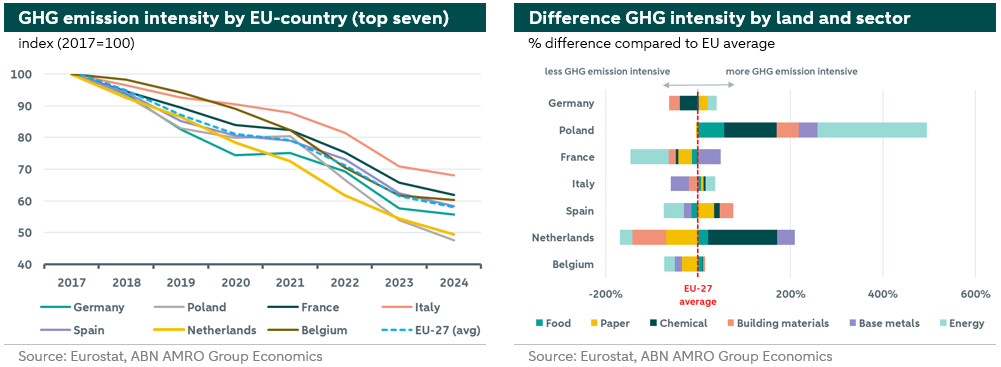
Sectors with relatively high emission intensity are more prone to carbon leakage (i.e. the relocation of production to regions outside the EU with no or less stringent climate policies). These are the sectors that are hardest hit by carbon pricing and/or stricter climate regulations, which translates into higher production costs. These sectors are to one being urged more intensively to accelerate sustainability through the EU Emissions Trading System (EU ETS) – via carbon pricing and the phasing out of free emission allowances – and the Carbon Border Adjustment Mechanism (CBAM, see also here). The energy-intensive sectors are shown in the figure on the right above. The figure shows how much the sectors per country deviate from the EU-27 average in 2024. This provides more insight into the differences between the sectors within the countries. Poland's deviation is immediately noticeable, as it is well above the EU average in every energy-intensive sector. The Netherlands also stands out in a negative sense, particularly due to the higher average GHG emission intensity of the chemical industry compared to the EU average.
What detracts from this comparison between sectors is that a limited number of large polluting companies within the energy-intensive sectors can in many cases have a major impact on the average. In the Netherlands, for example, approximately 95% of GHG emissions in the base metals industry fall under the EU ETS. These emissions relate to only one company, Tata Steel IJmuiden. This somewhat clouds the averages.
Climate policy and – goals 2030
EU climate policy has contributed to reducing emission intensity in recent years. Reduced use of fossil fuels (particularly oil and coal) and increased use of renewable energy sources have made the EU's energy mix cleaner over the years. We had already noted that the fossil fuel share of final energy consumption had fallen by 10% in the EU-27. The supply of renewable energy and biofuel increased by 20% in the period 2017-2023.
A decrease in the share of resource- and energy-intensive industries in total economic activity and improvements in energy efficiency have also resulted in lower emission intensity. In the EU-27, the share of energy-intensive industrial sectors in the total EU economy was approximately 1.2 percentage points lower in 2023 compared to 2000 (from 4.5% in 2000 to 3.3% in 2023). The share of energy-intensive industry in relation to total industry in the EU-27 is approximately 20%. However, this share has remained unchanged since 2017.
Energy intensity refers to the amount of energy used to produce one unit of GDP. In general, the higher the intensity, the more energy is used to produce a product or service. The trend in energy intensity can be used to guide or adjust objectives and policies. A positive trend is that energy intensity has been declining since the 1990s thanks to various efficiency improvements. A decrease in energy intensity usually means lower emission intensity. In the period 2017-2024, energy intensity decreased by 22%, while emission intensity fell by 27%.

For several years now, the EU has been a pioneer in setting ambitious climate targets. With its climate policy, the EU aims to significantly reduce the EU's emission intensity by 2030, make its economy climate neutral by 2050 and maintain relatively low energy prices for end users. A proactive climate policy remains necessary to achieve these goals, not only at EU level but also at national level. However, not every policy is received equally positively by the business community, especially if it increases production costs and undermines competitiveness. Nevertheless, the business community remains an important channel in ultimately achieving the climate goals. For example, if companies invest more in low-carbon technologies (such as heat pumps, solar panels, electric transport), the emissions associated with energy conversion and use per economic unit will continue to decline. This also applies to countries that are focusing more on renewable energy (wind or solar energy). In order to achieve the climate targets and maintain its competitive position, the EU is investing in the development of low-carbon technologies, supporting the most innovative sectors, seeking to reduce dependence on fossil fuels in the energy sector and further improving energy efficiency. On the path to achieving these targets by 2030 – whether they are ultimately achieved in full or only in part – both energy and emission intensity will ultimately have to continue their downward trend.
Conclusion
Comparing emission intensity between countries and their sectors reveals significant differences, which are based on energy efficiency and final fuel consumption. Countries that still rely heavily on fossil fuels, such as Poland and Bulgaria, have higher emission intensity, while countries with a focus on cleaner energy mixes, such as Sweden and Luxembourg, score much lower. The share of energy-intensive industrial sectors and the energy mix of countries are often decisive factors in this regard.
Emissions intensity within the EU-27 has been declining for years, partly due to improvements in energy efficiency and productivity, but also due to a gradual decline in fossil fuel consumption. Energy efficiency in the EU improved in the period 2017-2023. Investments in energy efficiency have played a key role in this, but rising production costs and labour shortages have prevented the necessary acceleration. In addition, EU climate policy has contributed to cleaning up the energy mix and reducing emission intensity. The EU is pursuing ambitious climate targets for 2030, including a climate-neutral economy by 2050 and relatively low energy prices. Business remains, however, a decisive factor in this transition, with investments in low-carbon technologies and a focus on innovation. In this regard, stimulating government policy based on financial incentives can help to accelerate the transition to more sustainable processes (see here for more information). Energy and emission intensity are expected to continue to decline in coming years, provided that the EU does not relax its current climate policy too much.