Carbon Market Strategist-Supply uncertainty and weaker demand reshape carbon market outlook
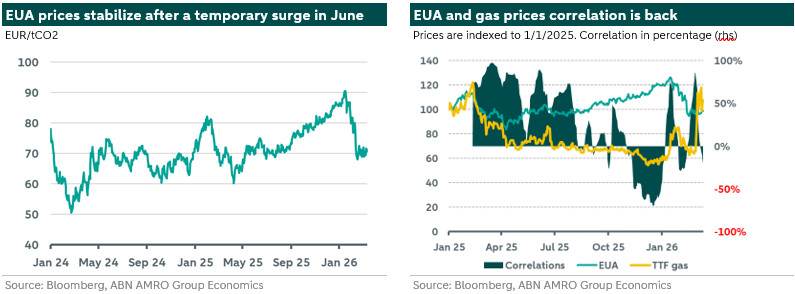
EUA prices peaked early 2026, then fell back as sentiment weakened and intervention possibility increased. Tighter LNG markets revived fuel switching dynamics, but impacts are expected to be smaller than in 2022. Traders reduced long positions and increased shorts as bullish sentiment faded. Rising geopolitical uncertainty reduces allowance demand expectations from main sectors. CBAM entered its definitive phase; upcoming EU ETS/MSR reforms increased near term supply uncertainty. We revised 2026 outlook downward, though price recovery is still expected later in the year.

Carbon markets began the year by sustaining the upward trend in prices that started late last summer. Prices peaked in mid-January at levels last seen in July 2023, touching 91 EUR/tCO2 levels. However, the trend reversed, and the market has for now stabilized around 70 EUR/tCO2. The shift in sentiment was driven by several global developments, including escalating tensions in the middle east, as well as growing discussions within the European Commission (EC) and among policymakers about potential interventions in the EU Emissions Trading System (EU ETS) to support struggling industries. Meanwhile, the relationship between carbon and gas markets has regained attention. Renewed tightness in Liquified Natural Gas (LNG) markets, driven by the ongoing conflict in the Middle East, has raised the possibility of fuel switching (using coal instead of gas), which could result in an increase in emissions from power generation. This, in turn, increases demand for carbon credits and would push prices up. However, demand prospects remain subdued, particularly from key sectors such as industry, shipping, and aviation, which are facing significant headwinds. As a result, the market has adopted a cautious tone, balancing the anticipation of anticipated regulatory changes with the evolving impacts of geopolitical tensions and the Middle Eastern conflict. Currently, EUA prices are trading around 71.5 EUR/tCO2.
Carbon market developments
The war in the Middle East has disrupted the balance in the gas market. Prior to the conflict, the market was moving towards a surplus after years of tight conditions. However, the effective closure of the Strait of Hormuz has tightened the LNG market even further. This has brought fuel-switching dynamics into focus again, as high gas prices could incentivize a shift to coal for power generation, increasing demand for emission allowances. That said, the impact is expected to be less significant compared to the energy crisis of 2022. This is largely due to the evolving role of gas in the power sector, as renewables power generation has grown substantially in recent years, which implies that the usage of gas has become more focused on ensuring grid flexibility during periods of low renewable output (read more about the changing relationship between gas, power and carbon price in our earlier publication ). Additionally, the rise in emissions from power generation may be mitigated by the significant reduction in coal power plants across Europe in recent years. Countries like Germany, the UK, Slovakia, and Spain have notably downsized their coal power fleets, which further limits the potential for a major increase in coal usage.
Industrial demand recovery in Europe comes to a halt as the manufacturing PMI (Purchasing Managers' Index, as shown in the left chart below) continues to decline steadily, signaling persistent challenges in the manufacturing sector. In January, the manufacturing PMI declined again to 48.8 and further towards 48.4 in February. France and Germany manufacturing PMIs saw sharper decline. Accordingly, business confidence remains weak across most eurozone countries. The war in the Middle East and the associated energy price shock puts the earlier prospects of Europe’s economic recovery in 2026 (triggered by increase in government spending on defense and infrastructure projects) into question. This would lower the prospects of industrial demand for allowances and contribute to lower prices.
The ongoing war in the Middle East has already impacted the shipping sector, leading to a surge in freight rates. Moreover, the resulting energy shock is expected to have significant consequences for global economic growth, industrial output, and trade flows. These disruptions could lead to a reduction in emissions from shipping activities, particularly for voyages to and from European ports. Consequently, the demand for EU allowances in sectors such as shipping and aviation (following a huge rise in fuel costs) would decline, putting further downward pressure on prices.
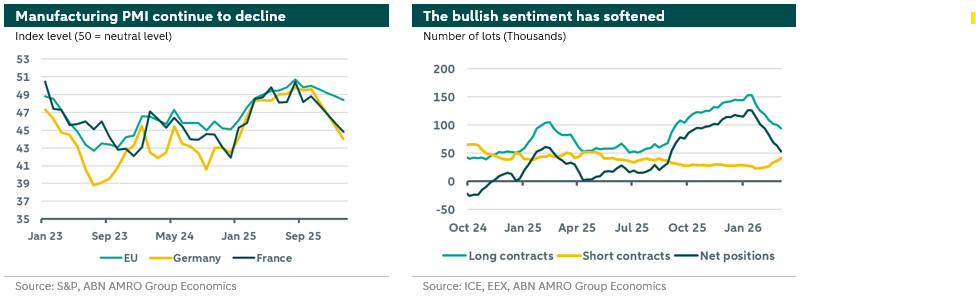
Meanwhile, signals of potential market intervention have played a key role in halting the upward trend in carbon market prices. The market was moving towards a tightening of the emissions cap and the gradual phaseout of free allocations. These changes were expected to reduce medium-term supply and had become a key driver behind the rising prices, signaling a clear supply deficit anticipated in 2026. However, these dynamics are now uncertain due to the potential intervention by the European Commission, which could alter the expected trajectory of supply and pricing. Specifically, leaders from Germany, France, and Italy have recently expressed the need to reassess the EU Emissions Trading System (EU ETS), citing concerns over the impact of high carbon prices on industrial competitiveness (more on this in the next section). Italy, for instance, is exploring subsidies for gas-fired power plants to manage energy costs. Such subsidies could distort markets by compromising the efficiency of the EU ETS in driving emissions reductions. Consequently, the bullish sentiment in the carbon market has softened, with traders adjusting their positions—reducing long contracts and increasing short ones, as reflected in the right graph below.
Regulatory developments
In December 2025, the European Commission finalized an extensive "operationalization" package comprising 11 legislative acts, marking a pivotal step for the carbon market with the official launch of the CBAM’s definitive phase on January 1, 2026. Among the key updates, the market welcomed a legally binding 50-tonne mass-based exemption designed to alleviate compliance burdens for 90% of small importers. Additionally, the introduction of a 10% markup on default emission values to penalize non-reporting entities signals stricter enforcement measures, while the move toward a quarterly pricing model for CBAM certificates linked to the EU ETS adds a dynamic layer to pricing mechanisms.
Of particular market interest, the Commission unveiled a proposal to expand the CBAM’s scope by 2028, aiming to include 180 downstream products such as automotive parts and industrial machinery. This expansion highlights a strategic effort to address lingering risks of carbon leakage in manufacturing and signals deeper integration between carbon accountability and industrial competitiveness within the EU’s regulatory framework.
The forthcoming EU ETS reform, slated for a formal legislative proposal in July 2026, is set to redefine the carbon market by aligning it with the EU’s ambitious 2040 climate targets while addressing structural scarcity. Market participants are closely watching key aspects of the review, including the integration of Carbon Dioxide Removals (CDRs) to offset residual emissions, the anticipated inclusion of municipal waste incineration by 2028, and the expansion of maritime and aviation coverage to account for non- effects. These measures are expected to broaden the scope of the ETS and tighten emissions accountability across sectors.
A pivotal shift in the Market Stability Reserve is also on the horizon, moving away from surplus reduction toward liquidity management. This likely includes ending the automatic "invalidation" of certificates and creating a reserve aimed at stabilizing prices during periods of volatility. Furthermore, the reform underscores the commitment to reinvest 100% of auction revenues into industrial decarbonization initiatives, signaling stronger support for the EU’s transition to a net-zero economy.
Outlook
Contrary to expectations, 2026 has taken a sharp turn due to a series of developments that shifted market sentiments and halted the previously rising trend. On one side, demand outlooks have weakened significantly across most sectors, exacerbated by the prolonged conflict in the Middle East, which continues to fuel uncertainty as the war evolves. This has dampened confidence in sustained demand growth and created volatility within the emissions market.
On the other side, the upcoming Market Stability Reserve (MSR) review and ongoing debates regarding the impact of EU ETS costs on industrial competitiveness and the broader economy have heightened uncertainty around the medium-term supply trajectory. The increasing likelihood of market intervention has become a major talking point, with speculation growing that the Commission might address the anticipated supply deficit by front-loading future surpluses. Such a move would fundamentally alter supply dynamics and significantly reshape market outlooks.
Considering the developments outlined above, we have revised our outlook for carbon prices downward for Q1 2026, with EUA prices now expected to average 78 EUR/tCO2, compared to the previous forecast of 86 EUR/tCO2. Despite the current challenges, we still anticipate an upward trend for the subsequent quarter, primarily driven by tighter allowance supply. However, this upward movement is projected to occur at a lower pace than previously forecast, reflecting a more pronounced reduction in demand. The table below outlines our updated EUA price outlook for 2026.
