Eurozone - ECB speeds up policy normalisation
The eurozone economy seems to be slowing down rapidly, which is in line with our base scenario of a recession in the coming quarters. The ECB has stepped up the pace of rate hikes. In our revised base case, we see another 75bp hike in October, followed by a 50bp step in December.

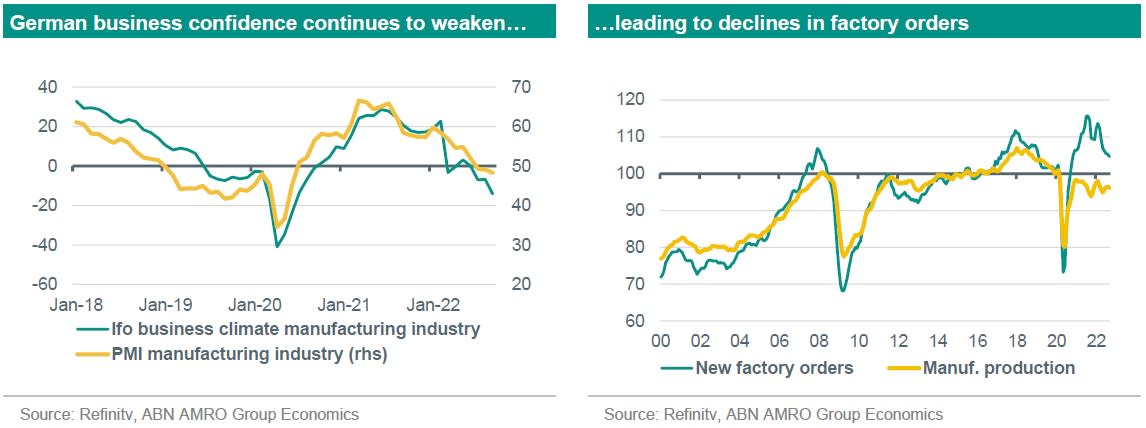
This is part of the Global Monthly, see here The eurozone economy seems to be deteriorating rapidly, now that most of the post-pandemic rebound in consumption has materialized and households’ real disposable income and corporate profitability are being eroded by soaring energy bills. Moreover, the economy will suffer from the impact of tightening financial conditions and a slowdown in world trade on the back of aggressive central bank rate hikes. The volume of private consumption increased by 1.3% qoq in Q2, which was higher than expected and was due to a sharp rebound in services consumption. Household income data for Q2 have not yet been published, but it is likely that the rise in consumption went hand in hand with a further drop in the savings rate. Fixed investment expanded as well in Q2 (+0.9% qoq), but excluding volatile investment in Ireland, eurozone investment expanded by 0.3% only. Looking forward, we expect consumption and fixed investment combined to decline during the three quarter period 2022Q3-2023Q1. Drops in consumer and business confidence and in the composite PMI have all pre-signalled contraction in GDP in the next few quarters.
Inflation increased to 9.1% yoy in August, up from 8.9% in July. Core inflation increased to 4.3% yoy, up from 4.0% in July. Recent developments led to declines in the energy and food components of the HICP, but inflation was lifted by surging gas prices and the filtering through of past jumps in food and energy prices into services and manufactured goods prices. Looking forward, we think that the rise in inflation has not yet ended and that the peak could be reached in September-October, with inflation subsequently easing somewhat. Nevertheless, inflation should remain elevated throughout this year and we see it declining more significantly in 2023. The impact of high energy and food prices filtering through into core inflation is different from the second round longer-term effect that would result from high inflation leading to wage growth that is well above labour productivity growth. We think that this second effect will be more moderate as the outlook for employment growth is deteriorating rapidly and an expected rise in the unemployment rate should limit wage growth.
The ECB raised its key policy rates by 75bp at its September meeting, as expected. It also signalled that ‘based on its current assessment, over the next several meetings, the Governing Council expects to raise interest rates further to dampen demand’. In the press conference, ECB President Lagarde suggested that the terminal rate could be reached in the December or February meetings. She added that market expectations for the terminal rate (somewhat above 2%) were not far off the ECB’s thinking. We upgraded our view of the ECB rate peak. We now expect the ECB to raise its deposit rate to 2% most likely by end-2022. In our revised base case, we see another 75bp hike in October, followed by a 50bp step in December. The policy rate then settles at 2% through 2023. The most likely alternative to this base, is three steps of 50bp, with the terminal rate being reached in February 2023. We had previously signalled a peak rate of 1.5%. We saw the risks to our previous peak rate call as being skewed to the upside, but we see the risks to our new forecast as being balanced.