Eurozone - Higher than expected inflation bodes ill for GDP growth in Q4
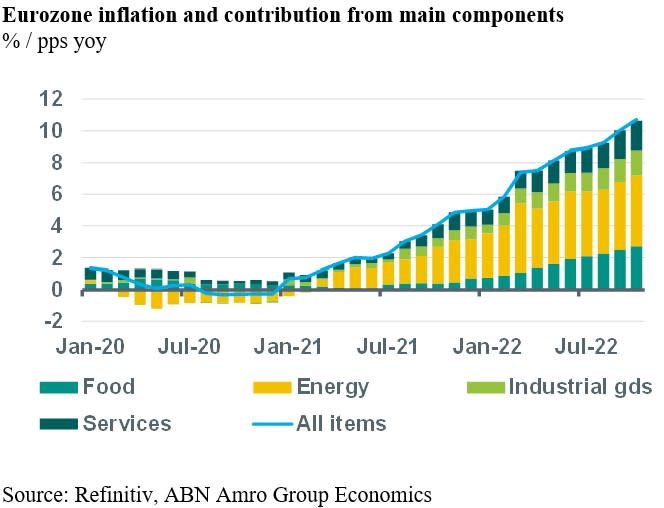
Eurozone inflation came in well above the expectations again in October. Headline HICP inflation increased to 10.7%, up from 9.9% in September, with the core rate rising to 5.0% up from 4.8%. Again, food and energy price inflation were the main drivers behind the rise in inflation. The new jump in inflation moving into Q4 means that household real disposable income will have eroded further, which bodes ill for economic growth in the final months of the year. After eurozone Q3 GDP growth came in higher than expected, at 0.2% qoq, we expect significant contractions in GDP in 2022Q4 and 2023Q1.

Eurozone inflation came in well above the expectations again in October. Headline HICP inflation increased to 10.7%, up from 9.9% in September, with the core rate rising to 5.0% up from 4.8%. Again, food and energy price inflation were the main drivers behind the rise in inflation. Indeed, the inflation rate of processed food, alcohol & tobacco increased to 12.4%, up from 11.5% in September and the inflation rate of unprocessed food jumped to 15.4%, up from 12.7%. Energy price inflation increased to 41.9%, up from 40.7%. A further breakdown of energy inflation from more detailed national and local inflation data suggests that household energy price inflation (electricity and gas) again increased in October, whereas transportation energy price inflation, which is closely linked to changes in global energy commodity prices, declined. Based on trends in global food and energy commodity prices in recent months, we think that eurozone food and energy price inflation should peak soon and will start declining in the coming months. This should also result in total inflation moving lower, but probably at a slower pace than the food and energy components, as core inflation probably is more sticky. The breakdown of the main components of core inflation in October, shows that services inflation edged higher to 4.4%, from 4.3% in September, and that the inflation rate of non-energy industrial goods accelerated more significantly, to 6.0%, up from 5.5%. The rise in non-energy industrial goods inflation no longer seems due to global supply chain bottlenecks, which have become less severe since the start of the year, but now seems mainly related to the pass-through of high energy prices, combined with euro weakness. This pass-through tends to be sluggish and can continue for some months after global energy commodity prices have peaked. All in all, we still think that eurozone inflation is close to its peak level and will start declining in the coming months. Meanwhile, the new jump in inflation moving into Q4 means that household real disposable income will have eroded further, which bodes ill for economic growth in the final months of the year.
Eurozone Q3 GDP growth also came in higher than expected. The eurozone economy expanded by 0.2% qoq in Q2, following 0.8% in Q2. Details of GDP have not yet been published, but it seems likely that a sharp rebound in post-corona services consumption (e.g. tourism and recreation) in the final months of Q2 and first months of Q3, has more than outweighed contractions in industry and construction sector activity. Recent monthly data for economic activity and sentiment all suggest that a significant fall in activity occurred during the course of Q3 and moving into Q4. Therefore, we have maintained our expectation of sharp contractions in eurozone GDP in 2022Q4 and 2023Q1. The economy should be hit by the erosion of household disposable income and corporate profitability due to high food and energy bills, a rapid tightening of financial conditions and a slowdown in world trade growth on the back of aggressive central bank rate hikes.