Eurozone indicators drop in March, with worse to come
The escalation of the Russia-Ukraine conflict and the related energy and other commodity supply shocks, has clearly hit the eurozone economy. Consumer confidence dropped by almost 10 points in March. The eurozone PMIs fell more moderately than expected in March but the underlying trends were worse than the headlines suggested. The drops in consumer sentiment and the PMIs seem in line with our base scenario for the eurozone economy of modest quarterly growth in the first half of this year.

Consumer sentiment and PMIs drop lower
The escalation of the Russia-Ukraine conflict and the related energy and other commodity supply shocks, has clearly hit the eurozone economy. Consumer confidence dropped by almost 10 points in March (to -18.7, down from -8.8 in February) and fell almost to the low point that was registered during the first wave of the pandemic. The details of consumer confidence have not yet been published, but it seems likely that the assessment of (future) economic conditions and households’ financial situation plummeted, while the expected labour market conditions probably also deteriorated. As we wrote in our Daily earlier this week, we expect soaring energy prices to result in only moderate consumption growth in the first half of this year, despite the post-lockdown rebound in services consumption (see here).
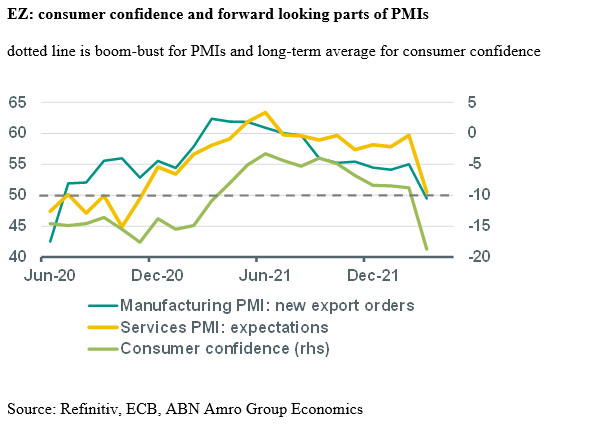
The eurozone PMIs also fell in March, with the underlying trends worse than the headlines suggested. The composite PMI declined by one point to 54.5, better than the consensus and our own forecasts. Still, the details of the report show that the underlying trends deteriorated more noticeably. To begin with, the decline in the manufacturing PMI (to 57.0, down from 58.2 in February) was moderated by a lengthening of suppliers’ delivery times (which contributes positively to the total manufacturing PMI). Supplies were disrupted by the Ukraine war and sanctions on Russia, which came over and above disruptions related to new pandemic-related lockdowns in China. The manufacturing PMI would have dropped by almost one point extra if suppliers’ delivery times had not lengthened. Moreover, the new orders component in the manufacturing PMI declined by almost 3 points (new export orders -5.6 points), which bodes ill for future production growth.
The services PMI fell by merely 0.7 points in March, to 54.8, which was also better than expected. However, it seems that activity in March was lifted by the unwinding of COVID-related restrictions as the forward looking business expectations in services dropped by more than 9 points, suggesting that activity will slow down noticeably in the months ahead. All in all, the drops in consumer sentiment and the PMIs seem in line with our base scenario for the eurozone economy of modest quarterly growth (of around 0.3-0.4% qoq) in the first half of this year, which is below the consensus forecast and also below the ECB’s most recent projections.