Eurozone - Looking under the surface of eurozone inflation

Energy, taxes, surging factory gate prices and a normalisation of holiday prices explain the acceleration of eurozone inflation. Inflation is likely to accelerate further, but it should fall sharply from the start of next year as factors currently driving higher inflation should dissipate, while wage growth is still subdued. Inflation should end up comfortably below 2% by the end of next year and in 2023.

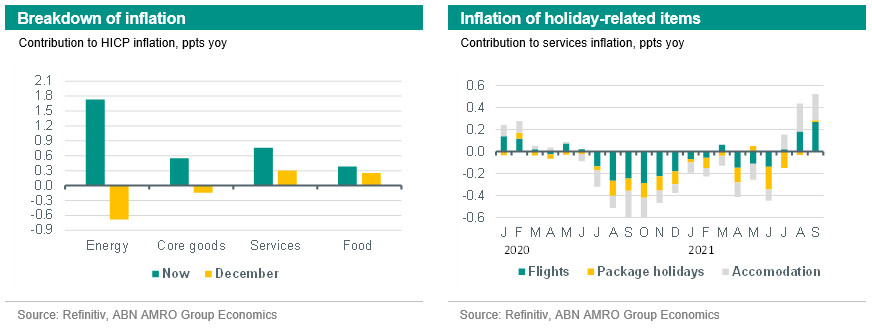
Eurozone inflation was confirmed at 3.4% yoy in September, up from 3% in August and just below 1% at the start of this year. There is a great deal of volatility in the shifts of the components from one month to another, but a better idea of trends can be seen by looking at changes over a longer period. The chart on the left below show the change in the contribution to HICP inflation of the main components now compared to December of last year (when inflation stood at -0.3% yoy). As can be seen, by far the biggest swing factor has been energy inflation, which currently accounts for half of the entire HICP inflation rate. We have also seen an acceleration in core inflation, distributed equally between services and core goods. One factor that has certainly made a contribution to this is a change in the contribution of taxes, especially reflecting the swings in the German VAT rate. Taxes were subtracting 0.1 percentage points from inflation in December of last year, while they are currently adding 0.6 percentage points to HICP inflation. Meanwhile, service sector inflation has been boosted by a recovery in prices of services related to holidays.
As the chart below shows, holiday-related inflation was a major drag on inflation in the second half of last year and the first half in of this year. However, it has bounced back sharply over the last few months. Finally, core goods inflation looks to have been boosted by sharp rises in factory goods inflation, reflecting sharply higher commodity price inflation and supply-chain bottlenecks. The components within the core goods category are not very homogeneous and sometimes difficult to link to the bottleneck narrative in a consistent way. However, it is clear that producer prices for consumer durables have accelerated, and historically these tend to be followed by rising core goods inflation.
Looking forward, headline HICP inflation is likely to accelerate further, to around 4% by the end of the year. However, we think inflation will fall sharply from the start of next year and end up comfortably below 2% by the end of the year and in 2023. First of all, the upward impact of tax rates will largely evaporate. Second, the contribution of energy inflation will likely start to decline, though the really sharp fall in the contribution will be in the second half of next year given base effects and also that it will take a while for the current energy price shock to unwind (see first chapter). Third, holiday-related inflation and hence services inflation is likely to ease, as we judge that the prices of these items have largely normalised. At the same time, wage growth at the eurozone level is still subdued. Finally, the impact on prices of supply bottlenecks should ease over time, even though a complete normalisation of the supply-side could take around a year.