Eurozone - Solid underlying growth seeing some cracks
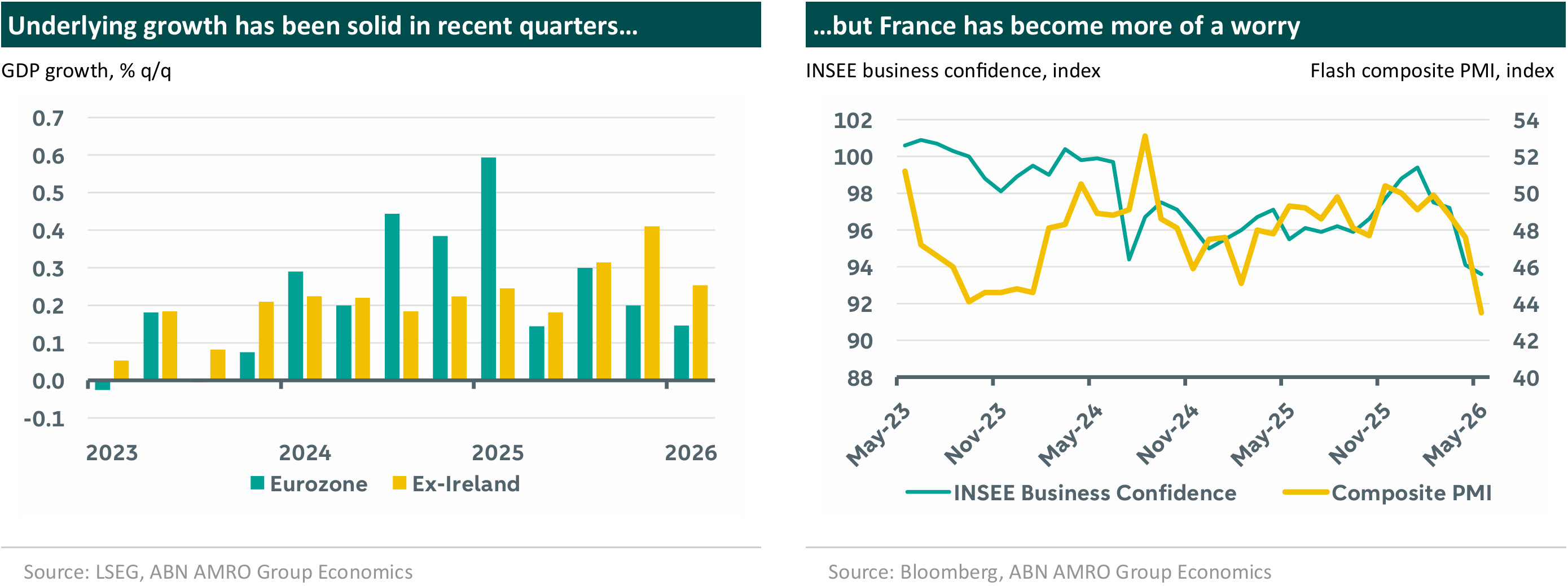
Underlying momentum going into the energy shock has been solid in the eurozone overall. But France has become more of a worry amid weak growth and confidence. The ECB is still expected to hike at coming meetings in order to anchor inflation expectations.


GDP growth surprised to the downside in Q1, with the eurozone eking out just 0.1% q/q. While this was a clear slowdown from Q4, the weakness was exaggerated by – you guessed it – Ireland, where output plunged 2% q/q. Just as the frontloading of Irish exports to beat US tariffs was inflating eurozone growth in early 2025, the unwind of that frontloading is now a distortionary drag on activity. Taking Ireland out of the equation, growth actually accelerated towards the end of last year, and while there was still a slowdown in Q1, it was more modest than headline GDP suggests. The chief driver of this strength in underlying activity has been Germany, which is finally growing again after years of stagnation. And while growth risks are clearly mounting from the energy shock, the surge in defence spending that drove growth around the turn of the year is likely to remain a support going forward.
Alongside Germany, growth also remains solid in southern Europe – especially in booming Spain. But in France, the eurozone’s 2nd biggest economy has made a notable turn southwards. The French economy stagnated in Q1, and the latest confidence indicators point to a possible contraction in Q2. The composite flash PMI plunged in May to well below the contraction mark. And although the PMIs have not been a reliable predictor of activity (for instance, they pointed to a recession in 2023 when the economy was expanding solidly), the latest reading is corroborated by INSEE’s more reliable business confidence index, which fell to a 5 year low in May. According to the PMI, the impact of the Iran conflict and high energy prices were cited as the main drivers, while INSEE’s report showed a particular weakening in retail trade and in the employment subindex. France has been less willing and fiscally able to offset the energy shock, and confidence is probably still weighed by political uncertainty due to the fragile minority government. Moreover, as discussed in this month’s Global View, there are signs that the impact of the Iran war might be having a bigger impact on growth than we currently foresee in our base case, and this bears close watching over the coming months.
ECB’s inflation focus keeps it on course to hike in June and July
But for now at least, the inflation impact continues to clearly dominate, and this is keeping the ECB on a hiking path. While supply shocks that impact both growth and inflation adversely complicate decision making, there is no doubt where the central bank’s priority is. At the 30 April meeting, the Governing Council re-asserted its commitment to set ‘monetary policy to ensure that inflation stabilises at the 2% target in the medium term’. Indeed, the ECB President also revealed that the Council debated a rate hike already at this meeting and that she knew where the ECB is ‘headed’ on interest rates directionally. For an institution that has moved away from forward guidance, this is as close to a signal of a coming rate hike as you are going to get. President Lagarde was quite open in signalling that the June meeting would be the moment. She noted that it would be the ‘right time to assess’ developments, given the central bank would have more data, the new projections as well a better understanding of where the conflict was heading. Our base case is that the ECB will raise its deposit rate by 25bp at the June and July Governing Council meetings taking it to 2.5%.