Transaction Trends - When temperatures spike, consumption seeks cooling

Extreme heat not only affects health and quality of life, but also leads to noticeable shifts in household spending behavior. The recent heatwave was accompanied by a temporary decline in Dutch household consumption. Online spending and cash withdrawals declined during the heatwave, while card spending initially increased and only fell during the most extreme heat conditions. Card spending held up relatively better in highly urbanised areas than in less urbanised regions. In particular, spending at restaurants and cafés increased in these areas, while fuel expenditures declined sharply elsewhere.


An exceptional heatwave in June
Periods of exceptionally warm weather influence not only how people spend their time, but also where, when, and on what they spend their money. During a heatwave, daily routines change: some activities are avoided while others become more attractive. As a result, extreme heat can have a visible short-term impact on household consumption.
At the end of June 2026, the Netherlands experienced an exceptional heatwave. Following an already warm first half of the month, temperatures rose above 30°C across large parts of the country from 22 June onward, reaching 33°C to 36°C in some regions. Due to the combination of high temperatures, warm nights, and high humidity, the Dutch meteorological institute () issued a Code Red warning for extreme heat for the first time.
This publication examines how the heatwave affected Dutch household consumption, focusing on spending patterns, regional differences, and changes across payment categories. Using anonymized daily transaction data at the municipal level, consumption during the heatwave is compared with average daily consumption before the heatwave. Further details on the data, methodology, and panel selection are provided in the box at the end of this publication. The analysis shows that households temporarily spent less money during the heatwave. Online purchases and cash withdrawals declined, while card payments initially increased during the warm weather before falling during the hottest days. Significant differences also emerged between large cities and less urbanized areas. In major cities, card spending remained relatively resilient, especially at food and beverage establishments.
Heat temporarily reduces consumption, but recovery is rapid
The extreme heatwave had a direct effect on economic activity in the Netherlands. Schools, amusement parks, and events closed, delivery services were suspended, and non-essential work was postponed during the peak of the heatwave (). At the same time, the need for cooling likely stimulated additional spending on groceries, hospitality, and recreation.
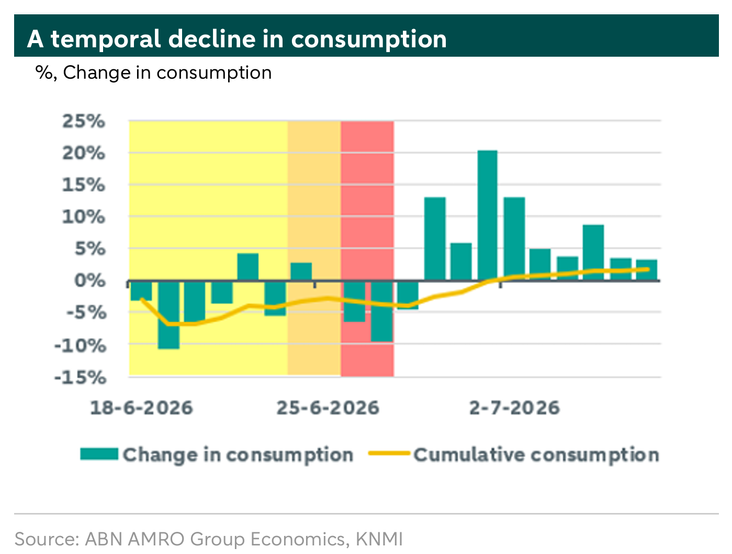
The analysis indicates that the heatwave had a clear but temporary effect on household consumption. Spending fell below normal levels during the heatwave. By the end of the period, households had spent approximately 4% less than usual. Once the heatwave ended, however, expenditures quickly recovered. Spending even rose above normal levels in the following days, suggesting that part of consumption was simply postponed and later made up. Within four days after the heatwave, the consumption shortfall had been fully recovered.
Decline is driven by online spending and cash withdrawals
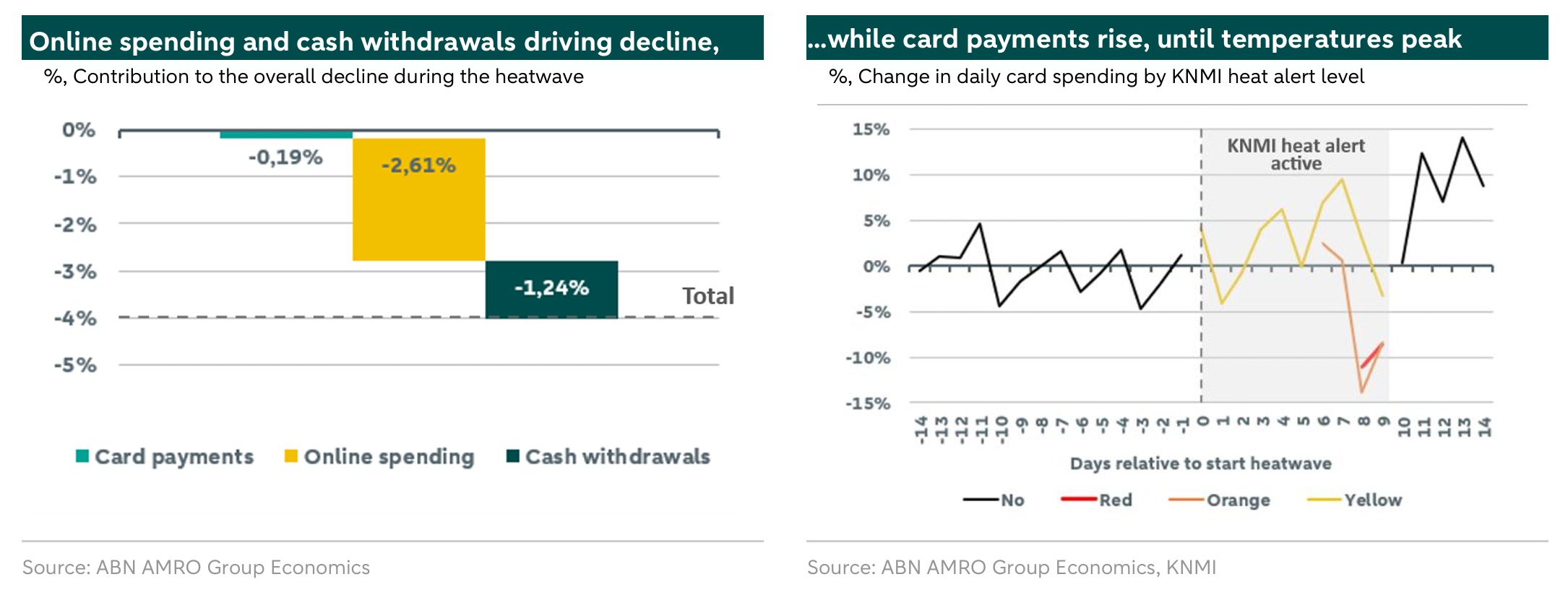
Average household consumption declined by 4% during the heatwave. This reflects the combined effect of online spending, card payments and cash withdrawals. The impact can be expected to differ across payment methods. Online purchases do not depend on physical mobility and can easily be made from home. By contrast, card payments are often linked to in-person shopping, visits to restaurants and cafés, and recreational activities, all of which are likely to be strongly influenced by weather conditions. Cash withdrawals may also follow a different pattern, as they are not directly tied to the timing of consumption. A breakdown by payment method therefore provides greater insight into how households adjusted their spending behaviour during the heatwave. Indeed, the effects varied considerably across payment methods. Notably, the overall decline in consumption was driven by lower online spending and cash withdrawals, while card spending remained broadly in line with its usual level (see left-hand figure above).
Card payments rise at first, but fall as the heat peaks
The stable pattern in card spending is striking at first glance. However, the fact that card expenditure remained broadly in line with its usual level on average does not mean that the heatwave had no impact on card payments. This average masks substantial differences across the various phases of the heatwave. Looking at card spending on a day-by-day basis provides a more nuanced picture. During the first days of the heatwave, and while Code Yello
w was in effect, card spending was actually higher than normal. However, during the extremely hot days when Code Red was in force, card spending declined significantly (see figure on the right above). This pattern suggests that the relationship between temperature and consumption is not linear. Warm summer weather can encourage additional spending outside the home, but once temperatures become extreme, this positive effect reverses and begins to weigh on consumer spending. The relatively stable level of card spending therefore turns out to be the net result of two opposing effects.
Heat effects also vary across regions
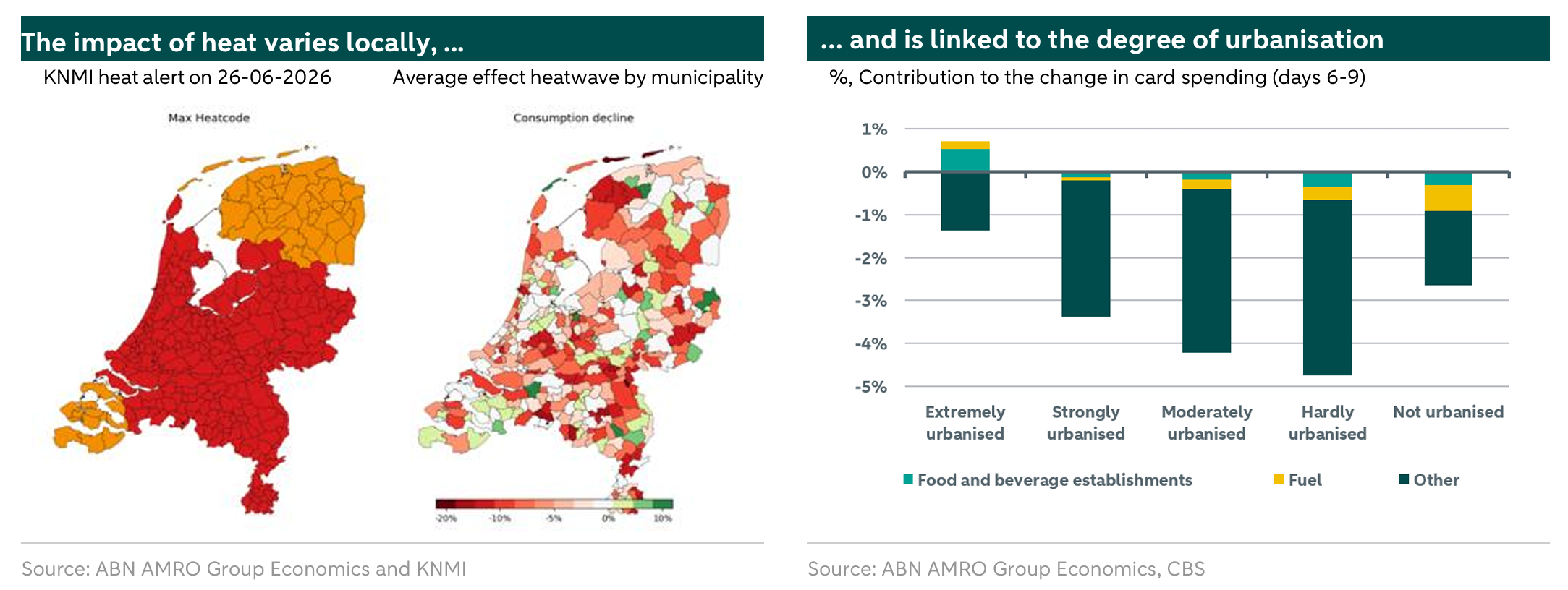
The intensity of the heat clearly influences consumer spending behaviour. However, the severity of the heat varied not only over time and across payment methods, but also across different parts of the country. Although exceptionally warm weather was experienced throughout the Netherlands, both the (perceived) temperatures and the duration of the heat differed by region. On 26 June, the peak of the heatwave, the KNMI issued Code Red warnings for large parts of the country, while Code Orange remained in force in other regions. These differences were also reflected in spending patterns. In most municipalities, spending fell below normal levels. On average, the decline in consumption was larger in areas subject to Code Red than in municipalities where Code Yellow or Code Orange applied. However, even within the Code Red areas, considerable variation remained. Notably, the decline in spending was relatively limited in more urbanised areas.
Urban residents are more likely to cool off away from home
A breakdown of card spending by category shows where expenditures declined and where they increased. Across the country, spending at supermarkets rose, while card spending at other retail outlets declined. To better understand why the decline in spending was relatively limited in more urbanised areas, we further analyse spending patterns by degree of urbanisation during the most extreme days of the heatwave. For this purpose, we use the of urbanisation, which is based on the average number of addresses per square kilometre within a municipality.
Even during the Code Red period, the decline in spending in the most highly urbanised areas remained limited. In fact, spending at restaurants, cafés and other food and beverage establishments in these municipalities was higher than normal, while such spending fell below normal levels in the rest of the country. At the same time, less urbanised areas experienced a decline in fuel expenditure, a pattern that was not observed in highly urbanised areas. This drop in fuel spending suggests that households in less urbanised regions reduced their mobility more during the hottest days.
One possible explanation is that urban areas offer more opportunities to seek relief from the heat outside the home, for example in restaurants, cafés and other hospitality venues. Households outside urban areas are also more likely to have access to a garden or other green outdoor space where they can stay cool. In addition, homes in densely populated urban areas tend to retain more heat, potentially increasing the incentive to seek cooler environments elsewhere. We also know that less urbanised areas generally have a larger share of older residents. This group is typically more vulnerable to extreme heat and is more likely to follow advice to limit physical activity and travel during the hottest hours of the day.
These factors may have contributed to households in less urbanised areas staying at home more often and reducing their spending during the Code Red period, whereas residents of highly urbanised areas were more likely to seek relief from the heat outside the home. This suggests that the impact of extreme heat depends not only on temperature itself, but also on local characteristics.
Conclusion
The findings show that extreme heat affects not only health and quality of life, but also the economic behaviour of house
holds. Although the overall decline in consumption proved to be temporary, both the timing and location of spending shifted. This suggests that extreme heat primarily leads to a temporary displacement of consumption over time, rather than to a permanent loss of spending.
The impact of heat also varies with the severity of temperatures and across regions. In areas where the heat was most intense, declines in consumption were generally larger. At the same time, spending remained relatively more resilient in urban areas, partly because households there were more likely to seek relief from the heat outside the home.