Eurozone - The ECB can afford to wait, for now
Governments are taking the edge off the energy shock, but inflation is still yet to reach a peak. Still, even a more negative inflation shock is likely to be an order of magnitude smaller than in 2022-23. Hard data suggests a tepid start to the year, and likely downside risks to our 0.2% Q1 growth forecast. Even hawkish Governing Council members seem minded to hold rates at the 30 April ECB meeting, leading us to push back our call for hikes to June and July.


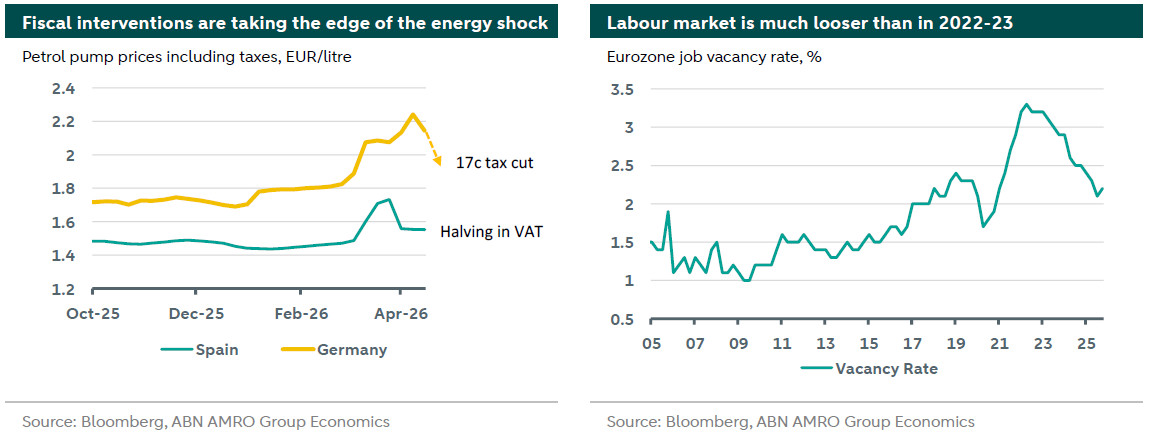
Uncertainty is still high, but we continue to think the economic impact of the Iran conflict on the eurozone will be considerably different to – and smaller than – what we saw during the 2022-23 energy crisis. Inflation in March already jumped well above the ECB’s 2% target to 2.6% y/y, and is likely to pick up further before it falls back. But even in a negative scenario, with a prolonged conflict and even higher energy prices, inflation would peak much lower than the double digits we saw four years ago – nearer 5-6% rather than 10%. As things stand, and following our base case of severe energy supply disruptions lasting until the end of May, inflation is now expected to peak slightly lower than we expected last month, at 3% in Q2. This is partly due to the smaller impact on natural gas prices, forecasts of which we revised down this month, as well as fiscal interventions: following Spain’s halving of VAT on petrol and diesel pump prices, Germany looks set to cut fuel duty by 17c per litre from next month (albeit time-limited for two months). We now expect inflation for the year to average 2.6% in the eurozone, down from 2.8% previously.
What about growth? While we only modestly downgraded our growth forecast on the back of the Iran conflict, underlying growth hardly looks strong. Incoming hard data suggests the year has started on tepid note so far. Despite Germany’s defence spending splurge, industrial production started the year with a contraction and held below 2025 levels in February. Construction has been similarly weak. Consumption has not fared much better, with retail sales essentially flat year to date. Next week’s Q1 GDP release is expected to come in at a modest 0.2% q/q. Absent a particularly strong March, the risks to this forecast look tilted to the downside.
ECB to hike in June rather than April
With risks of a very negative scenario for energy prices looking to have abated in recent weeks, even hawkish Governing Council member Isabel Schnabel said last week “the ECB can afford to take time to analyse the Iran shock.” This essentially takes an April rate hike off the table. Market pricing for rate hikes has declined substantially following the less hawkish remarks and also in light of ceasefire optimism, although markets continue to price in roughly 50bp higher rates by end-2025 than they did prior to the conflict breaking out. Aside from ceasefire optimism, what may also be giving the ECB and markets some comfort is that the labour market is dramatically looser than it was four years ago, with the job vacancy rate hovering close to a 5 year low of 2.2% in Q4 25. This lowers the chance of the same wage-price spiral dynamics of 2022-23 taking hold this time around. Still, even in positive scenario where energy prices more quickly normalise, inflation would likely stay above the ECB’s target for at least six months. While central banks typically look through energy price spikes, the risk to inflation expectations – so soon after the last shock – remains substantial. Though a rate hike at the 30 April meeting now looks unlikely, we still think the Governing Council will want to get ahead of a de-anchoring of inflation expectations by hiking at the June and July meetings.