FX Weekly - Higher rates support the dollar

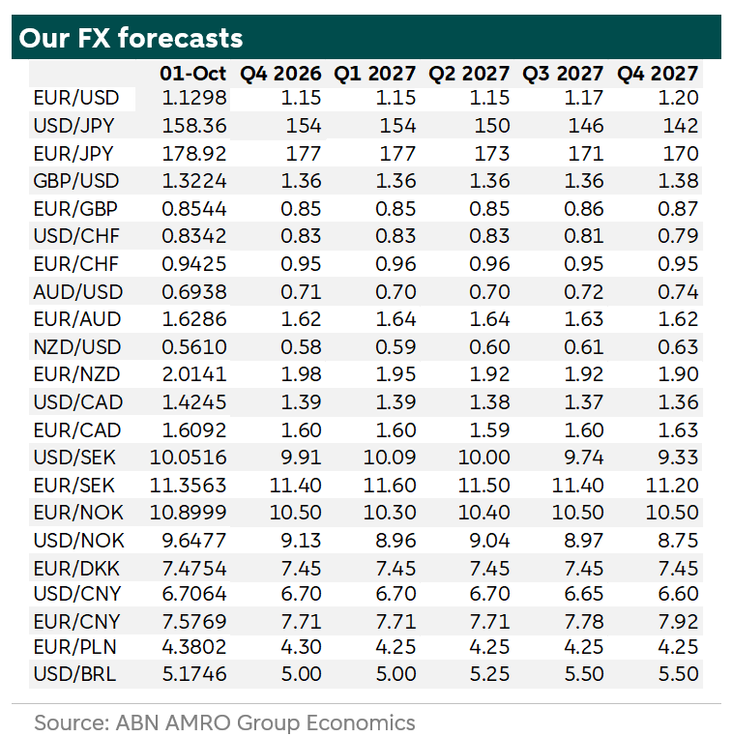
US dollar gained 1.0–2.4% since 17 September against major currencies. Wider US interest-rate differentials have driven the dollar rally. EUR/USD fell by more than 3% from 1.17. The next key downside level is 1.10. Downside in EUR/USD is protected but the upside is constrained. We maintain our EUR/USD forecast of 1.15 for end 2026

Latest developments
Since our previous FX Weekly on 17 September, the US dollar has strengthened considerably. It has gained between 1.0% and 2.4% against major currencies. The Australian dollar weakened the most, while the British pound weakened the least.
Interest-rate differentials had become less important in determining the direction of major currencies, but they are now playing a central role again. The two-year rate differential has moved in favour of the US, as have the ten-year nominal and real rate differentials. Markets now expect for the Fed around 90 basis points of rate hikes by the end of 2027, up from 65 basis points on 17 September, while expectations for ECB rate hikes over the same period have changed only slightly. The main reason for the dollar’s rally has therefore been the widening interest-rate differential in favour of the US.
The euro has weakened by 1.5% against the US dollar. EUR/USD declined below its 24 June low of 1.1325. The pair has shown little ability to recover, even after falling by more than 3% from 1.17 since 20 August. The next important support level is 1.10.
EUR/USD: Downside protected, but limited upside
We expect the downside in EUR/USD to remain limited but upward potential is likely also limited. The main factor limiting further downside is the market’s aggressive pricing of Fed rate hikes. Financial markets currently price in almost four additional Fed hikes, compared with our forecast of only one, while they price in slightly more than three ECB hikes, compared with our forecast of two. If market expectations move towards our forecasts, the adjustment should weigh more on the dollar than on the euro, providing a floor for EUR/USD.
At the same time, the scope for a sustained rise in EUR/USD is also limited. We expect energy prices to remain high for longer. Historically, high energy prices have weighed more heavily on the euro and the yen than on the US dollar, creating a clear constraint on the euro’s recovery.
Political uncertainty is likely to reinforce this range-bound outlook. The US midterm elections could put some downward pressure on the dollar in the coming months. However, later this year and early next year, uncertainty surrounding the French elections in April 2027 is also likely to weigh on the euro. These risks should therefore partly offset each other.
Greater market scrutiny of public finances is also unlikely to produce a clear directional move in EUR/USD. Fiscal concerns may weigh on the US dollar, but similar concerns in the eurozone (France) and the UK could also put pressure on the euro and sterling. The relative impact on EUR/USD should therefore remain limited.
Taken together, these factors suggest that EUR/USD is likely to remain close to current levels. The market’s aggressive pricing of Fed rate hikes limits the scope for sustained dollar strength, while high energy prices and political uncertainty in Europe constrain the euro’s recovery. We therefore maintain our year-end EUR/USD forecast of 1.15, although the recent loss of momentum means that the risks are increasingly tilted to the downside.