Gas Market Strategist - Tight supply and thin storage set the stage for a tough winter
European gas prices hover above EUR 70/MWh amid geopolitical disruption, low storage and intensifying LNG competition. EU storage stands at 65%, well below 82% average, and may reach only 75% by November. Lost Qatari LNG is only partly offset, leaving Europe without a sufficient operational supply buffer. Europe–Asia LNG competition is set to intensify, keeping prices high and volatile. Low storage leaves Europe exposed to cold winter or unplanned US and Norwegian disruptions which could trigger shortages and renewed price spikes. Prices may ease to EUR 45-50/MWh in Q4 if Hormuz reopens; prolonged closure implies EUR 70-80/MWh.

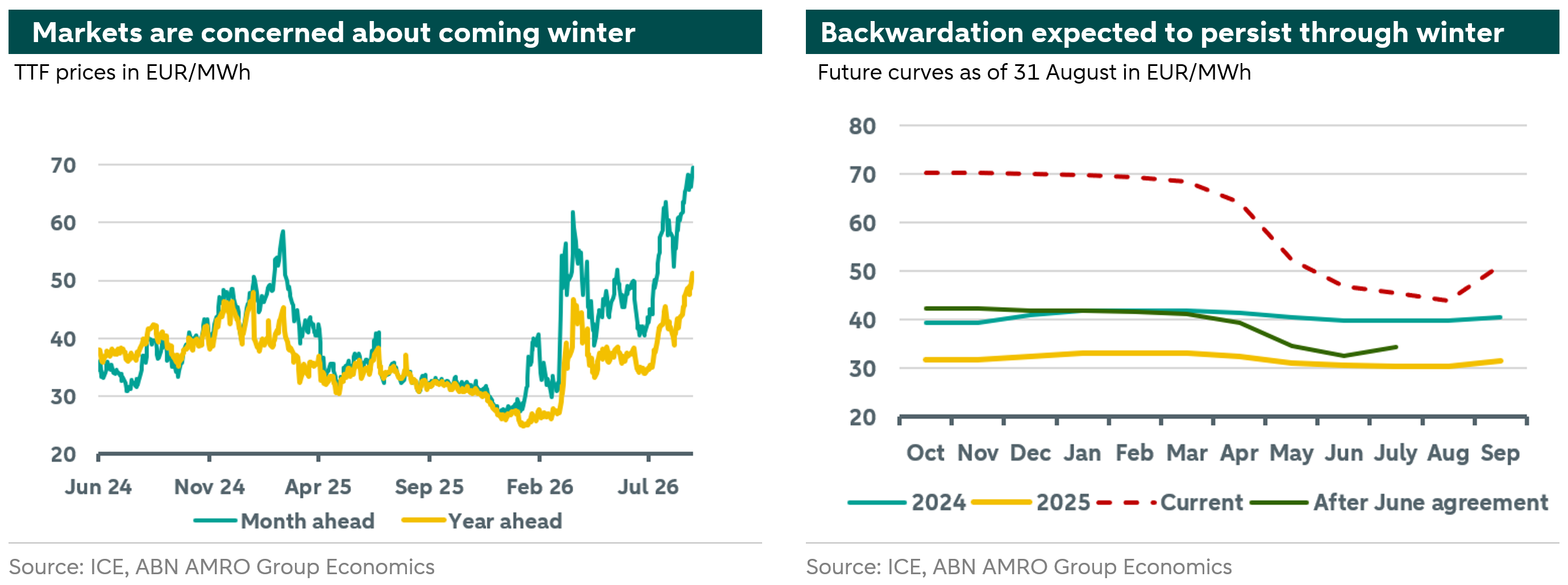
European gas prices initially surged following the US-Iran conflict, then stabilised as Asian demand weakened and US LNG imports increased. A temporary US-Iran agreement offered brief relief, but prices rose again when military operations resumed and prospects for a lasting resolution faded. Prices are now hovering around EUR 70/MWh, a four-year high. The market remains tight while Qatari LNG exports are stalled, summer heatwaves slowed storage injections, and competition from Asia is intensifying ahead of the heating season. Low storage levels, a backwardated forward curve (i.e. near-term prices higher than long-term prices) discouraging injections, and limited spare supply from the US and Norway leave Europe with little buffer against further disruptions. Prices could ease to EUR 45-50/MWh in Q4 if the Strait of Hormuz reopens, but are likely to remain at EUR 70-80/MWh if it stays closed.
European gas market developments
European gas storage stands at 65%, well below the five-year average of 82%, after Qatari LNG disruptions and summer heatwaves slowed injections. US and Norwegian flows remain stable, but spare capacity is limited: US export terminals are operating near capacity and are exposed to hurricane risks, while Norwegian maintenance is expected to reduce autumn flows.
Despite low inventories, the relatively flat and backwardated futures curve offers little incentive to inject gas now for sale during the heating season. This has weakened the pace of stockbuilding and increased exposure to cold weather or supply disruptions.
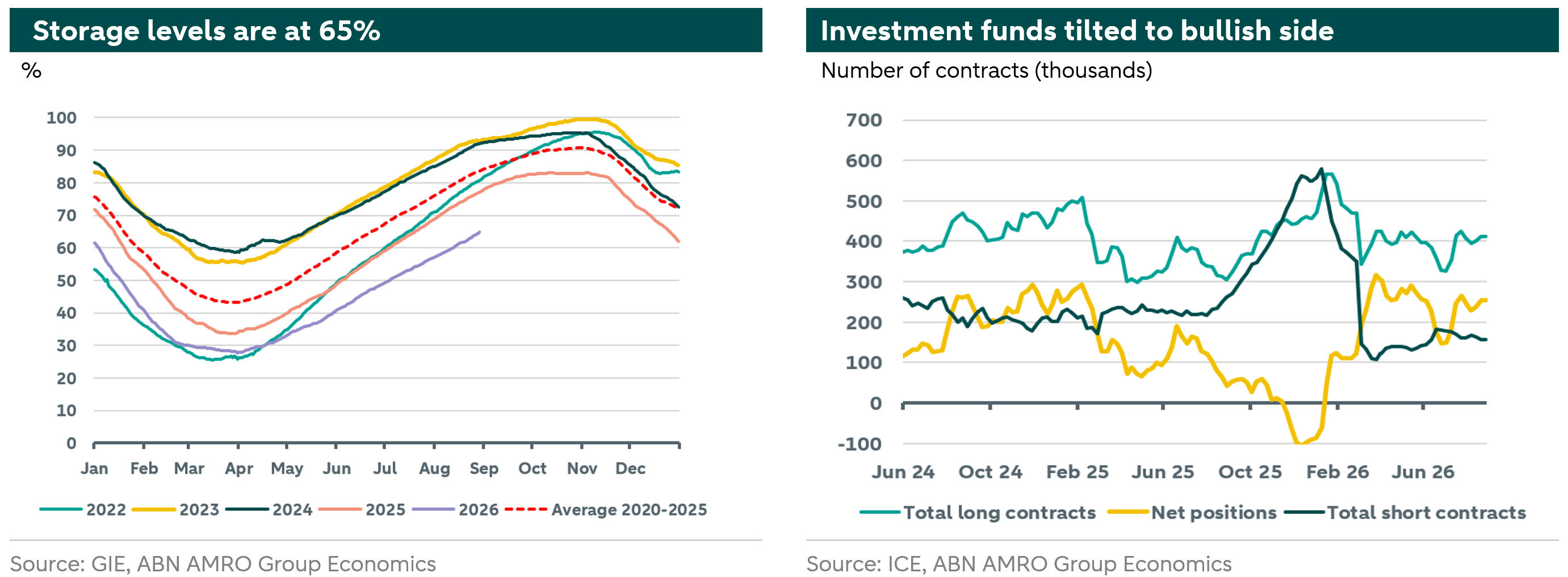
Expectations that the EU will prioritise storage replenishment have encouraged bullish positioning, adding to upward price pressure. Some governments are therefore considering intervention; Germany, for example, is exploring consumer-funded support for storage injections.
Offsets for Qatari LNG disruption
Qatari LNG remains largely unavailable on the market, with little expectation of its return in the near future. Meanwhile, Iran's Persian Gulf Strait Authority has heightened tensions by threatening to fine or confiscate dozens of ships, including 10 LNG carriers, sparking fears of further disruptions to shipments through the vital waterway.
The effective closure of the Strait has caused Qatari LNG exports to plummet by approximately 96%, reducing global supply by roughly 100–105 bcm/year. Over six months, Qatar managed to export only 18 cargoes compared to its historical average of over 500, further compounded by physical strikes that damaged LNG units 4 and 6 at Ras Laffan.
Meanwhile, the market has been benefiting from new LNG export capacity-primarily from the US Gulf Coast and West Africa-adding 35–55 bcm/year between late 2025 and mid-2026. This expansion offsets around 33–50% of the lost Qatari volumes. However, severe shipping bottlenecks, driven by war-risk insurance spikes, vessel rerouting, and tanker damage, have also limited the effective delivery of alternative supplies.
In addition, and in response to soaring spot gas prices, demand destruction emerged as another stabilizer, with energy-intensive industries across Europe and price-sensitive nations in Asia cutting gas consumption, accounting for 20–30 bcm/year of demand reduction. Asian LNG imports for the first half of 2026 fell by nearly 4% year-over-year, supported by reduced spot purchases from China. Emergency fuel-switching efforts further displaced gas consumption, with coal-fired power plants reactivated (absorbing 12–18 bcm/year), dual-fuel power plants switching to oil and distillates (8–10 bcm/year), and increased nuclear and renewable output in Europe displacing another 8–12 bcm/year of gas demand.
While these measures theoretically address the Qatari shortfall, they leave no operational buffer heading into winter 2026.
How much storage is sufficient?
Severe European winters have historically caused significant spikes in gas consumption for heating and power generation, leading to substantial drawdowns in underground gas storage. Notable examples include Winter 2017–2018, Winter 2020–2021, Winter 2021–2022, and Winter 2024–2025. During these periods, storage levels peaked between 77% and 95% before winter and dropped to troughs ranging from 18% to 39% by the season's end, with net drawdowns of 50% to 70% of total storage capacity. Given the EU's total working gas storage capacity of 100–110 bcm, a typical cold winter results in 55–75 bcm of natural gas being withdrawn.
The EU has set a target to achieve 90% gas storage between October and December, aiming to secure sufficient reserves to maintain system pressure, meet late-season demand, and stabilize market prices. However, given current storage levels and injection rates, we expect storage to reach 75% by November, assuming favourable weather conditions in the interim. Entering winter with only 75% gas storage is workable with mild winter, but it could prove insufficient in a severe winter due to operational and logistical risks.
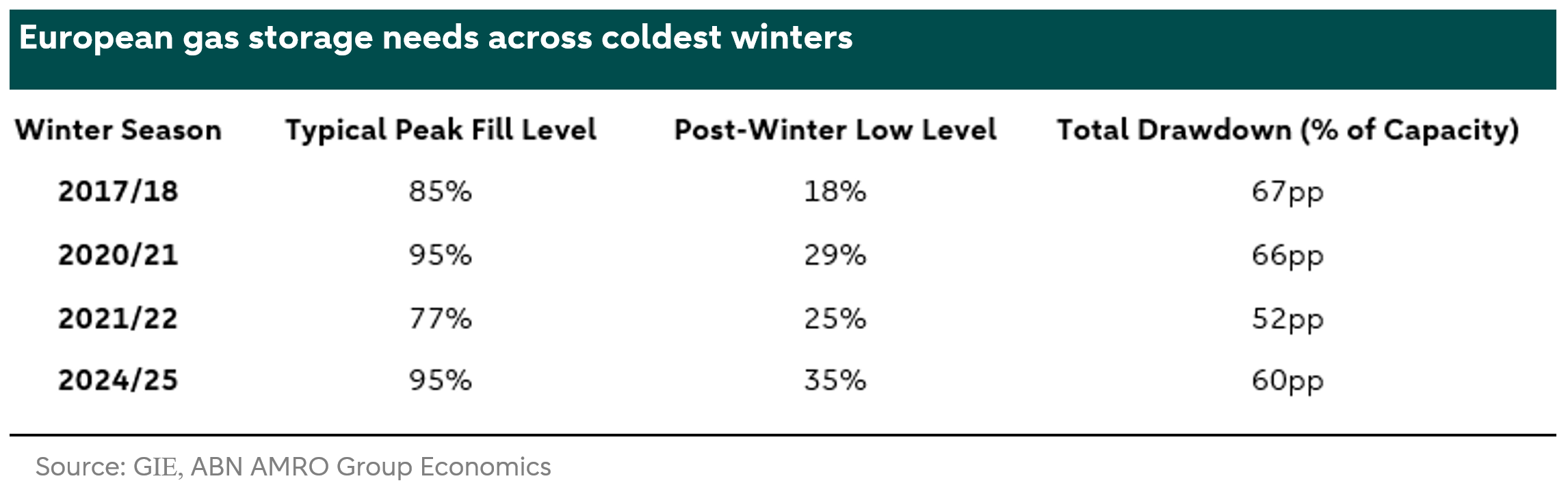
While a cold winter might draw down 60% of capacity on paper, natural gas logistics are more complex. First, storage facilities rely on internal pressure to extract gas, and as levels drop below 30%, pressure declines, limiting the rate of extraction during peak demand. Second, storage only supplements Europe’s winter gas needs, covering 25%–33% of total consumption, with the rest dependent on imports. A low starting level leaves minimal margin to handle simultaneous cold spells and supply disruptions. Finally, ending winter with critically low storage (5%–10%) creates refilling challenges, triggering price spikes as countries scramble to rebuild stocks for the next season.
More competition on the horizon
Summer optimism that Qatari supply could return, together with weaker Asian demand, initially reduced the urgency to secure LNG. As prospects for an agreement fade and winter approaches, market attention is shifting to tighter cargo availability.
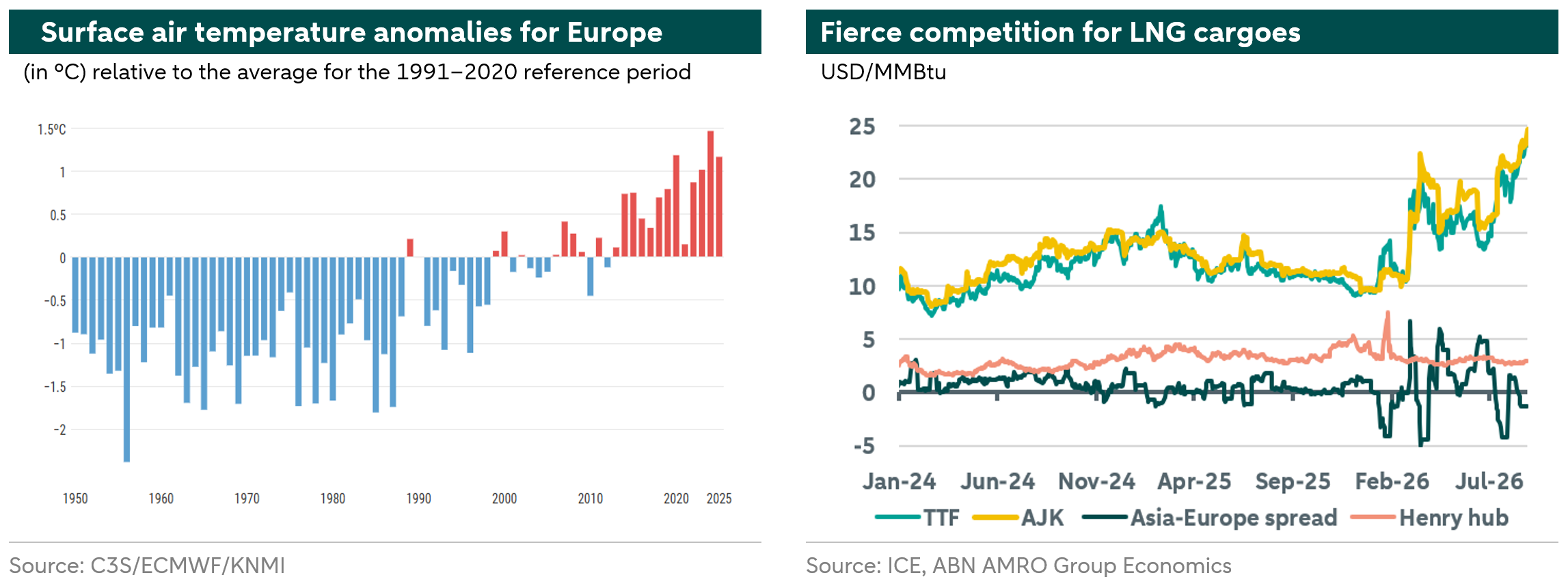
The Asia-Europe spread measures the incentive for LNG cargoes to head to Europe versus Asia, accounting for factors such as exchange rate differences and unit conversions. A negative spread indicates higher LNG prices in Europe compared to Asia, making Europe a more attractive destination for cargoes. Since the onset of LNG disruptions in the Strait of Hormuz, the spread has shown increased volatility, alongside a rise in TTF and AJK prices as competition intensifies ahead of the heating season. This trend is expected to escalate as long as Middle Eastern disruptions persist and Qatari LNG remains unavailable. Unlike oil, LNG transport requires highly specialized and complex ships-among the largest in the industry-that are difficult to miss, making ‘dark fleet’ passage more challenging. Additionally, the ship-to-ship transfer currently used for oil to pass through the Strait of Hormuz is far more challenging for LNG due to the strict conservation requirements and temperature stability needed for handling super-chilled liquid.
El Niño could play a role in the European gas market
Europe's upcoming heating season could benefit from a mild winter driven by an exceptionally strong El Niño, a phenomenon that releases heat from the Pacific Ocean into the atmosphere and often pushes global temperatures to record highs. Scientists predict 2027 could become one of the hottest years on record, potentially overtaking 2024, which was 1.5°C above the pre-industrial average, according to National Oceanic and Atmospheric Administration (NOAA). However, while this El Niño is expected to be the strongest in over a decade, its impact on European winter temperatures remains uncertain. Europe's winter climate is primarily influenced by the North Atlantic Oscillation (NAO), where a positive NAO brings mild, wet conditions, and a negative NAO leads to colder weather. Although El Niño may slightly increase the chances of a milder winter in Europe, the connection is weak and far less predictable compared to other regions. To significantly reduce Europe's winter gas demand and offset low inventories, El Niño would need to raise temperatures at least 2°C above the historical average—a scenario that remains unlikely.
European gas outlook
Europe entered September with gas storage at 65% capacity, the lowest late-summer level since 2011. Our baseline assumes stable inflows from Norway and the US, favourable weather, timely ramp-up of new LNG capacity such as the Golden Pass, and reopening of the Strait of Hormuz by the end of Q3. Under these conditions, European storage should reach around 75% by November, later than previously expected when the US-Iran agreement remained in place.
The main downside triggers are a colder-than-expected winter, outages or maintenance overruns in Norway, hurricane-related disruption to US LNG exports, delays to new liquefaction capacity, or continued closure of the Strait. Any combination of these risks would tighten cargo availability, slow storage replenishment and intensify price pressure as Europe and East Asia compete for non-Hormuz LNG. Bullish trader positioning underlines near-term supply concerns. A strong El Niño could provide some relief through milder weather, while weaker Asian demand, further demand destruction and government intervention to secure cargoes should cap—but only partly offset—price increases.
We expect European gas prices to remain above seasonal averages and average EUR 57-62/MWh in Q3. If the Strait reopens as assumed, improved LNG availability could allow prices to ease to EUR 45-50/MWh in Q4 as Europe enters the heating season. If it remains closed, stronger winter demand and persistent market tightness are likely to keep prices at EUR 70-80/MWh. For 2027, we expect prices to drop due to the return of Qatari flows and more additional new capacity become online.
