Carbon Capture and Storage: what does the future hold?

Carbon capture and storage (CCS) is increasingly viewed as a necessary complement to energy efficiency and renewable energy in achieving net zero-emissions. The EU has acknowledged this role by establishing a certification framework for carbon removals, carbon farming and carbon storage in products. Global CCS deployment is projected to increase from 60 MtCO2/year today to 2.6 GtCO2/year in 2060. Today, around 85% of installed CCS capacity is linked to natural gas processing, but the sector is expected to shift towards other hard-to-abate industries by mid-century. Europe is expected to emerge as one of the world’s leading CCS markets, driven by rising carbon prices, industrial carbonization needs and growing transport and storage infrastructure.

The primary objective of climate policy remains the reduction of greenhouse gas emissions through energy efficiency improvements and the replacement of fossil fuels with renewable energy sources. However, an increasing number of studies and climate scenarios suggest that these measures alone are unlikely to be sufficient to achieve climate neutrality. According to the Intergovernmental Panel on Climate Change (IPCC), carbon dioxide removals will be needed to offset residual emissions from sectors where complete decarbonisation is technically challenging or prohibitively expensive. Carbon capture and storage (CCS) is therefore increasingly viewed as a necessary complement to emissions reduction efforts rather than an alternative to them. While CCS is unlikely to deliver net zero on its own, it is becoming an increasingly important enabler of industrial decarbonisation, particularly in hard-to-abate sectors where alternatives remain limited.
In a previous publication, we examined the economics of carbon capture technologies and their relationship with carbon pricing (see here). The current note takes a broader perspective and explores the future role of CCS and carbon removals in net-zero pathways, including expected deployment trends, the growing role of hard-to-abate industries, and Europe's emerging transport and storage infrastructure.
Although the European Union has committed to achieving climate neutrality by 2050, carbon removals from terrestrial ecosystems have declined in recent years, while industrial-scale carbon removals remain limited. To help address this gap, the EU adopted a regulation in 2024 (see ), establishing a certification framework for permanent carbon removals, carbon farming and carbon storage in products. The framework aims to improve transparency, strengthen confidence in carbon-removal claims and stimulate investment in high-quality removal activities.
CCS: From Niche Technology to Industrial Necessity
While CCS has attracted growing attention as a decarbonisation technology, its current deployment remains heavily concentrated in the oil and gas sector. According to DNV (see ), natural gas processing accounts for approximately 85% of installed carbon capture capacity worldwide. The reason is relatively simple: many natural gas fields contain significant quantities of CO2 that must be removed before the gas can be sold or transported. Because CO2 separation is already part of the production process, the additional step of compressing and storing the captured CO2 is comparatively straightforward and cost-effective.
By contrast, capturing CO2 from industrial activities such as cement, steel and chemical production is typically more complex and expensive. These sectors emit CO2 through large volumes of relatively dilute flue gases, requiring dedicated capture equipment and substantial energy input. As a result, CCS deployment has historically been concentrated in natural gas processing, hydrogen production and a limited number of industrial applications where capture costs are relatively low.
However, the industry is entering a new phase. Global CCS deployment accelerated significantly between 2024 and 2025. According to the European Commission Joint Research Centre (see ), operational capture capacity increased from 51 MtCO2 to 64 MtCO2 per year, while the number of operating facilities rose from 50 to 77. Meanwhile, the number of projects in advanced development increased by 46%, indicating a rapidly expanding project pipeline.
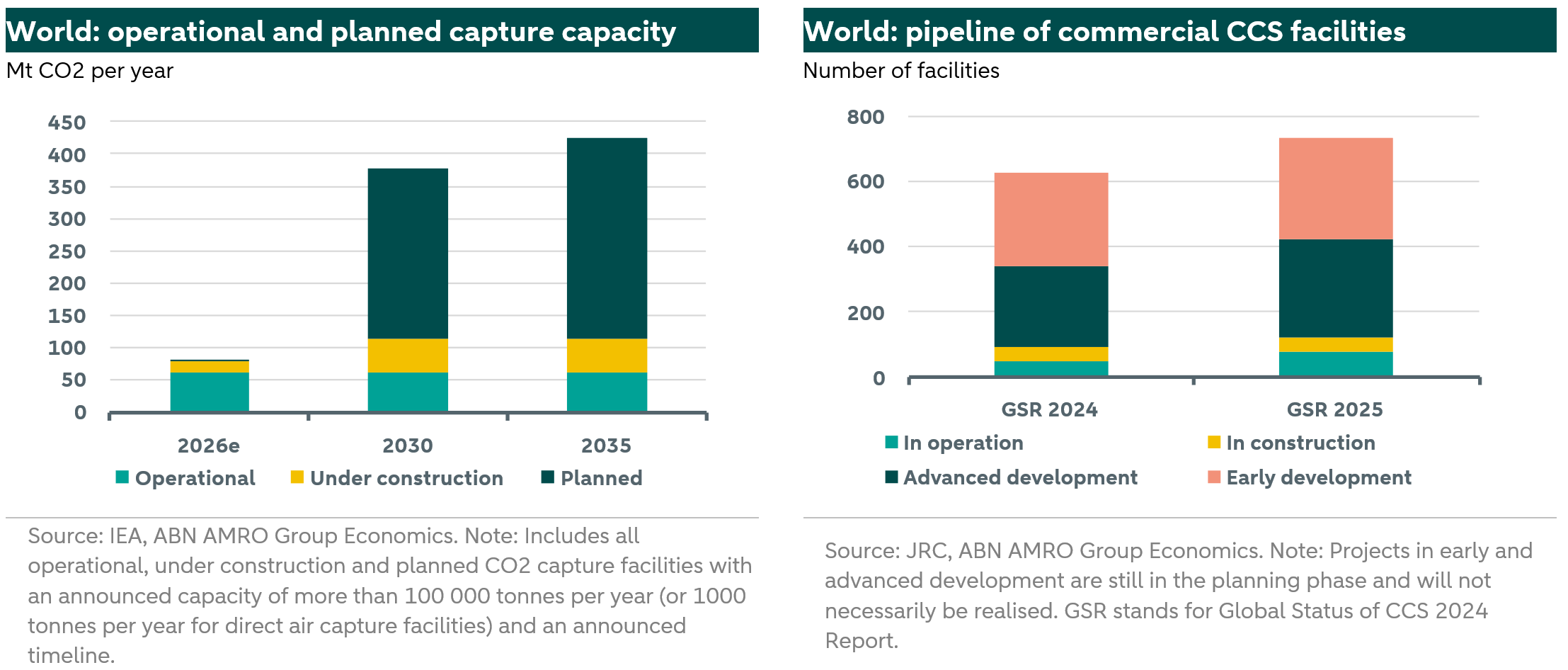
Looking ahead, DNV projects global CCS deployment to increase from around 60 MtCO2 per year today to approximately 2.6 GtCO2 per year by 2060, representing growth of more than fortyfold. By then, CCS is expected to capture nearly 14% of global emissions.
This expansion, however, remains well below the levels assumed in many net-zero scenarios, where CCS and carbon removals typically reach 7-10 GtCO2 annually by mid-century. The gap reflects the distinction between DNV's assessment of what is most likely to occur under current market and policy conditions and what would be required to deliver a net-zero pathway. While CCS is expected to become an increasingly important decarbonisation tool, economic, regulatory and infrastructure constraints will most likely limit deployment, leaving CCS volumes significantly below those required to offset residual emissions and achieve global net-zero emissions by 2050.
Importantly, future growth is expected to come from a very different set of sectors than those that dominate the market today. While natural gas processing currently accounts for the majority of captured volumes, DNV expects hard-to-abate industries such as cement, steel and chemicals to drive most new CCS deployment. That is because these sectors generate significant process emissions that cannot be readily eliminated through electrification, renewable energy, or other conventional decarbonisation measures, making CCS one of the few viable mitigation options. By 2060, manufacturing is projected to become the largest source of captured CO2.
Overall, CCS appears to be evolving from a niche technology into a broader industrial decarbonisation tool. The key question is no longer whether CCS can work technically, but whether policy support, infrastructure development and declining costs can enable deployment at the scale required to support climate objectives.
Europe’s emerging CCS ecosystem
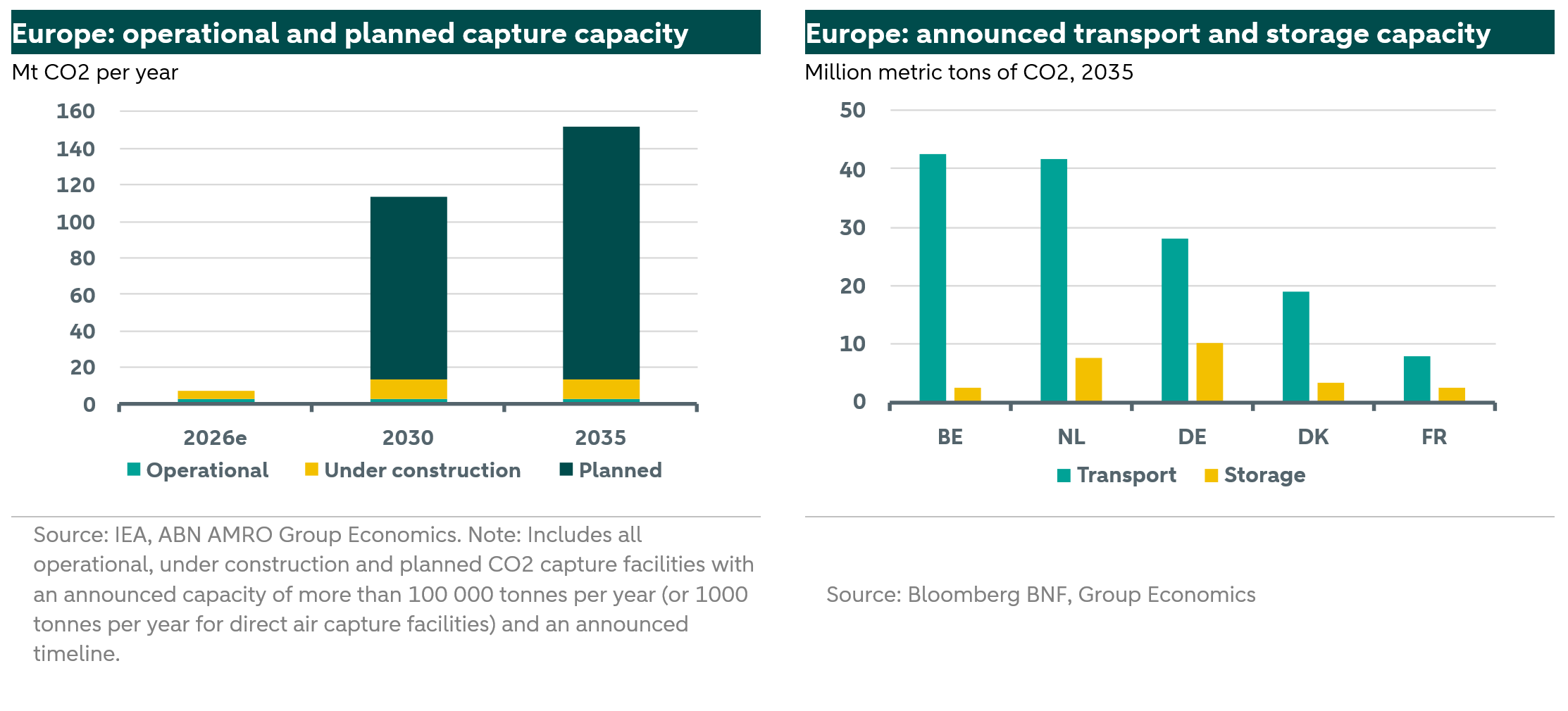
Although DNV has recently lowered its long-term CCS deployment outlook, Europe remains one of the most promising regions for CCS development. Unlike many other regions, Europe combines a meaningful carbon price with a rapidly developing transport and storage network, creating both the economic incentives and the infrastructure required for large-scale CCS deployment.
Several factors underpin this positive outlook. First, the European Union Emissions Trading System (EU ETS) places a price on carbon emissions, creating a financial incentive for companies to reduce or capture their CO2 emissions. Second, governments are supporting early-stage CCS projects through grants, contracts for difference and other funding mechanisms. In addition, the Net-Zero Industry Act (NZIA) sets a target of achieving at least 50 MtCO2 of annual CO2 injection capacity by 2030, highlighting the EU's commitment to developing the storage infrastructure required for large-scale CCS deployment.
As a result, the European CCS market is expected to develop around industrial hubs in which multiple emitters share transport and storage network. Captured CO2 is likely to be transported across national borders and stored in shared geological reservoirs, particularly in the North Sea. This approach can reduce costs, improve efficiency and accelerate deployment by creating economies of scale.
The scale of the infrastructure challenge is considerable. According to the European Commission Joint Research Centre (JRC), Europe's CO2 transport network could expand to around 19,000 km by 2050, requiring investments of approximately EUR 23.1bn. These estimates highlight that the success of CCS will depend not only on capture technologies but also on the development of a continent-wide transport and storage network connecting industrial emitters to suitable storage sites.
Recent developments in the Netherlands illustrate this growing policy commitment (see ). The Dutch government has announced plans to invest approximately EUR 1.3 billion in the Aramis CO2 transport and storage project, which will connect industrial emitters in the Port of Rotterdam with offshore storage sites beneath the North Sea. While the project is not expected to reduce net CO2 emissions before 2031, built-in implementation flexibility means that the timeline could extend by several additional years. Together with initiatives such as Northern Lights, Porthos and Greensand, Aramis forms part of a broader European effort to build the infrastructure needed for large-scale industrial carbon capture and storage.
However, significant challenges remain. A recent report by Deloitte (see ) notes that, although Europe hosts nearly 40% of the more than 800 CCS projects currently under consideration worldwide, large-scale deployment continues to be constrained by economic and infrastructure barriers. In particular, the report identifies a substantial "value gap" between the cost of CCS and the value of avoided carbon costs. In Europe, for example, CCS projects can cost EUR 150 per tonne of CO2 more than prevailing EU ETS carbon prices. As a result, the costs of capturing, transporting and storing CO2 often exceed the financial benefits of avoiding emissions or of paying for an additional allowance, leaving projects dependent on government support. Investment decisions are further complicated by uncertainties surrounding transport costs, future carbon prices, CO2 purity requirements and long-term storage costs.
Deloitte therefore argues that continued policy support, targeted subsidies and investment in shared transport and storage infrastructure will remain essential for scaling up CCS. The report concludes that CCS can play an important role in the decarbonisation of European industry, particularly in hard-to-abate sectors, but that regulatory support and infrastructure development will be critical to unlocking deployment at the scale required to decarbonise Europe’s hard-to-abate industries.
Direct Air Capture: the ultimate removal technology?
Beyond capturing emissions from industrial sources, attention is increasingly turning to technologies that actively remove CO2 from the atmosphere. A related technology attracting growing attention is Direct Air Capture (DAC), which removes CO2 directly from the atmosphere. DAC facilities pull ambient air through chemical filters that selectively capture CO2 before compressing it for permanent storage.
However, the economic challenge is substantial. Atmospheric air contains only around 0.04% CO2, roughly one hundred times less than human breath and significantly less than most industrial emission streams. Consequently, processing sufficient air volumes requires large amounts of energy and capital. DNV expects DAC costs to remain around USD 350 per tonne of CO2 through 2050.
Nonetheless, DAC offers a unique advantage: it removes CO2 that has already accumulated in the atmosphere. For this reason, DNV expects DAC deployment to increase gradually and reach approximately 84 MtCO2 per year by 2050, complementing lower-cost carbon removal technologies such as bioenergy with carbon capture and storage (BECCS).
CCS remains essential, but not sufficient
Overall, CCS is evolving from a niche technology associated primarily with natural gas processing into a key decarbonisation solution for hard-to-abate sectors such as cement, steel, chemicals and parts of the energy industry. Europe is well positioned to become one of the world's leading CCS markets, supported by the EU Emissions Trading System, targeted policy measures and continued investment in CO2 transport and storage infrastructure.
Nevertheless, the scale challenge remains substantial. DNV's latest outlook suggests that, although CCS deployment is expected to grow significantly over the coming decades, its contribution may be more limited than previously anticipated due to challenges related to project economics, infrastructure development and policy implementation. As a result, energy efficiency, electrification, renewable energy deployment and other emissions-reduction measures are expected to remain the primary drivers of the energy transition.
This perspective is consistent with IPCC mitigation pathways, which indicate that the majority of emissions reductions must come from direct cuts in CO2 and non-CO2 emissions. Carbon removal technologies, including Direct Air Capture (DAC), are expected to play a complementary role in achieving net zero and to become increasingly important for offsetting residual emissions thereafter. At the same time, delaying emissions reductions today would increase reliance on large-scale carbon removal technologies in the future, many of which remain costly and have yet to be deployed at the scale required. Ensuring early and sustained emissions reductions therefore remains the most effective and least uncertain pathway to achieving long-term climate goals.