Germany - Cautious optimism

Economic output is rising, but no decisive breakthrough is in sight. Still, we are raising our GDP growth forecast for 2026. The inflation rate is likely to hover just below 3.0% over the coming months.
Alexander Krüger
Chief Economist Germany
Against the backdrop of the ongoing Iran war, the German economy has remained resilient in the latest data releases. Solid GDP growth has now been recorded for three consecutive quarters. Nevertheless, the cumulative growth gap vis-à-vis other euro-area countries since the end of the Covid pandemic remains wide. This is unlikely to change any time soon, particularly as, in our view, the composition of GDP growth is not particularly encouraging. Growth continues to be driven to a significant extent by debt-financed government consumption. More recently, foreign demand has also provided a stronger contribution. Domestically, however, the picture remains subdued. Consumers continue to be unsettled by high energy prices and erratic policymaking. While the governing coalition has passed a reform package – which we welcome, as it contains several promising measures, including efforts to reduce bureaucracy – it falls well short of a far-reaching economic overhaul on the scale of Agenda 2010. The combined reforms to taxation and social security contributions provides no meaningful relief for private households or businesses. Energy remains expensive. Genuine incentives for an investment offensive are lacking, while the competitiveness of many companies remains impaired. We therefore doubt that the inclination of companies to relocate and of workers to move abroad will diminish materially. At least the persistent decline in investment appears to be bottoming out. A self-sustaining upturn, however, remains elusive. Moreover, the predominantly consumption-oriented use of the fiscal package points to a short-lived cyclical boost rather than a shift to a sustainably higher growth trajectory.
Nevertheless, we are becoming cautiously more optimistic about the growth outlook. Public investment, including defence investment spending, will continue to rise noticeably and support growth. However, we expect the spillover to other demand components to remain limited. In particular, the loss of purchasing power resulting from elevated energy prices, together with a more uncertain labour market outlook, will likely keep a lid on the recovery in private consumption. Despite full order backlogs, industrial capacity utilisation is unlikely to increase to any significant extent given the difficult conditions for doing business in Germany. In addition, financing conditions are becoming less supportive. Another burden is that companies continue to face the repercussions of the Iran war. Taken together, these factors point to a growth trajectory ranging from subdued to solid. Partly reflecting statistical upward revisions – which raised cumulative growth over 2011–2021 by 0.8 percentage points – we have revised our GDP growth forecast for 2026 from 0.7% to 1.3% and for 2027 from 0.9% to 1.1% (working day adjusted: to 1% from 0.7%, 2027 unchanged at 1%). We continue to monitor potential disruptions from US tariff policy and supply-chain developments.
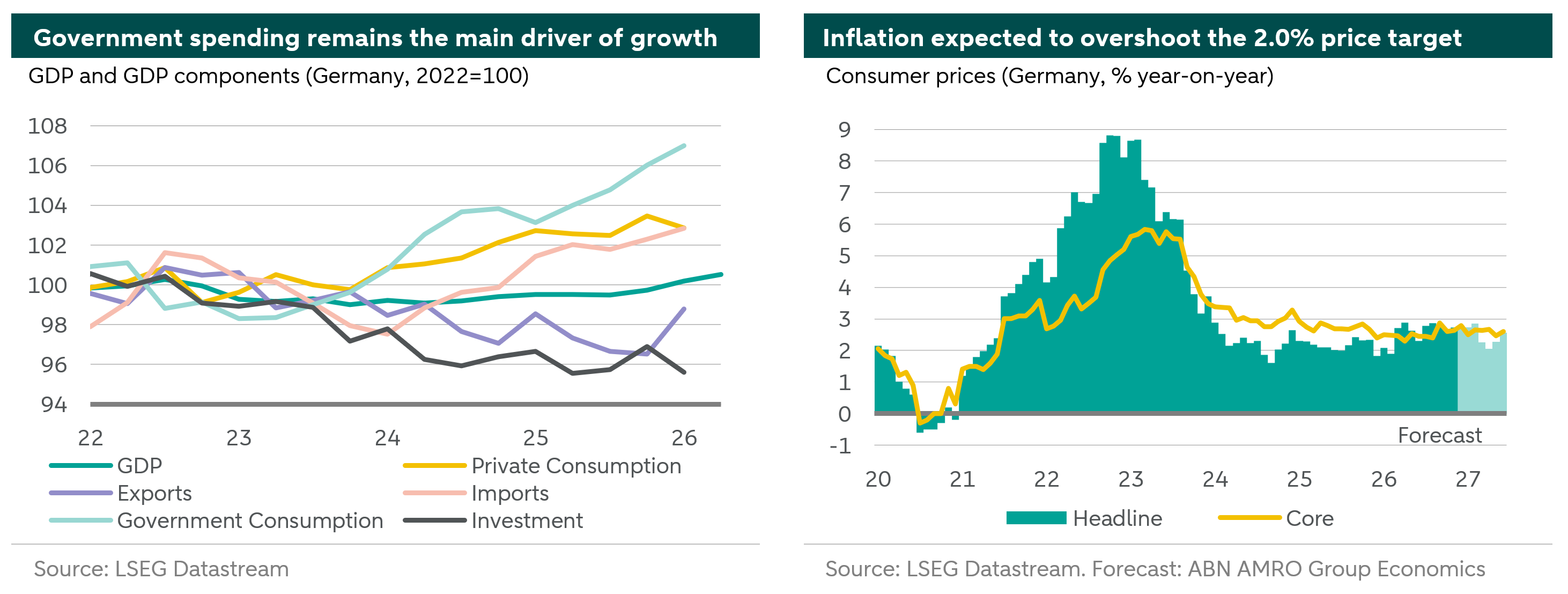
Concerning inflation, a fundamental easing is not yet in sight. The increase in energy costs caused by the Iran war continues, with crude oil, gas, and electricity prices having risen markedly again since the beginning of July. Low water levels on the Rhine and crop failures caused by heatwaves are also likely to result in upward pressure on agricultural commodity and food prices. We expect companies to pass through most of these higher costs to consumers. Against this backdrop, the inflation rate is likely to come in just below 3.0% this year. We expect inflation to move broadly back towards the 2.0% ECB inflation target by spring 2027. In our view, risks to the inflation outlook are tilted to the upside.