Germany - Political uncertainty keeps weighing on economy

The economy is stabilizing but remains fragile, with inflation above target. Some progress on pension reforms, but internal tensions persist. Rising political risks and uncertainty due to voter dissatisfaction.

Following a setback in February, the latest sentiment indicators point to a bottoming out. For instance, the Ifo index has increased albeit remaining at a low level. Consumer confidence has risen as well, reflecting a more favourable labour market outlook according to the IAB and Ifo. These tentative improvements follow reports of a ceasefire between the US and Iran and may continue if peace negotiations develop positively. Earlier, in response to the conflict and the resulting rise in energy prices, we revised our GDP growth forecasts downwards to 0.8% for this year and 1% for next year. At present, we see no reason to adjust these projections further. Although uncertainty continues to weigh on consumption and business investment, the economy is supported by higher public spending. The government is investing in defence, infrastructure and climate measures, albeit more slowly than anticipated. The 2025 elections forced the government to operate under a provisional budget for an extended period, resulting in only 65% of the €37 billion infrastructure fund being spent last year. In 2026, implementation has accelerated, with 28% of the €40 billion allocation deployed by April. Nevertheless, sluggish fiscal roll-out at the local government level continues to justify our cautious growth outlook. According to preliminary figures inflation fell to 2.3% year-on-year in June, down from 2.6% in May, and 2.9% in April. Inflation is currently being depressed by the reduction in fuel duties introduced in May, as well as the recent drop in energy prices. The fuel duty cut will lapse as planned in July, and although energy prices are now falling, rising core inflation (especially goods) is expected to keep overall inflation above target for some time.
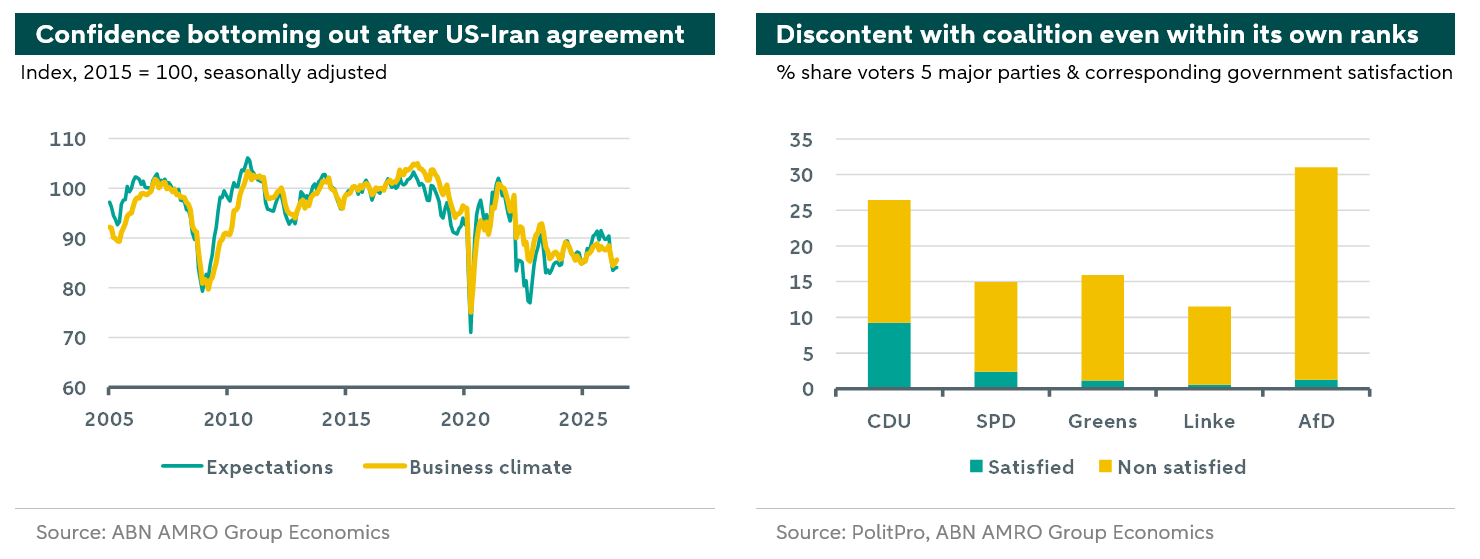
The government took first steps towards pension and labour market reforms. It intends to supplement the pay-as-you-go scheme with a funded pillar that invests in riskier, but potentially higher-yielding, capital market assets. Progress on this front is welcome, as little has so far come of Merz’s election pledge to implement structural reforms, aside from changes in healthcare and a new heating law. Merz had promised to put an end to the infighting that characterised the previous government but has failed to do so. Nor has he delivered on his pledge to halve support for the AfD. Recent polls suggest that the pro-Russia, anti-Nato and anti-EU AfD is now leading. Many voters are not so much drawn to AfD out of conviction, but rather out of disappointment with the established parties. Indeed, nearly half of voters believe the coalition should not serve out its full term. The coalition has already suffered setbacks in two state elections and several elections on the municipality level and risks further losses in three more elections scheduled for September. The SPD in particular is bearing the brunt. It faces a difficult dilemma: whether to adopt a more socially conservative stance to win back voters from the AfD, or to pursue a more progressive course that appeals to those who have defected to the Greens and Die Linke. Further political fragmentation appears likely in the event of a poor electoral outcome. It is even conceivable that the SPD could withdraw from the government. CDU/CSU might then opt to govern without a fixed coalition, seeking ad hoc majorities on a case-by-case basis. The Dutch experience, however, illustrates the challenges of such an arrangement. This applies all the more to Merz, who is unpopular even among CDU voters. Overall, the government remains on fragile footing. Early elections are a possibility, with the AfD potentially gaining further ground. For the economy, this would mean heightened uncertainty and a risk of delays in reforms and decisions on defence and infrastructure spending. All the more reason for the current coalition to press ahead with reforms.