Global Daily – Deconstructing the surge in eurozone inflation
Euro Macro: Inflation jump does not reflect fundamental drivers – Eurozone inflation accelerated sharply in January, reaching the giddy heights of 0.9% yoy, up from -0.3% yoy in December. The rise in inflation was bigger than expected, even following the upside surprise from early data from a number of member states (consensus: 0.6% yoy). At this stage, we have the major components of inflation, but not the full detail (to be published on 18 February).

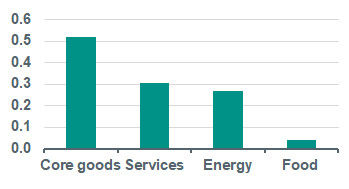
The chart below show the contributions to the acceleration in inflation in January compared to December of last year. Core goods inflation (non-energy industrial goods prices) made the largest contribution followed by services inflation (the other and larger component of core inflation) and energy prices.
Contribution to change in annual HICP inflation between January and December
Percentage points
What explains these movements? First of all tax changes. The temporary reduction in the VAT rate in Germany of July 2020 was reversed in January. Also in Germany, a national carbon pricing system for sectors not covered by the EU ETS was introduced. Indeed, Germany was also the member state that saw the sharpest acceleration in inflation.
Second, inflation may been pushed higher by the methodology that statistics agencies are using to estimate prices that could not be collected due to mobility restrictions or closures of shops (see ). This might have been a particular issue for core goods prices, where the share of imputed prices rose to 18% in January from 5% in December, while the annual comparison might have been exacerbated as it is usually a period of discounting.
Third, new (preliminary) weights were used to reflect the significant effect that the COVID-19 pandemic had on household consumption patterns. This means that items that have seen sharp falls in demand and hence prices have been given a lower weight in the basket, and hence the impact of any given price fall on inflation is less from January onwards. As noted above, we do not have full details yet, however in 2020, we observed that the prices of items related to travel fell very sharply. For instance, in December, three items (package holidays, flights and accommodation) were depressing annual services inflation by 0.4 percentage points and explained two-thirds of the total drop in services inflation last year.
It is difficult to explain the trends in inflation on the back of fundamental drivers, which still look disinflationary. For instance, while core goods inflation was up by 1.4% yoy in December, producer prices ex-energy are flat year-over-year, while core import prices fell by 1.6% yoy in the latest reading. The latter reflects still subdued global price trends as well as the strength of the euro. More importantly, there remains large amounts of spare capacity in the eurozone economy. Even assuming a strong economic recovery in the second half of the year, the output gap will likely be in the 3-4% area. As noted in our recent note, slack is also building in the eurozone labour market (see here).
Looking forward, the acceleration of inflation is far from over. Although energy inflation turned less negative in January (to -4.1% you from -6.9% yoy), it will likely shoot into positive territory over the next few months and could push inflation up by almost a percentage point compared to current levels by around May, before falling back again. In addition, we are likely to see further upward pressure from the VAT changes in Germany, especially in the summer due to base effects. Working against these upward pressures, will likely be the fading of statistical upward pressures on inflation once lockdowns end and more accurate price collection can resume. So 2021 looks likely to be a year of relatively elevated inflation.
However, it will very likely be a one off. These transitory factors will dissipate come next year, leading to a sharp drop in inflation as the disinflationary pressures from the economic shock come to the fore. Our sense is that the ECB is still facing a very significant undershoot of its inflation goal over 2022 and 2023.(Nick Kounis)