Global Daily – Eurozone consumption bounces back + Fed speakers update
Euro Macro: Consumption bouncing back rapidly – Lockdown measures have been unwound rapidly in the eurozone since the middle of May.


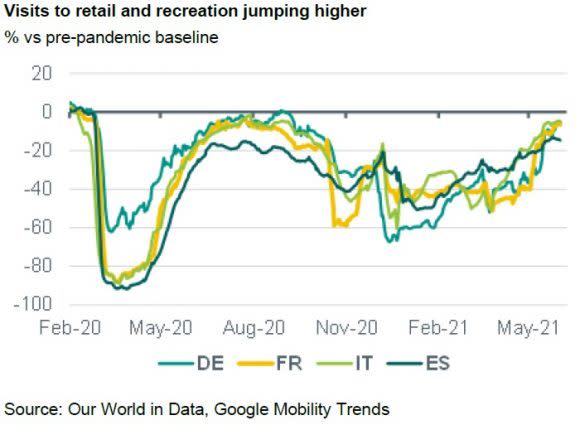
The accelerating the pace of vaccinations since March has encouraged governments to end curfews and allow shops, hotels, restaurants and the sports, entertainment and leisure industries to re-open, albeit often with some form of social distancing measures. The unwinding of lockdown measures has been somewhat earlier than we had assumed before, i.e. around the middle of Q2 instead of at the end of Q2. This means that the rebound in private consumption growth will partly shift towards Q2 and away from Q3. High frequency data for visits to retail and recreation shows that by mid-June, activity had returned to about 5-6% below pre-pandemic levels in Germany, France and Italy, whereas in Spain the gap still was around 14%. We expect the gap versus pre-pandemic levels to close further in the coming months, as the tourism season starts and social distancing measures are expected to be unwound further. We expect private consumption to grow by around 3% qoq in Q2 (following -2.3% in Q1) and another 4.5% in Q3. However, we expect the level of private consumption to remain below pre-pandemic levels at the end of this year. To begin with, household disposable income (which increased by only 0.5% in nominal term in 2020 and by 0.3% in real terms), will probably decline in real terms in 2021. Wage growth has declined in the first months of this year, while inflation has accelerated. Moreover, the level of employment will probably also remain below pre-pandemic levels throughout 2021. Finally, the savings rate should fall further in the remainder of the year but is expected to remain somewhat above pre-pandemic levels. (Aline Schuiling)
Fed View: Powell and Williams defend inflation view, while Bullard flags risks – Following the FOMC meeting last week, we have seen a host of Fed speakers on the wires, culminating in Chair Powell’s semi-annual testimony to Congress today. Chair Powell and New York Fed president Williams reiterated the tone of last week’s press conference, which continued to take a largely relaxed view of the current rise in inflation – pointing to the temporary factors driving it, and the expectation that inflation would be back at more normal levels by next year. Williams was particularly dovish, downplaying the prospect of an imminent tapering of asset purchases (stating that the Fed is ‘quite a ways off’ from ‘substantial further progress’ towards its goals), while on inflation, he said “My view is that the spike in inflation mostly reflects the temporary effects of the surprisingly rapid opening of the economy. Once these prices have fully adjusted to the reopening economy, they shouldn’t continue to increase at recent elevated rates, and their effect on overall inflation should subside.” These comments came in contrast to those of St Louis Fed president Bullard. In the past one of the most dovish members of the FOMC, Bullard has been among the most outspoken about the risks from the recent jump in inflation, and admitted he was one of the members who pencilled in a 2022 rates lift-off in last week’s new projections. On inflation, Bullard said ‘we have to be ready for the idea that there is upside risk’, while on rates, he said that although unlikely, the first rate hike could come even before the end of tapering (i.e. potentially as soon as the first half of 2022). Bullard’s views typically do not reflect mainstream Fed thinking, and as such we would put more weight on the views of Powell and Williams in getting a sense for where the Fed is going. We continue to expect the first rate hike to take place in late 2023, though the rise in inflation and inflation expectations has raised the risk of a somewhat earlier move. (Bill Diviney)