Global Daily – Global manufacturing still powering ahead, but losing some steam
Global Macro: Global manufacturing PMI drops, but still at high level – Last week, the monthly manufacturing PMIs were published for a wide range of developed and emerging economies.


On an aggregate level, the global PMI dropped for the first time in five months (to 55.5), after having reached an 11-year high of 56.0 in May. This drop was broad based, with the global subindices for output, new orders and export orders all coming down in June compared to May. The loss in momentum suggested by this drop could well be related to – amongst others – a rebalancing in global demand from goods to services (led by the US) as economies reopen, to policy tightening in China and some other EMs (the drop in the global PMI in June was mainly driven by emerging economies), and to various supply side bottlenecks (see below). All told, the global manufacturing PMI is still at a relatively high level and remains well above the neutral 50 boundary between expansion and contraction. This suggests that further growth in global manufacturing and trade is on the cards, extending the remarkable recovery from the initial covid-19 shock in early 2020. Indeed, according to the latest CPB data, in April global trade and industrial production were up 25.2% yoy and 18.2% yoy, respectively. This is in line with our view that global industry and trade would be much less hit by virus flare ups and new lockdown measures compared to global services sectors.
Early signs of easing cost push pressures – However, there are signs that supply side bottlenecks are still an impediment to the recovery. These include the general scarcity of semiconductors in automotive and other high tech industries, constraints in global container transport, and – particularly in the US – labour market frictions. The global PMI sub-index for delivery times reached a fresh record low of 36.0 (suggesting longer delivery times), clearly below the levels seen one year ago when the initial pandemic shock struck global supply chains, and container freight tariffs (particularly those from Chinese ports) have also risen again in recent months. Globally, the employment sub-index picked up slightly to 52.6 (May: 52.5), but in the US the pace of hiring declined, and in the ISM survey the employment sub-index even dipped below 50, to 49.9. Survey respondents for both Markit and ISM surveys in the US continued to report difficulties finding adequately qualified staff – an issue we delved into more deeply in our June Global Monthly.
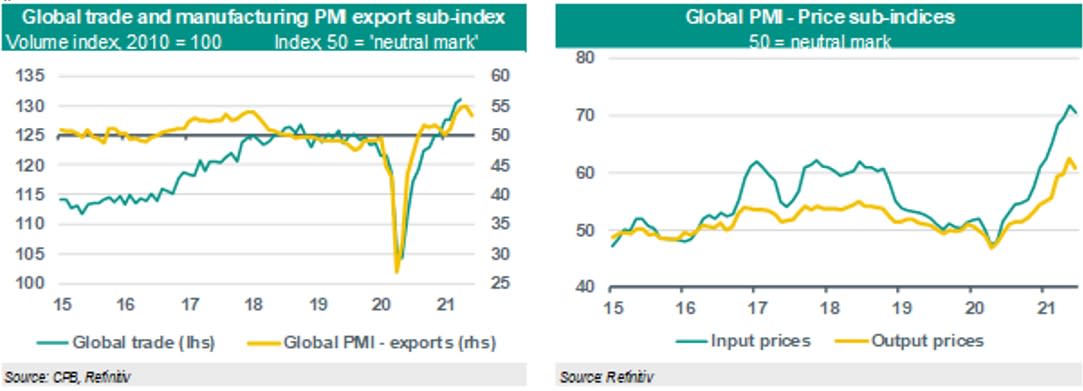
Although these disturbances do seem to be putting a lid on the rebound in global output at present, they are likely to lead to a more protracted recovery, assuming that global demand remains strong (given the ongoing global easing of restrictions). Meanwhile, some good news is that after having risen to multiyear highs in May, the sub-indices for input prices (from 71.7 in May to 70.6 in June) and output prices (from 62.6 to 60.9) both came down. This marked the first decline for both sub-indices in fourteen months, and is an early sign of an easing in cost push pressures stemming from commodity prices and supply side bottlenecks.