Global manufacturing: Still expanding during turbulent times

Global manufacturing PMI remained (just) in expansion territory at end-2025 – Following some US tariff related weakness in mid-2025, PMI manufacturing surveys indicate that global industry has remained in expansion mode in the second half of last year, though not at a spectacular pace. Since August 2025, the global manufacturing PMI has been back above the neutral 50 mark separating expansion from contraction, with a peak of 50.9 in August and October. In December, this index dropped back slightly to a five-month low of 50.4 (November: 50.5). The picture was stable across the board, with the aggregate index for developed markets (DMs) staying at 50.5, and the aggregate index for emerging markets (EMs) slightly down to 50.4 (November: 50.5).

The improvement in the global manufacturing PMI since the summer of 2025 is consistent with our view that downside risks to global growth had eased somewhat following the conclusion of more US trade deals. Our global base case presented in our 2026 Outlook, The shifting world order, is a relatively benign one, which should in principle be a supportive background for global industry. This view is based on expectations of solid (though more and more unevenly distributed) growth in the US, eurozone growth benefiting from more government spending, and growth in China being underpinned by targeted stimulus (with some shift from consumption to investment support). However, recent developments (Venezuela, Greenland, Iran) point to a flare-up of geopolitical/geo-economic risks, including new (Iran-related) tariff threats. These risks may well affect the growth outlook, on top of the risks we flagged in our Outlook (such as attacks on Fed independence, stretched AI valuations, and sovereign debt concerns).
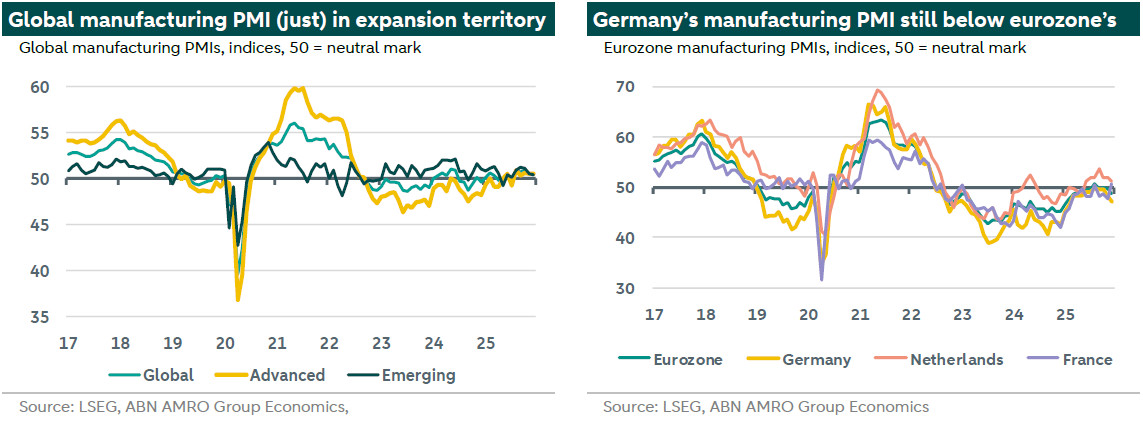
Germany still negative outlier within eurozone – Amongst DMs, the indices for the US and the eurozone came down in December, while those for Japan and the UK improved. After having been briefly above the neutral mark (in August and October), the eurozone manufacturing PMI fell back further into contraction territory in December, to a 9-month low of 48.8. Germany remained a negative outlier, with the index dropping to a 10-month low of 47.0, although this contrasts with German factory orders for November coming in much stronger than expected last week. Meanwhile, France’s index rose by almost three full points, to 50.7, the highest level since June 2022. The manufacturing PMI for the Netherlands remained above the eurozone average and in expansion territory, but dropped to a 7-month low of 51.1. Amongst EMs, China’s PMI from RatingDog that is included in the EM aggregate improved marginally, while the official PMI rose by almost a full point (see here). India’s manufacturing PMI dropped further to a two-year low of 55.0, although staying well above the neutral mark.
On the global scale, supply conditions are still stronger than demand conditions... – Looking at the various subcomponents of the global manufacturing PMI, the supply side in global industry remains stronger than the demand side. On the supply side, the global output component fell by 0.3 points to 50.9; this weakening was driven entirely by DMs. The future output index remained stable and at 60.2 is still well above the neutral mark. On the demand side, the global (domestic) orders component fell by 0.4 points to 50.0, with also here the weakening led by DMs. After a pick-up in November 2025, the global export component dropped back to 49.1, remaining in contraction territory for the ninth month in a row. This contrasts sharply with the resilience in global trade volumes as reported by the CPB (increase of 4.3% y/y in January-October 2025), as highlighted in our 2026 Global Outlook and a related podcast, although the CPB’s index dropped by 1.3% m/m in October. This is just another example showing that the relation between ‘hard activity data’ and survey data like the PMIs seem to have become more complicated in a period of large trade policy uncertainty, given potential impact of shifts in sentiment and the prevalence of practices such as trade frontloading in the run-up to (expected) higher tariffs, and the unwinding thereof.
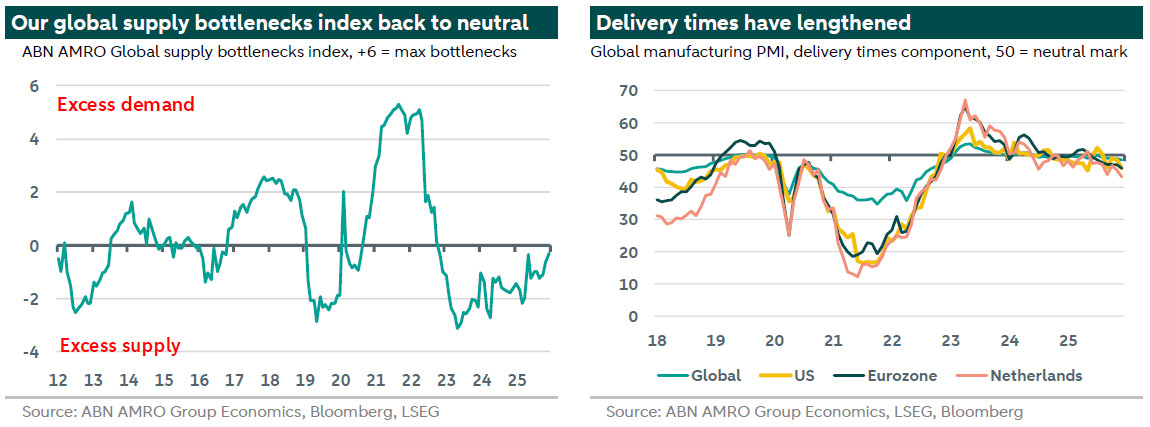
…but longer delivery times (and higher container tariffs) indicate rising supply bottlenecks –Although global supply conditions remain stronger than global demand conditions, our global supply bottlenecks index has moved towards ‘neutral’ in recent months. That mainly reflects more signals of disturbances in global supply chains re-surfacing. The delivery times subcomponent of the global manufacturing PMI dropped further to a three-year low of 48.5 (lower readings imply lengthening delivery times), although remaining clearly above the troughs seen during the pandemic. This drop was driven mainly by DMs, with the DM average (included in our bottlenecks index) falling to a 38-month low of 46.6. Amongst DMs, this subindex is currently the lowest for the UK (45.2), the US (45.8) and the eurozone (45.9). Within the eurozone, the Netherlands’ component for delivery times was even lower (43.2), reflecting issues with China related to semiconductors (Nexperia) and port congestion in Rotterdam (see here). Indeed, more broadly, the delivery times component of the global PMI for electronic equipment – also included in our index – fell to a three-year low of 45.8 in December. Meanwhile, global container tariffs have started rising again since October, although remaining relatively low compared to the peaks seen since the pandemic.