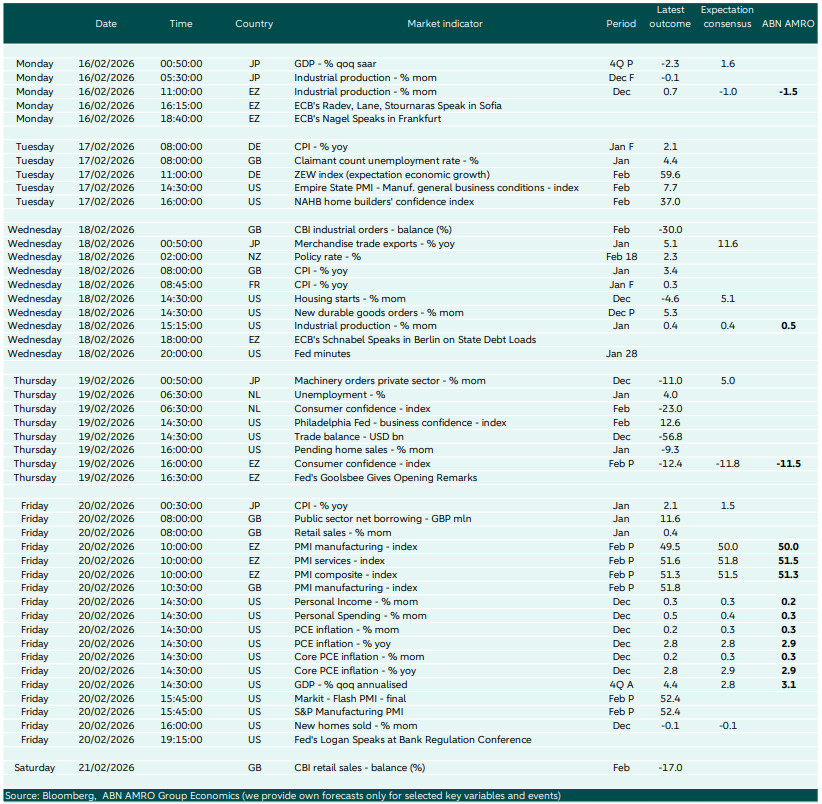
Key Macro Events 16 – 21 February 2026

These are the Key Macro Events for the upcoming week.


United States – Next week Friday we get GDP growth for the fourth quarter of last week. We expect astrong reading of 3.1% QoQ annualized, following an even stronger Q3 at 4.4%. We continue to expect strong spending and non-residential investment, as well as a positive contribution from net exports. Government and residential investment were likely close to flat. Our, and other nowcasts point to risks tilted to the upside. The same report will also contain December PCE inflation. We expect both headline and core to come in at 0.3% m/m, leading to y/y figures of 2.8% and 2.9% respectively, on a pickup of services inflation. We estimate that personal spending and income slowed to 0.3% and 0.2%. On Wednesday we get industrial production and the January FOMC meeting minutes. Following the strong US manufacturing PMI, we expect a strong reading at 0.5% m/m. Regarding the minutes, the Fed decided to pause the easing cycle in January. December already showed some members preferring to hold, and we'll likely see that base having widened. Since the job report this week, markets have pushed back their expectations of rate cuts. We still see the Fed resuming in June.
Eurozone – A host of survey data is released this week, including the German ZEW, eurozoneconsumer confidence and the flash PMIs. We expect these to show a continued gradual recovery, particularly in the manufacturing side, as worries over US tariffs continue to ease and the domestic economy shows further signs of firming. Eurozone industrial production for December is expected to pull back temporarily amid this broader recovery, as indicated by incoming country-level data.
Asia – No Chinese data are on the agenda the coming week, as the country is celebrating the LunarNew Year holiday. Japan’s Q4-25 GDP (Monday) is expected to show a clear rebound, after a contraction in Q3. Headline inflation is expected to drop below 2% (partly reflecting lower energy inflation and base effects), while core inflation (excluding fresh food and energy) is also expected to come down, to around 2.5% y/y.