Key views from the Global Monthly January 2022
Macro and Central Banks & Markets summarized from our Global Monthly: We expect the post-pandemic recovery to continue in 2022, with above trend growth to resume in the eurozone, the US and China following the current Omicron-induced soft patch. However, uncertainty over the economic outlook is now arguably the highest it has been since the start of the pandemic in early 2020. While economic growth has been strong, as economies have largely opened up, the supply-side has struggled to keep up with resurgent demand, with the consequence being inflation. This has brought forward the likely timing of interest rate rises in the US, with the Fed expected to begin raising rates in March. While we do not expect the ECB to follow, given the very different macroeconomic circumstances in the eurozone, this will have global spill-over effects over the coming year, pushing bond yields higher and ultimately dampening growth.

Macro
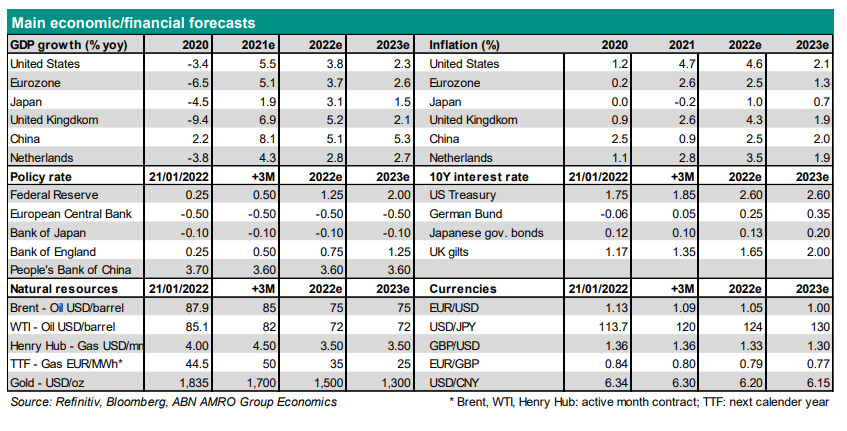
Eurozone – The economy has entered a soft patch. Supply side bottlenecks and record-high (energy price) inflation are restraining growth in industry and reducing real incomes. In addition, a new coronavirus wave has hit the region. We expect GDP to have been stagnant in 2021Q4 and grow modestly in 2022Q1. Following this soft patch, growth is expected to rebound sharply and remain above trend, supported by fiscal and monetary policy and solid employment growth. Inflation is likely to stay elevated in the first months of 2022 but should gradually decline during the year, ending up below the ECB target in 2023. We do not expect wage growth to accelerate sharply.
Netherlands – Despite new lockdown measures in late December, annual growth in 2021 is still expected to come out at 4.4%. However, looking ahead, we have downgraded our growth expectations for 2022 from 3.8% to 2.8% due to these new restrictions. Indeed, we expect restrictions to be in place for a large part of Q1, which will depress consumption. Constraints to growth stemming from the notoriously tight labour market and supply bottlenecks will weigh more heavily as the economy closes the gap with trend growth. Inflation is expected to average at 3.5% in 2022, with upward pressure from energy and supply bottlenecks gradually fading in the coming year.
US – The economy grew strongly in 2021, and above trend growth should continue in 2022. However, unexpected tightness in the labour market is putting additional upward pressure on inflation, with wage growth surging in recent months, and with the recovery in labour supply less than we previously expected. The spread of Omicron is – if anything – intensifying those risks. While we expect above-trend growth to continue in 2022, we expect growth to slow to below-trend rates in 2023, on a combination of fading post-pandemic catch-up effects, weaker government spending following the failure of Biden’s Build Back Better plan, and tighter monetary policy.
China – Qoq growth picked up in Q4, with supply bottle-necks from a power crunch and covid-19 policy fading. However, yoy growth reached the lowest pace in 1.5 year, with drags from real estate and the pandemic remaining. We have cut our near-term growth forecasts on pandemic risks/Omicron. Omicron is putting China’s strict covid-19 policy to the test in the run-up to the Lunar New Year and the Winter Olympics, with lockdowns/tighter restrictions adding to supply bottlenecks. With drags from Omicron and real estate, remaining and CPI inflation below target, we expect (piecemeal) monetary and fiscal easing to continue and real estate policies to be relaxed further.
Central Banks & Markets
ECB – A slowdown in the central bank’s net asset purchases is on the cards. The wind down of purchases under the PEPP will not be offset by a temporary increase in the APP pace (to EUR 40 billion in Q2 and EUR 30 billion in Q3). Beyond that, the ECB will run net purchases at EUR 20bn until shortly before it starts raising the key ECB interest rates. We expect policy rates to remain unchanged through our forecasting horizon, given that the central bank is projecting that inflation will moderately undershoot its goal all the way through 2024. The tone of Governing Council officials has turned more hawkish though due to near term upside risks to its inflation goal.
Fed – Given persistently elevated inflation in the US, and upside risks to the outlook, we now expect the Fed to begin hiking rates in March, and to hike rates four times this year, with three further hikes in 2023. This would take the target range of the fed funds rate back to the pre-pandemic level of 1.5-1.75% by mid-2023. The risk continues to be for an even steeper path of rate hikes. Shortly after lift-off, we expect the Fed to begin unwinding its balance sheet in late Q2, initially at a gradual pace, but eventually for this to run at $60bn per month. There is a significant risk that the Fed reduces the balance sheet at a much faster pace, potentially using it as a tool in its fight against inflation.
Bond yields – Given that we forecast the Fed funds rate to be at its eventual peak of around 2.50-2.75% by end 2025, we expect longer term yields will move higher in 2022, with the 10y US Treasury yield settling at around 2.6% at year-end. In previous cycles, the 10y US Treasury yield also settled around the eventual peak in the Fed funds rate, although well ahead of that time. Once we move closer to the first rate hike, which we have pencilled in for mid-2022, we expect the US Treasury curve to bear flatten. The rise in US Treasury yields will also put further upward pressure on their European counterparts, despite the ECB keeping its policy rates on hold.
FX/EURUSD – We expect more weakness in EUR/USD. The key driver will be a significant policy divergence between the Fed and the ECB over the coming years. We now expect that the Fed will begin hiking interest rates in March 2022 and to hike four times in 2022. We believe that the ECB is facing a different set of macroeconomic circumstances than faced by the US central bank. The ECB has also explicitly ruled out a rate hike in 2022 and has hinted that it could well be “on hold” for much longer. Our forecast for EUR/USD at year-end 2022 is 1.05 and 1.00 for year-end 2023.