Key views Global Monthly January 2024
The global economy is likely to grow at a subdued pace in the near term, as high rates continue to bear down on demand in advanced economies, while China continues to face both cyclical and structural headwinds. Global trade and industry looks to be bottoming out, but a sharp rebound is unlikely while rates remain restrictive. On the positive side, inflation has fallen significantly and is now within touching distance of central bank targets. The Red Sea disturbances are unlikely to meaningfully impact inflation, but a major escalation in the Middle East could change matters. Further falls in inflation will enable central banks to pivot to rate cuts by mid-2024, and financial conditions are already easing in anticipation of this. Still, monetary policy will remain relatively tight for some time yet, and this will keep a lid on the recovery.

Macro
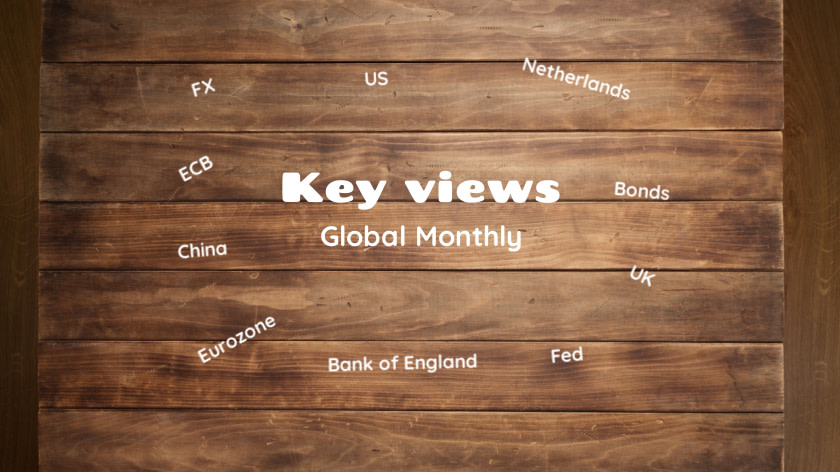
Eurozone – GDP declined by 0.1% qoq in 23Q3. We expect another moderate fall in 23Q4, but recent data indicates that the risks are tilted towards a stronger fall. We expect GDP to stabilise in 24Q1 and grow below the trend rate during the rest of the year. Headline inflation rose in December due to base effects in energy price inflation. Still, the other main components of inflation (food, industrial goods and services) have remained on a downward trajectory. Despite higher energy inflation, HICP inflation is expected to continue to decline in the coming months. Core inflation should fall to around 2% by mid-2024.
The Netherlands – GDP contracted in the first three quarters of 2023 which means the Dutch economy still is in a technical recession. We expect growth to resume in the coming quarters but remain sluggish. Dutch GDP growth is expected to average 0.1% in 2023 and pick up slightly to 0.5% in 2024. The Dutch economy remains resilient; the labour market is still tight and bankruptcies creep up only slowly. We expect inflation (HICP) to average 2.8% in 2024 and 2.4% in 2024.
UK – Disinflation has continued, providing some relief to the Bank of England, but upside inflation risks remain significant given that wage growth is still elevated and well above levels consistent with the 2% target. At the same time, unemployment has started rising, and we expect a softening in demand to dampen wage growth over time. The economy is expected to broadly stagnate over the coming year or so, weighed by tight monetary policy.
US – Growth slowed in Q4 following an exceptionally strong Q3, but remained well above trend. The recent strength in inventory build makes the economy vulnerable to a sharp slowdown in coming quarters. We also expect a slowdown in consumption given the cooling labour market and a reduced tailwind from excess savings. We expect weak growth in the next few quarters, before easing financial conditions set the stage for a recovery later in 2024. Wage growth has peaked, and inflation is moving in line with expectations back to the 2% target. A recovery next year hinges on a timely pivot to rate cuts by the Fed in response to falling inflation.
China – The economy has recovered from the dip in Q2-23, but headwinds from property and the slowdown in global demand remain. The focus now shifts to the annual NPC in early March, when the 2024 growth target will be announced. Absent a similar reopening bonus like in 2023 and with Beijing trying to reshape China’s growth model, growth in 2024 will be more reliant on effective policy support. We expect ongoing piecemeal monetary easing and additional targeted fiscal support, but still no credit bazooka, and have kept our 2024 growth forecast at 4.7%.
Central Banks & Markets
ECB – The ECB kept interest rates unchanged in January. In December, the ECB announced a very gradual wind down of PEPP reinvestments. Although macro data continues to point in the direction of a start of a rate cut cycle over the next few months, we think it will take the Governing Council time to form consensus and change its communication. Therefore, we expect a first rate cut in June. Recent comments by ECB officials have been clearly designed to bring down market expectations of early cuts in policy rates. We think the deposit rate will eventually reach 1.5% in the course of 2025.
Fed – The FOMC has kept rates on hold since its last rate hike in July. We expect the Fed to start cutting rates from June, with the risk somewhat tilted to earlier cuts. Even with rate cuts starting next year, monetary policy is expected to remain restrictive throughout 2024 and even into 2025. We expect the upper bound of the fed funds rate to reach 4.25% by end-2024, and 3% by mid-2025. The Fed also looks set to wind down its quantitative tightening somewhat sooner than previously expected, though this will be well telegraphed and gradual.
Bank of England – The MPC has kept policy on hold since last August. We think Bank Rate has peaked at 5.25%. The BoE is in full data-dependent mode, and UK macro data has been erratic over the past year. We do not expect rate cuts until next August. The risk is tilted towards somewhat earlier cuts given the more rapid progress on inflation. However, sticky wage growth – which poses upside risks to medium-term inflation – is likely to stay the MPC’s hand.
Bond yields – Since the start of the year, Central Banks and financial market’s battle on the start of the rate cut cycle is one of the main market drivers. Despite some repricing, we think that the market remains too optimistic on pricing the first rate cut in April/May. Until all rate-cuts wagers before June are priced out, we could see further upward pressure on yields. However, this upward move will be short-lived as we expect rates to come down again before the first rate cut occurs. We expect both US and EU rates to pursue this downward trend in 2025. This rates’ development will lead both Treasury and Bund yield curves to dis-invert and bull-steepen throughout the year.
FX – For this year we expect expectations for Fed/ECB policy to continue to drive the direction in EUR/USD. The market expects both the Fed and the ECB to start its easing cycle in April/May and rates to be reduced to 4% for the Fed and 2.5% for the ECB by the end of 2024. We expect the easing cycles to start later, in June, and the Fed to arrive at 4.25% and the ECB at 2.75% at the end of the year. So, both for the Fed and the ECB we are somewhat less dovish than the market and the difference with the market is roughly the same. Therefore we expect EUR/USD to stay around 1.10 for the time being.