Key views Global Monthly January 2026
The transition from one world order to another is in full swing, but it is still unclear how that new world order will look. The advent of AI, China’s rise, and the US’s relative decline offer challenges but also opportunities. Tariffs have made a comeback as threat to the outlook, driven by the transatlantic dispute over Greenland. Still, global growth has been resilient given the headwinds. Our base case sees that resilience continuing, albeit with considerable risks. Growth in the US is expected to stay solid, but this masks variation and vulnerability below the surface. Eurozone growth is expected to pick up on higher German fiscal spending, while China may take modest measures to lift demand while keeping its manufacturing growth model intact. Inflation in the US is expected to continue accelerating, but to stay broadly benign in the eurozone. Despite this, the divergence in Fed & ECB rates is expected to narrow significantly, with the ECB expected to keep rates on hold and the Fed ‘looking through’ the US inflation overshoot by continuing to cut rates.

Macro
Eurozone
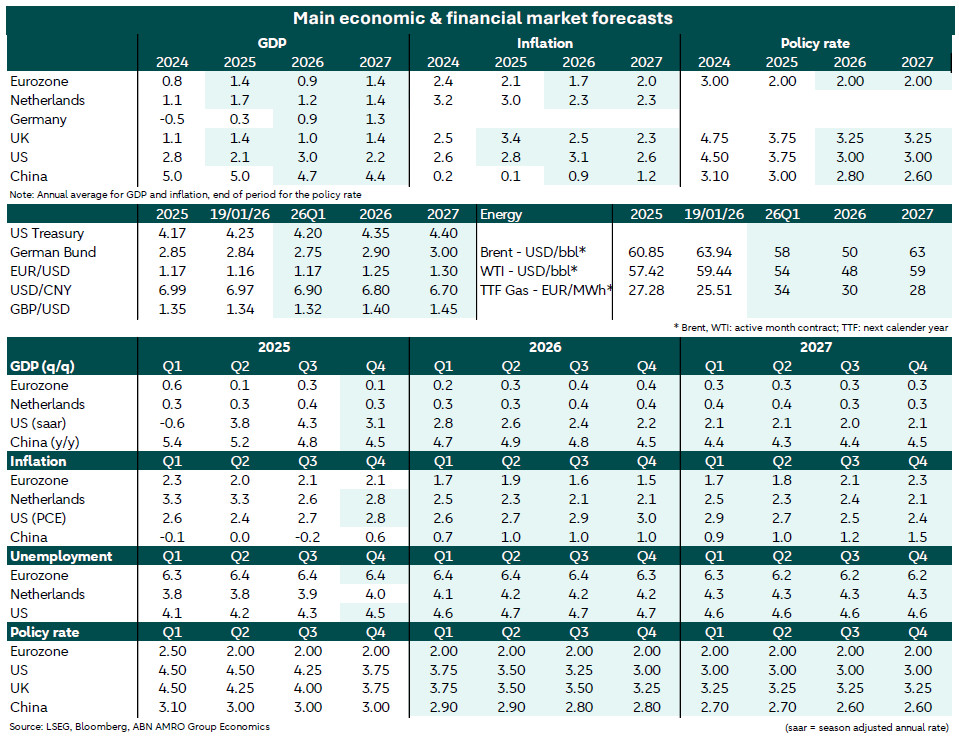
The domestic economy continues to gradually recover, helped by strengthening consumption and resilience in industry, despite the headwinds from US tariffs. This year, higher defence and German infrastructure spending are likely to drive higher quarterly growth. Aggregate inflation remains well behaved, but some key countries are seeing a persistent undershoot of the 2% target. Falling energy prices are likely to drive an undershoot of the 2% inflation target later this year, helped by a stronger euro. However, core inflation is expected to hold steady around the ECB’s target.
The Netherlands
The Dutch economy has shown resilience in 2025, we expect a solid final quarter with GDP at 0.3% q/q in Q4. In 2026 growth is expected to cool from 1.7% in 2025 to 1.2% in 2026. Private consumption and government spending remain the drivers of the outlook. While the geopolitical situation and uncertainty keep a lid on export growth and investment. Inflation (CPI) is expected to ease, further slowly throughout the year to average 2.4% in 2026 down from 3.3% in 2025. The next Government is expected to have minority states, lacking majorities in both parliament and the senate.
UK
The economy is slowing on the back of the US tariff shock. Still, the UK is less vulnerable to US tariffs than the eurozone, as it is less export dependent. Lower interest rates and higher government spending are also giving some support to growth. The budget delivered sufficient backloaded tax rises to keep the UK sticking to its fiscal rules and therefore bond markets on side. Inflation remains stubbornly high, with wage growth still well above levels consistent with 2% inflation, but recent data suggest inflation is moving back in the right direction.
US
The impact of tariff and immigration policy continues to gradually build in the data. However, any negative impact in the headline figures is be overshadowed by the positive impulse from AI investments and monetary and fiscal easing. We further upgraded our near-term growth forecast on the back of strong export momentum. After a cooldown in the beginning of the year, inflation rises again due to continued pass-through of tariffs, as well as demand effects from stimulus. Unemployment continues a gradual, but not dramatic increase, as supply and demand remain mostly in balance.
China
Real GDP growth fell to a 3-year low of 4.5% y/y in Q4, as expected. We expect full-year growth to slow from 5.0% in 2025 to 4.7% in 2026 and 4.4% in 2027. Exports are holding up growth, with trade rerouting/diversification still offsetting the drop in direct exports to the US. Domestic imbalances keep rising, with supply still stronger than demand, and the property slump not easing yet. We assume the US-China truce will broadly hold in 2026. As the export engine keeps functioning, we still expect targeted stimulus (and no ‘bazooka’), with the focus shifting a bit from consumption to investment support.
Central Banks & Markets
ECB
The Governing Council kept policy on hold in December, and is likely to remain on hold for the foreseeable future. President Lagarde has reiterated that the ECB is ‘well positioned’ to face the coming period of tariff impact and uncertainty. Despite the expected undershoot of the 2% inflation target, the GC seems minded to look through this on the expectation that inflation will return to target in 2027. Near term risks are still tilted to another cut given the looming inflation undershoot, but in 2027, those risks could tilt back towards a hike, with upside risks likely to build from higher German fiscal spending.
Fed
The Fed cut rates in the last three meetings of 2025 but will likely again enter another pause in the first part of this year. Due to stronger growth and demand, waning pressure from the labour market, and continued above-target inflation, we think the Fed will keep on hold until the June meeting, the first meeting with the new chair. From that point onward, it will gradually start easing once a quarter in response to a gradually slowing economy, despite still elevated inflation. We expect the policy rate to reach 2.75-3.00% by the end of the year, the lower end of neutral estimates.
Bank of England
The MPC lowered Bank Rate to 3.75% in December, in line with our expectations. The BoE is now nearing the end of its rate cut cycle, with limited room for further easing given stubborn underlying inflation. We expect another rate cut by the Spring (likely at the April meeting), and possibly one additional cut thereafter, but this will be highly data dependent and the risk is that rate cuts end with Bank Rate at 3.5%. Injecting considerable uncertainty is the high degree of division on the MPC, with doves and hawks still split finely down the middle.
Bond yields
The start of the new year has been marked by geopolitical tensions, but so far this has not had a major impact on government bond markets. However, the significant bear steepening in JGBs did result in a steepening of the curve for both EGBs and US Treasuries. We see still further room for EGB curves to steepen, led by the long end. However, we expect a greater steepening of the US Treasury curve, with short-end yields falling on the back of expected Fed rate cuts and the further pricing in of term premium at the long end of the curve.
FX
This year we expect weakness of the dollar due to: Fed rate cuts, lower US real yields, the growth inflation mix, more dollar hedging, long term structural deficits, and attacks on US institutions. We expect the euro to strengthen against the dollar, with the EUR/USD exchange rate reaching around 1.25 by the end 2026. If (geo)political risks cause more foreign investors to sell US assets, the dollar could weaken even more (risk scenario). We adjusted our forecasts for the yen. We expect that Sanae Takaichi’s policies — both fiscal and (geo)political — to keep pressure on the yen in the near-term, despite its undervaluation.